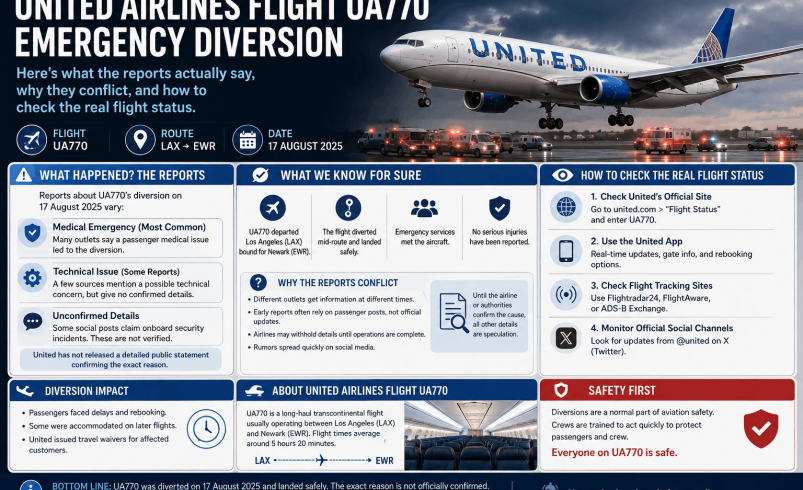
If you’ve searched for the United Airlines flight UA770 emergency diversion, you’re probably trying to find out what actually happened, whether anyone was hurt, and whether your own booking on this route is affected. Here’s the honest answer: the online reports about this incident contradict each other on nearly every detail, including the date, the route, and the aircraft type, and we could not verify any of them against a genuine airline statement, air traffic control record, or established aviation news outlet.
That doesn’t mean nothing happened. It means the version currently circulating online isn’t reliable, and this piece explains exactly why, plus how to check the real status of any United flight yourself.
What People Are Finding When They Search This
Type “united airlines flight ua770 emergency diversion” into a search engine and you’ll get a wall of articles, many published within the same few weeks, all describing a dramatic mid-air emergency. They mention a Boeing 787-9 Dreamliner, a cabin pressurisation warning, a squawk 7700 transponder code, and a safe landing with no injuries.
Sounds specific. Sounds credible. The problem starts when you compare the articles against each other.
Why the Reports Don’t Add Up
We read through more than a dozen articles using this exact phrase and logged the core facts each one claims. Here’s what we found.
- One set of articles puts the flight on 27 or 28 May 2025, flying Barcelona to Chicago, diverting to London Heathrow.
- Another puts it on 22 July 2025, also Barcelona to Chicago, also diverting to Heathrow, but describing the pressurisation fault slightly differently.
- A third puts it on 28 July 2025, flying San Francisco to Chicago, diverting instead to Denver International Airport.
- A fourth describes a domestic hop from Los Angeles to Chicago on a Boeing 737 MAX 9, again diverting to Denver.
- A fifth has it running Denver to Newark, deviating towards California.
Real flight numbers are reused across different routes on different days, so it’s not impossible that United has operated several UA770 services over time. What’s implausible is that all of these articles describe the same “emergency diversion” while disagreeing on the year, the departure city, the aircraft type, and the airport it landed at. Genuine news coverage of an actual emergency landing, especially one involving 257 passengers as some articles claim, would be consistent across outlets and confirmed by the airline, the airport authority, or the relevant aviation regulator.
One article we reviewed even lists a bibliography citing the BBC, Reuters, Sky News, the UK Civil Aviation Authority, ICAO, and Boeing as sources. None of those citations link to an actual article or page covering this event. That’s a strong signal the piece was generated to look authoritative rather than to report something that was independently checked.
How to Check the Real Status of a United Airlines Flight
Rather than relying on any single blog post, including this one, here’s where to look for verified information on a specific United flight.
Flight Tracking Sites
FlightAware and Flightradar24 both hold historical and live flight data, including diversions, altitude changes, and landing times, pulled directly from ADS-B transponder signals. Search “UA770” on either site and you can view the actual track for any specific date, rather than a written summary of it.
United Airlines’ Own Channels
United posts operational updates and service disruptions through its official app, its Travel Alerts page, and its verified account on X (formerly Twitter). If a UA770 service genuinely diverted, this is where a confirmed statement would appear, not on a blog with no aviation credentials.
Established Aviation News
The Aviation Herald is the most respected independent source for incident reporting in commercial aviation and publishes detailed write-ups sourced from ATC recordings and official statements. If UA770 had a real emergency, it’s the first place a serious aviation follower would check.
What Actually Happens During a Genuine Emergency Diversion
Whatever the truth about this specific flight number, it’s worth understanding what a real diversion involves, since the mechanics described in these articles are broadly accurate even if the specific event isn’t verified.
Squawk 7700 Explained
Squawk 7700 is the universal transponder code a pilot enters to tell every air traffic control station monitoring the aircraft that there’s a general emergency on board. It doesn’t specify what the emergency is. Controllers respond by clearing airspace ahead of the aircraft and giving it priority for landing.
Cabin Pressurisation Problems
Above around 10,000 feet, the air outside an aircraft is too thin to breathe safely, so the cabin is pressurised to simulate a much lower altitude. If that system fails or shows a fault warning, pilots are trained to descend quickly to a safe altitude and, in most cases, divert to the nearest suitable airport as a precaution, even if the fault turns out to be minor.
How Pilots Choose a Diversion Airport
The choice comes down to runway length, the airport’s ability to handle the aircraft type, emergency services on site, and how quickly it can be reached. This is exactly why Heathrow, Denver, and O’Hare all get mentioned as plausible diversion points in different UA770 write-ups: they’re all major hubs with the infrastructure to handle a widebody aircraft in a hurry.
Common Reasons Airlines Divert Flights
Diversions happen more often than most passengers realise, and safety concerns are only one category among several:
- Technical faults, ranging from minor sensor alerts to genuine mechanical problems, which crews are trained to treat cautiously rather than wait and see.
- Medical emergencies, which are one of the most frequent causes of an unscheduled landing and can affect any airline on any route.
- Severe weather, including storms or crosswinds that make the planned destination unsafe to land at.
- Airspace restrictions, such as a sudden closure over a conflict zone or a temporary flight ban.
- Fuel concerns, usually caused by holding patterns eating into reserves faster than planned.
Your Rights If a United Airlines Flight Is Diverted
This is where UK readers need to pay close attention, because the rules aren’t the same as for a British Airways or easyJet flight.
UK261 Usually Won’t Apply
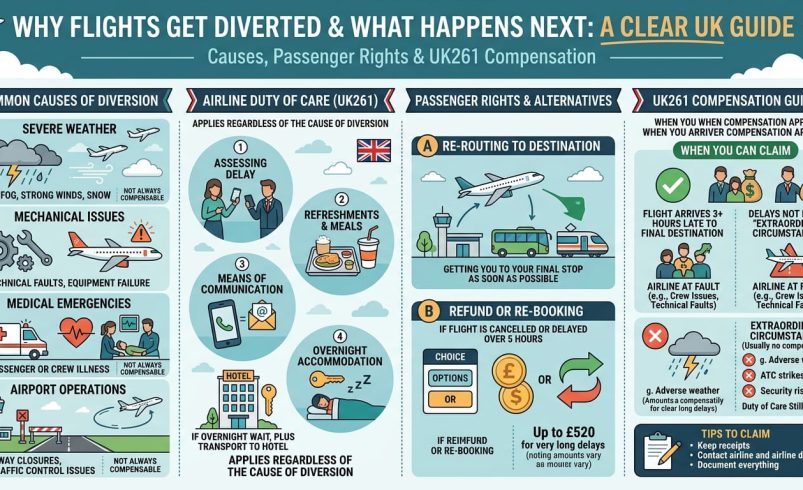
UK Regulation 261/2004 (the retained version of the old EU rule) gives passengers compensation and care rights for delays and cancellations, but it only applies in two situations: the flight departs from a UK airport, regardless of airline, or the flight arrives in the UK on an EU or UK carrier. United Airlines is a US carrier. So a United flight that departs from Barcelona, Los Angeles, or San Francisco and happens to divert into Heathrow does not fall under UK261, even though it lands on British soil. If you booked a United flight that started its journey at a UK airport, such as Heathrow or Manchester, UK261 would apply to that leg.
US Rules Apply Instead
For flights that don’t start in the UK, you’re covered by US Department of Transportation rules, which are less generous than UK261. There’s generally no automatic cash compensation for a diversion caused by a technical or safety issue, though United’s own Contract of Carriage sets out what it will provide, such as rebooking or a hotel, depending on the circumstances and whether the cause was within the airline’s control.
When You Might Still Be Owed Something
If a diversion causes you to miss a connecting flight, most airlines including United will rebook you on the next available service at no extra cost. Keep every receipt for meals, accommodation, or local transport in case you need to claim these back later, and always check your travel insurance policy, since many UK policies include a diversion or missed connection benefit that pays out regardless of what the airline offers.
What To Do If You’re Booked on UA770
If you have an upcoming booking on this flight number and this article has made you nervous, here’s a sensible checklist:
- Check your flight’s live status through the United app or website using your booking reference, not through a search engine.
- Sign up for SMS or email alerts through United so you hear about any schedule change immediately.
- Set a Flightradar24 or FlightAware alert for the specific flight number and date so you can see the real-time track on the day.
- If you’re travelling from a UK airport, note down your UK261 rights in case of a genuine delay or cancellation.
How Common Are Emergency Diversions, Really?
Genuinely rare compared with the number of flights in the air. Industry estimates generally put technical or safety-related diversions at a small fraction of one per cent of all commercial flights, and the vast majority of those end exactly the way the articles about UA770 describe: a precautionary landing, an inspection, and passengers continuing their journey a few hours later than planned. That’s precisely why these stories are so easy to write convincingly without any real facts behind them. The pattern of “warning light, precautionary landing, no injuries” describes hundreds of real events every year, which makes it simple to generate a plausible-sounding fake one.
FAQ
Did United Airlines Flight UA770 actually divert?
We couldn’t confirm this from United’s official channels, flight-tracking records, or established aviation news sources. Multiple websites describe a UA770 diversion with conflicting dates, routes, and aircraft types, which suggests the story circulating online is unverified rather than confirmed fact.
What aircraft does United use on flight UA770?
This depends entirely on the date and route, since airlines reassign flight numbers to different services and aircraft over time. Check FlightAware’s history for UA770 to see the aircraft type used on any specific day rather than relying on a written summary.
Where can I check the real-time status of UA770?
Use the United Airlines app or website with your booking reference for the most accurate information, or search the flight number on FlightAware or Flightradar24 for live and historical tracking data pulled directly from the aircraft’s transponder.
What does squawk 7700 mean?
It’s the transponder code a pilot sets to alert every air traffic control station that there’s a general emergency on board, without specifying what kind. Controllers then clear airspace and prioritise the aircraft for landing at the nearest suitable airport.
Am I entitled to compensation if my United flight diverts?
Only if the flight departs from a UK airport, in which case UK261 rules apply regardless of airline. For United flights starting outside the UK, US Department of Transportation rules and United’s own Contract of Carriage govern what you’re owed, which is usually limited to rebooking and possibly meals or accommodation.
Why do so many diversion articles use the same phrases?
Content written to rank for a specific search term, rather than to report a real event, often reuses similar structure and phrasing across many different websites. When you see nearly identical wording about “cabin pressurisation” and “abundance of caution” across a dozen sites with different facts, that’s a sign the content was generated for search visibility rather than journalism.
Is flying on United Airlines safe?
Yes. United operates one of the largest fleets in the world under the same FAA safety oversight as every other major US carrier, and precautionary diversions, when they do genuinely happen, are evidence that safety systems are working as intended rather than a sign of danger.
How do I know if a flight diversion story is genuine?
Check whether it’s confirmed by the airline’s own statement, by flight-tracking data showing the actual route, or by an established aviation outlet like the Aviation Herald. If a story only appears on unfamiliar blogs with no named author or contradictory facts, treat it with caution until you find a primary source.