

Why Flights Get Diverted and What Happens to Passengers
- August 20, 2026
- 0
If your flight has ever been diverted, or you’re flying soon and wondering what happens if it is, the short answer is this: a diversion means the aircraft



9621 Agnes Crossing, Lake Suzanneview, New Mexico Island 84604-9295.
If your flight has ever been diverted, or you’re flying soon and wondering what happens if it is, the short answer is this: a diversion means the aircraft
If your flight has ever been diverted, or you’re flying soon and wondering what happens if it is, the short answer is this: a diversion means the aircraft lands somewhere other than its scheduled destination, usually for safety reasons, and you may be entitled to compensation depending on why it happened and how late you end up arriving.
This guide explains the real reasons flights get diverted, what actually happens on board and after landing, what airlines are required to provide, and exactly when UK261 compensation applies, and when it doesn’t. No speculation, no unverified incidents, just how the process actually works.
A flight diversion happens when an aircraft lands at an airport other than the one it was originally scheduled to arrive at. This is different from a delay, where the flight still reaches its intended destination, just later than planned.
Diversions are a normal, if uncommon, part of aviation. Pilots and airlines have clear procedures for choosing an alternative airport, prioritising one with a long enough runway, suitable facilities, and the ability to support passengers or aircraft repairs if needed.
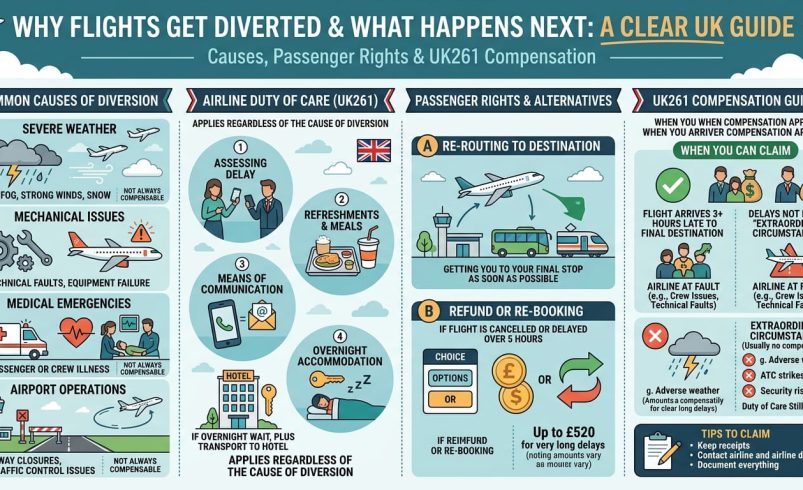
Severe weather, thunderstorms, high crosswinds, or an airport closed by fog or snow, is one of the most common reasons for a diversion. If conditions at the destination airport become unsafe to land in, crews will either hold until conditions improve or divert to the nearest suitable alternative.
If a passenger becomes seriously unwell mid-flight, the crew may decide the safest option is to land as soon as possible rather than continue to the original destination, particularly on long-haul routes where continuing could delay treatment significantly.
Mechanical or technical problems, anything from an instrument warning to an engine issue, can prompt a diversion so the aircraft can be inspected or repaired by qualified engineers at a suitable airport, rather than continuing the full journey.
Security threats, whether reported mid-flight or identified through other channels, can lead air traffic authorities or the airline to divert a flight as a precaution, even where the underlying concern later turns out to be unfounded.
Once a decision to divert is made, the flight crew typically informs air traffic control, coordinates with the chosen airport for landing clearance, and communicates with cabin crew and passengers about the situation as clearly as circumstances allow.
On the ground, the diversion airport prepares for the aircraft’s arrival, which can include emergency services on standby as a precaution, particularly for medical or technical diversions, even when the situation isn’t ultimately serious. Once landed, the airline works to arrange onward travel, whether that means refuelling and continuing to the original destination, transferring passengers to another aircraft, or rebooking onto later flights.
After a diversion, passengers generally remain on board or move to a terminal area while the airline assesses next steps. What happens next depends heavily on the reason for the diversion:
UK261 is the UK’s own version of the EU’s Regulation 261/2004, retained in UK law after Brexit through the European Union (Withdrawal) Act 2018. It applies if your flight departed a UK airport on any airline, or landed at a UK airport on a UK-registered carrier. EU261 works the same way for flights departing an EU, EEA, Iceland, Norway or Switzerland airport.
Under these rules, if your final arrival is delayed by three hours or more compared with your original scheduled time, and the cause was within the airline’s control, you may be entitled to fixed compensation:
Crucially, this delay is measured against your original intended arrival time, not the time you landed at the diversion airport, so a diversion that still gets you to your final destination within three hours generally won’t qualify for compensation, even though it caused real disruption.
Compensation under UK261 depends entirely on why the diversion happened, not just that it happened.
Compensation generally applies when the cause was within the airline’s control, certain technical issues, crew scheduling problems, or operational decisions the airline could reasonably have avoided.
Compensation generally doesn’t apply for what the law calls “extraordinary circumstances”, severe weather, air traffic control strikes, security threats, or genuine medical emergencies. Since December 2023, UK261 carries its own statutory definition of extraordinary circumstances, separate from EU case law, though the practical effect is similar: these situations exempt the airline from cash compensation while still requiring it to cover meals, accommodation and rerouting.
This is the detail that catches a lot of travellers out. Even when compensation doesn’t apply, the airline is still required to look after you, feeding, accommodating and rebooking you at no extra cost, regardless of what caused the diversion.
You may, but only if the diversion delayed your final arrival by three hours or more and the cause was within the airline’s control. Diversions caused by extraordinary circumstances, severe weather, security concerns or medical emergencies, generally don’t qualify for cash compensation, though the airline must still cover meals and accommodation.
Usually yes, once you’ve cleared any necessary immigration or security checks, though it’s worth checking with airline staff first, particularly if you might be rebooked onto a flight departing soon. If you leave and miss a rebooked flight as a result, that’s generally your own responsibility.
The airline is generally required to provide meals and, if an overnight stay is needed, accommodation and transport to and from it, regardless of what caused the diversion. If they don’t provide this directly and you pay yourself, keep your receipts to claim the reasonable cost back afterwards.
The delay is measured against your original scheduled arrival time at your final destination, not the time you landed at the diversion airport. A diversion that still gets you to your destination within three hours of the original schedule generally won’t meet the compensation threshold.
Extraordinary circumstances are situations outside the airline’s control, such as severe weather, air traffic control strikes, and genuine security threats. Since December 2023, UK261 has its own statutory definition of this term, separate from the EU’s case law-based approach, though the practical effect remains similar.
Compensation ranges from £220 for shorter delayed flights up to £520 for long-haul flights delayed four or more hours, with a reduced amount for long-haul delays of three to four hours. The amount depends on flight distance and length of delay, not the price you paid for your ticket.
Submit a written claim directly to the airline first, citing UK261, your flight details and the specific delay. If they refuse a claim you believe is valid, you can escalate to the CAA, which oversees UK261 enforcement, or pursue the claim through Money Claim Online as a last resort.