
BGS Grading: What Beckett’s Card Grades Actually Mean
- October 25, 2026
- 0
BGS grading is the trading card grading service run by Beckett Grading Services, a US company that assigns numerical grades to sports cards, Pokémon cards and other collectible



9621 Agnes Crossing, Lake Suzanneview, New Mexico Island 84604-9295.
BGS grading is the trading card grading service run by Beckett Grading Services, a US company that assigns numerical grades to sports cards, Pokémon cards and other collectible

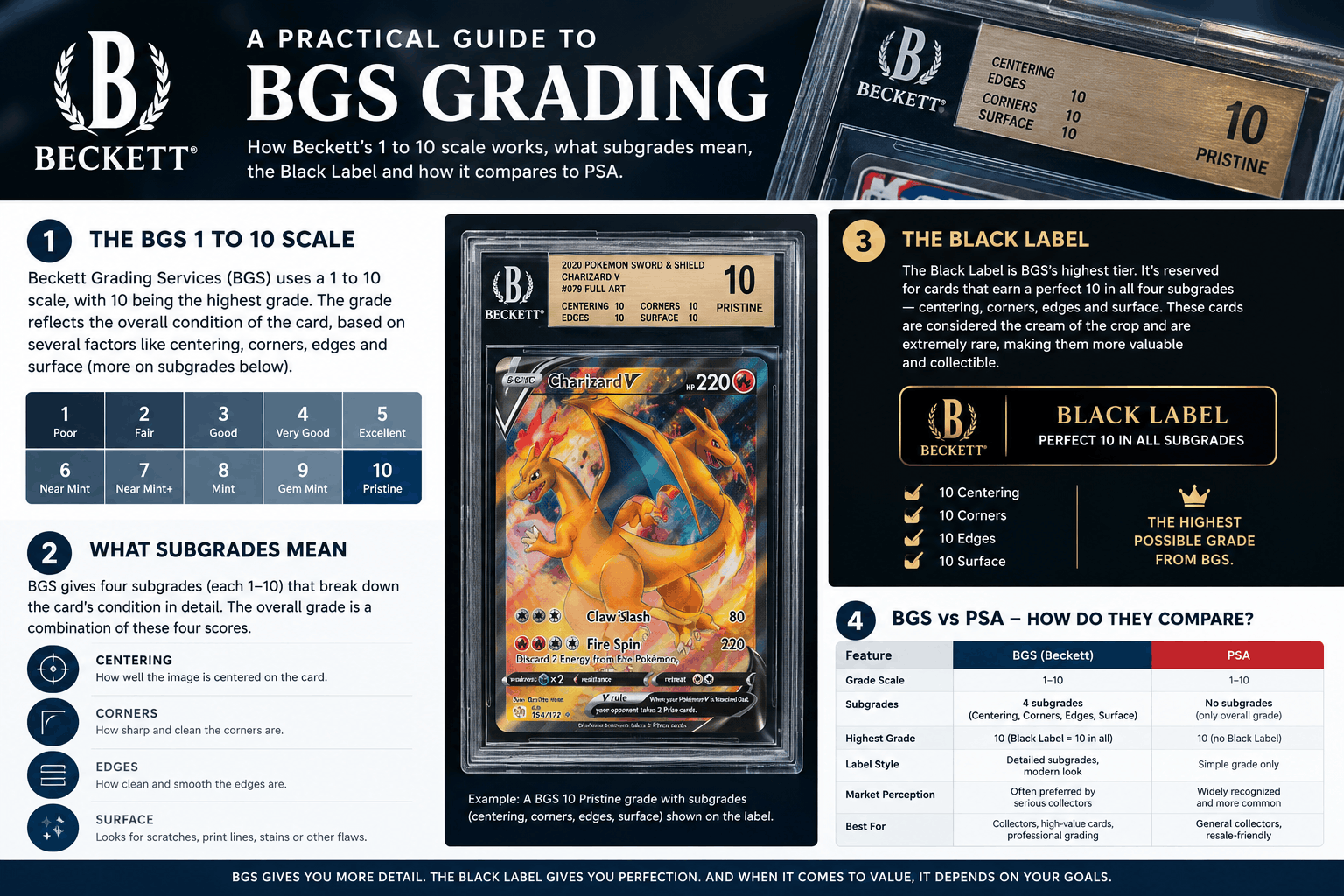
BGS grading is the trading card grading service run by Beckett Grading Services, a US company that assigns numerical grades to sports cards, Pokémon cards and other collectible cards. The scale runs from 1 to 10 in half-point increments, with a Pristine 10 at the top and a Black Label reserved for cards that score perfect 10s in every subcategory . This guide explains how the scale works, what the subgrades mean, why a BGS 9.5 is not the same as a PSA 10, and the practical checks worth making before you submit a card.
BGS stands for Beckett Grading Services, a division of Beckett Collectibles. The company authenticates cards and encapsulates them in tamper-proof holders known as slabs . It markets itself as having graded over 15 million sports trading cards, according to court filings cited in a 2022 lawsuit involving a trimmed Stephen Curry card .
The grading scale is straightforward on the surface: 1 to 10, with half-point increments. A card graded 9.5 is Gem Mint. A card graded 10 is Pristine . But the detail underneath that scale is where BGS differs from its main competitor, PSA.
BGS grades cards on four criteria: centering, corners, edges and surface . Each criterion receives its own subgrade. The overall grade is then calculated from those four subgrades.
The key thing to understand is that the overall grade is not an average. Beckett’s own guidance states that the lowest subgrade carries the most weight, and the final grade rarely lands more than two levels above the lowest subgrade . Beckett’s worked example: subgrades of 9.5, 9.5, 9 and 8 produce an overall 8.5, not the 9 that an average would suggest .
This matters because it means a single weak subgrade drags the whole card down. A card with perfect centering and corners but a visible surface scratch will not grade as highly as the three strong subgrades might imply.
| Overall grade | Label colour | What it means |
| Pristine 10 (Black Label) | Black | All four subgrades are 10 |
| Pristine 10 (Gold Label) | Gold | Overall 10, but at least one subgrade below 10 |
| Gem Mint 9.5 | Gold | Near-perfect, minor imperfections under magnification |
| Mint 9 | Silver | Mint on close inspection, minor wear allowed |
| NM-MT 8 | Silver | Sharp to the naked eye, slight imperfections under close examination |
Source: Beckett grading information and Heritage Auctions grading guide .
The Black Label is the rarest outcome. It requires a perfect 10 in centering, corners, edges and surface. Beckett introduced it in November 2014, and it applies to modern cards only, not vintage cards graded under Beckett’s BVG service . A Black Label card can sell for many times the price of a standard PSA 10 of the same card. In May 2026, a Black Label Mew ex sold for $236,543 at Goldin .
Understanding each subgrade helps you assess a card before you pay for submission.
Centering measures how well the card’s image is centred within its borders. A Pristine 10 requires 50/50 centering all around on the front, and 60/40 or better on the back . A Gem Mint 9.5 allows 50/50 one way and 55/45 the other on the front .
Corners are checked for wear, fraying or softness. A Pristine 10 has corners that are perfect to the naked eye and mint under magnification. A 9.5 allows slight imperfections under magnification .
Edges are checked for chipping, roughness or silvering. A Pristine 10 has edges that are virtually free of flaws under magnification .
Surface is checked for print spots, scratches, gloss loss and focus or registration issues. A Pristine 10 has flawless colour, perfect gloss and no scratches .
For collectors unfamiliar with the process, the practical upshot is this: BGS is generally regarded as a stricter grader than PSA. A card that might receive a PSA 9 could receive a BGS 8.5, and a card that might receive a PSA 10 could receive a BGS 9.5 . That strictness is why BGS 10s and Black Labels carry a premium.
The comparison comes up constantly in collecting communities, and it matters for anyone deciding where to send a card.
Subgrades. BGS provides four subgrades printed on the slab’s label. PSA provides a single overall grade. If you want to know why a card received its grade, BGS gives you more information .
Strictness. BGS is widely reported to grade more strictly than PSA. One collector who submitted cards to both described BGS as “stricter” and noted that a BGS 9.5 is roughly equivalent to a PSA 10 in terms of condition standards .
Liquidity. PSA generally has better market liquidity for many cards, particularly in the US. A lower grading fee at BGS does not automatically mean a better financial outcome if the card is harder to sell .
Turnaround and cost. As of mid-2026, Beckett’s Base service was listed at $14.95 without subgrades or $17.95 with subgrades, with a published turnaround of 75 or more business days. PSA’s Regular service was $79.99 . Beckett is cheaper at the entry level, but the slower turnaround has an opportunity cost if the card’s value is tied to a moving market.
The Black Label premium. BGS has a tier that PSA does not: the Black Label Pristine 10. A PSA 10 is the highest grade PSA gives, but it is not as scarce as a BGS Black Label. This scarcity is why Black Label cards can command multiples of the PSA 10 price .
Pre-screen the card yourself. Look at centering, corners, edges and surface before you pay. If any one of those is clearly weak, the overall grade will be capped. AI pre-grading tools exist that claim to predict BGS outcomes, but they are not a guarantee .
Check the declared value tier. Beckett’s pricing scales with turnaround speed and declared value. The Base tier is the cheapest but slowest. If you are grading a card worth hundreds of pounds, the Standard or Express tier may be worth the extra cost to get it back faster .
Understand the vintage distinction. BVG is Beckett’s vintage grading service for cards produced before 1981. It uses the same guidelines as BGS but is a separate service . If your card is pre-1981, check which service applies before submitting.
Do not confuse BGS with BCCG. BCCG is Beckett’s cheaper collectors club grading service. It uses different, looser guidelines. A BCCG 9 is described as “Near Mint or better,” which is roughly equivalent to a BGS 7. BCCG-graded cards typically sell for less than BGS-graded cards .
The Beckett website outage. As of October 2026, Beckett’s website had been offline since 9 September 2026, according to one report. Definitions and pricing were being drawn from archived copies . If you are planning a submission, check whether the service is operational before sending anything.
The British Geological Survey also uses the abbreviation BGS, and it operates several grading schemes that are entirely unrelated to trading cards.
BGS publishes a grain sorting classification scheme that grades sediment from “very well-sorted” to “extremely poorly-sorted” based on statistical measures of grain size distribution . It also produces agricultural land classification grades, running from Grade 1 (excellent quality) to Grade 5 (very poor quality), used in planning and land assessment . And its historical records include grading of mica for size and quality during the Second World War .
These are geological and agricultural systems, not card grading. The overlap is purely the abbreviation. If you search for “BGS grading” and encounter soil classifications or sediment sorting charts, you have found the British Geological Survey, not Beckett.
BGS grading is the trading card grading service run by Beckett Grading Services. It assigns cards a numerical grade from 1 to 10 in half-point increments, based on four subgrades: centering, corners, edges and surface. The overall grade is not an average, and the lowest subgrade carries the most weight .
A BGS 9.5 is a Gem Mint grade. It requires near-perfect centering, corners that are mint to the naked eye with only slight imperfections under magnification, and virtually mint edges and surface. It is one step below a Pristine 10 and is roughly equivalent to a PSA 10 in condition terms .
A BGS Black Label is a Pristine 10 with all four subgrades at 10. It is the highest grade Beckett gives and is much rarer than a standard Pristine 10, which may have one subgrade below 10. Black Label cards can sell for many times the price of a PSA 10 of the same card .
Yes, BGS is widely reported to grade more strictly than PSA. A card that might receive a PSA 9 could receive a BGS 8.5, and a BGS 9.5 is generally considered equivalent to a PSA 10. This strictness is why BGS 10s and Black Labels carry a premium .