

Healthcare Gig Marketplace Companies: US vs UK Guide 2026
- August 20, 2026
- 0
Trying to work out which healthcare gig marketplace companies actually operate where you live, and whether they’re worth your time? Here’s the short answer: in the US, apps


9621 Agnes Crossing, Lake Suzanneview, New Mexico Island 84604-9295.
Trying to work out which healthcare gig marketplace companies actually operate where you live, and whether they’re worth your time? Here’s the short answer: in the US, apps
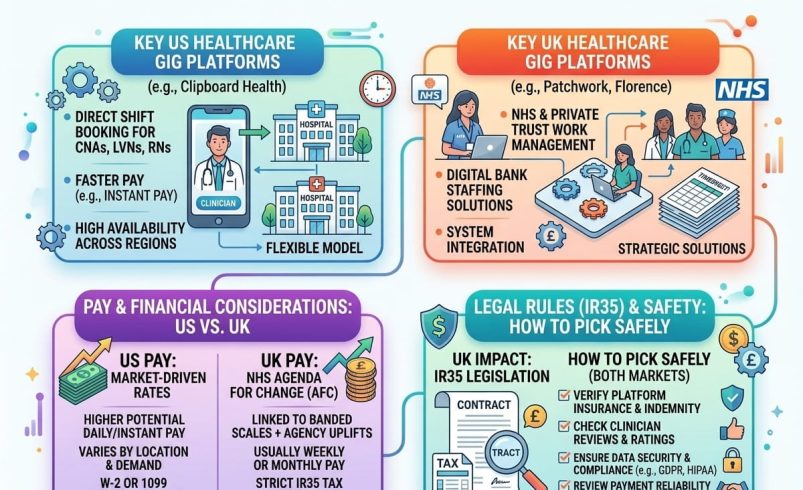
Trying to work out which healthcare gig marketplace companies actually operate where you live, and whether they’re worth your time? Here’s the short answer: in the US, apps like Clipboard Health, ShiftKey, ShiftMed and IntelyCare let nurses and carers pick up per diem shifts directly. In the UK, the market looks different: platforms such as Patchwork Health, Lantum and Locum’s Nest work mainly with the NHS and GP practices, and UK workers are usually classed as “workers” or self-employed locums rather than pure gig contractors.
That difference matters more than it sounds. Pay structures, tax treatment and even basic safety protections vary a lot depending on which side of the Atlantic you’re on. Below, we’ve mapped out the main healthcare gig marketplace companies in both countries, what they pay, how they’re regulated and the questions worth asking before you sign up.
A healthcare gig marketplace is an app or website that matches individual clinicians, carers or support workers with short-notice shifts at hospitals, care homes, clinics or private practices. Instead of going through a single staffing agency, the worker sees a live list of open shifts and books the ones that fit their schedule.
Most platforms take a cut from the facility (not the worker) for each shift filled. Some pay workers within 24 hours; others run on a standard weekly or monthly cycle. The pitch is always the same: flexibility for the worker, faster staffing for the facility. Whether that pitch holds up depends heavily on which company you’re dealing with.
This is different from a traditional locum or nursing agency, where a recruiter matches you to roles by phone or email. Gig marketplaces cut the recruiter out and let an algorithm, or the worker directly, do the matching.
The US market is the bigger and more mature of the two, and it’s grown fast. According to an April 2026 report from the AI Now Institute, <cite index=”20-1″>the ten most prominent gig nursing platforms have raised roughly $1.4 billion in funding combined, with ShiftKey valued at around $2 billion and Clipboard Health at $1.3 billion.</cite> That scale brings both convenience and controversy, which we’ll get into below.
Clipboard Health is one of the largest on-demand nursing platforms in the US, connecting nurses, CNAs and other healthcare workers with acute care, skilled nursing and assisted living facilities. <cite index=”22-1″>Facilities typically set the shift rate up front, though Clipboard Health also offers a rate negotiation feature on some listings.</cite> Pay is generally released fast after a shift is worked and approved.
The catch: because most workers are classed as independent contractors, there’s no employer-provided health insurance, sick pay or holiday pay built in. <cite index=”21-1″>Clipboard Health, alongside several competitors, does not require workers to carry their own health insurance either.</cite>
ShiftKey works on a bidding model. <cite index=”22-1″>Rather than a fixed facility rate, ShiftKey lets healthcare professionals bid on open shifts, and the facility typically accepts the lowest or most competitive offer.</cite> That structure has drawn criticism from labour researchers, who argue it can push pay down rather than up when workers compete against each other for the same slot.
ShiftKey has grown quickly regardless. Founded in 2016, it’s now one of the best-funded names in the space and covers a wide range of facility types, from nursing homes to hospitals.
ShiftMed connects nurses and nursing assistants with clinical facilities in real time, and it puts more emphasis on scheduling tools and workforce management features than some of its rivals. <cite index=”22-1″>The company secured $200 million in a Series D funding round in February 2023, taking its total funding to around $298 million as of early 2025.</cite> ShiftMed also focuses heavily on per diem work, similar to Clipboard Health.
CareRev built its name matching per diem clinicians with hospitals, health systems and outpatient centres, with a strong emphasis on letting facilities build their own internal float pools rather than relying purely on outside staff. That changed in early 2026: <cite index=”29-1″>CareRev was acquired by IntelyCare in January 2026.</cite> IntelyCare itself focuses on nursing and allied health staffing with a heavier AI-matching layer, and the combined business now competes directly with Clipboard Health and ShiftKey at scale.
Nursa and KARE round out the well-known names, both offering per diem shift marketplaces for nurses and nursing assistants across multiple US states. Their footprint has shrunk in at least one state recently, which brings us to a genuinely important point for anyone comparing US platforms.
Not every US state welcomes the gig staffing model in its current form. <cite index=”20-1″>In 2025, New York reclassified gig nursing platforms as healthcare staffing agencies, requiring annual registration and quarterly wage reporting, and blocking independent contractor classification outright. Following that law, Clipboard Health, Nursa and KARE stopped operating in the state.</cite>
That’s a real signal for anyone in the US considering these apps: what’s legal and available in Texas or Florida might not be legal in New York, and the rules are shifting. Always check a platform’s current state coverage before you build your income around it, since availability can change with little notice.
The UK picture is genuinely different, and conflating it with the US model is one of the most common mistakes people make when searching for “healthcare gig marketplace companies us uk”. UK platforms overwhelmingly serve the NHS and primary care, not private hospital chains, and most operate as digital staff banks rather than open bidding markets.
Patchwork Health was founded in 2016 by two former NHS doctors and has become one of the most widely used staff bank platforms in the country. <cite index=”13-1″>It’s the technology behind the UK’s largest collaborative staff bank and won the HSJ Partnership Award for Staffing Solution of the Year in 2022, with more than £80 million saved across over 50 healthcare organisations.</cite> Clinicians build a profile, join one or more NHS trust “staff banks,” and book shifts directly through the app, with automatic timesheet tracking and faster payment than the old paper-based process.
<cite index=”10-1″>Patchwork raised £20 million in a Series B funding round backed by Perwyn to expand its NHS staffing platform.</cite> It has also grown through acquisition, picking up medical appraisal and job planning software provider L2P Enterprise.
Locum’s Nest, also built by doctors, connects healthcare professionals with NHS hospitals to cover shifts. <cite index=”15-1″>Workers set filters by specialty, availability, seniority and location, apply to shifts with a tap, and keep credentials stored in a built-in digital passport so they don’t have to repeat compliance checks for every employer.</cite> It also supports “collaborative banks,” where several NHS trusts share a pooled bank of workers, avoiding duplicate HR checks and multiple payslips for the same person.
Lantum focuses more heavily on primary care and GP staffing, alongside hospital rota tools. It offers AI-assisted rota building for NHS organisations and locum GP booking on the worker side, positioning itself as workforce technology rather than a pure gig app.
Florence takes a slightly wider remit, covering both temporary and permanent nurses and care assistants, plus training tools for care providers. It works with care homes and complex care settings as well as NHS bodies, filling shifts from either a facility’s own staff bank or Florence’s own vetted worker pool.
The biggest structural difference is that UK platforms rarely operate as open marketplaces where anyone can undercut anyone else on price. Most are built around “staff banks”: a trust or GP practice sets pay rates in line with NHS Agenda for Change bands or locally agreed locum rates, and workers pick up shifts at that fixed rate rather than bidding down. There’s no ShiftKey-style reverse auction in the mainstream UK NHS staffing tools.
Domiciliary and social care is a bit more mixed. Some smaller platforms connect self-employed carers directly with individuals needing home care, and here the picture looks closer to the US gig model, with less standardisation on pay and fewer built-in protections. If you’re comparing platforms in this space, check whether the underlying care provider is CQC-registered, since <cite index=”36-1″>the Care Quality Commission regulates and inspects most care services in England, though small enterprises or micro-providers offering care at home can sometimes be exempt from registration.</cite>
This is where the US and UK diverge most, and it’s worth understanding before you commit hours to any platform.
In the US, most gig nursing platform workers are classed as independent contractors, similar to an Uber driver. That means no guaranteed minimum pay, no employer pension contribution, no statutory sick pay, and the worker is generally responsible for their own tax filing and any health insurance. <cite index=”21-1″>Researchers have also found that on some platforms, nurses are encouraged to bid against each other for shifts, sometimes accepting the lowest hourly rate on offer.</cite>
In the UK, the picture is more layered. If you work through an NHS staff bank via Patchwork Health or Locum’s Nest, you’re typically classed as a “bank worker,” which sits closer to casual employment and usually comes with holiday pay accrual and pension eligibility, though this varies by trust. If you work as a self-employed locum through your own limited company, IR35 rules apply.
IR35, formally the off-payroll working rules, decide whether HMRC treats your limited company engagement as employment for tax purposes. For NHS trusts and other public bodies, the client (the trust) must issue a Status Determination Statement confirming whether the role sits inside or outside IR35. Get this wrong, and the tax bill can land on the wrong party retrospectively.
There’s a fresh compliance layer landing too: <cite index=”35-1″>from 6 April 2026, new joint and several liability rules mean agencies can be held responsible for a shortfall if an umbrella company fails to pay PAYE tax correctly.</cite> If you’re paid via an umbrella company as part of a locum booking, it’s worth checking which umbrella your agency or platform actually uses, since this rule shifts real risk onto the agency, not just the worker.
On basic pay floors, the numbers are moving too. <cite index=”47-1″>From 1 April 2026, the National Living Wage for workers aged 21 and over rises to £12.71 an hour, with £10.85 for those aged 18 to 20 and £8.00 for under-18s and most apprentices.</cite> That’s the legal floor for any UK healthcare support role paid hourly, gig platform or otherwise, though most registered nursing and locum GP rates sit well above it.
Every platform on this list will tell you it vets workers thoroughly. The reality varies, and it’s worth being clear-eyed about it rather than taking marketing copy at face value.
In the US, independent research has raised real concerns. <cite index=”21-1″>On-demand nursing platforms including CareRev, Clipboard Health, ShiftKey, ShiftMed and IntelyCare have collectively raised more than $850 million from private investors, and researchers interviewing nurses found these apps can shift the costs and risks of doing business onto workers rather than the platform.</cite> <cite index=”26-1″>Some platforms allow a facility to cancel a booked shift as little as two hours before it starts with no penalty to the facility, while a worker who cancels can see their rating and future job allocations drop.</cite>
In the UK, NHS-facing platforms sit inside a more regulated system by default, since trusts have their own mandatory training, DBS checks and induction standards that a bank worker has to meet before joining. That doesn’t make every UK platform equal, though. Smaller domiciliary care apps outside the NHS system deserve the same scrutiny you’d give any care provider: check their CQC rating directly on the CQC website rather than relying on the app’s own claims.
There’s no single “best” platform, since the right one depends on your role, your country and how much stability you need against how much flexibility you want.
If you’re US-based and want the fastest pay, check Clipboard Health or ShiftMed first, since both are known for quick payout cycles, but confirm your state still permits gig classification before relying on either as a main income source.
If you’re US-based and prefer more control over your rate, ShiftKey’s bidding model can work in your favour when demand is high locally, though it can also push rates down when supply outstrips demand in your area.
If you’re UK-based and work mainly with the NHS, start with Patchwork Health or Locum’s Nest, since both plug directly into NHS trust staff banks and tend to offer more predictable pay and faster timesheet processing than agency routes.
If you’re a UK GP locum, Lantum is worth checking first, given its stronger focus on primary care bookings alongside hospital rota tools.
If you’re comparing UK domiciliary care platforms, verify CQC registration before anything else, since pay structure matters less than whether the underlying care provider is properly regulated and inspected.
Yes. UK platforms like Patchwork Health, Locum’s Nest and Lantum operate within existing NHS staff bank rules, employment law and IR35 tax legislation. They’re not open bidding marketplaces in the US sense, but structured digital versions of the traditional staff bank or locum booking process.
Not necessarily. In the UK, staff bank rates on platforms like Patchwork Health are usually set by the trust and often match or beat agency rates, since agencies add a commission layer. In the US, bidding platforms like ShiftKey can push rates down when many workers compete for one shift, while fixed-rate platforms like Clipboard Health tend to be more predictable.
Mostly not. Most major US platforms classify workers as independent contractors, meaning no guaranteed minimum pay, no employer health insurance, and no paid holiday. New York changed this in 2025 by requiring gig nursing platforms to register as staffing agencies and blocking contractor classification, and several platforms stopped operating there as a result.
IR35 is UK tax legislation that decides whether a limited company contractor should be taxed like an employee. It applies if you’re paid through your own limited company for locum work, including bookings made via a gig-style app. It doesn’t apply if you’re paid through PAYE as a bank worker or through an umbrella company, though umbrella arrangements carry their own rules.
No. Availability changes as states update their staffing and worker classification rules. Clipboard Health stopped operating in New York in 2025 after the state reclassified gig nursing platforms as staffing agencies. Always check current state coverage on the platform’s own site before relying on it.
It depends on the type of care and the size of the provider. Small enterprises or micro-providers offering care at home can sometimes be exempt from CQC registration, but most domiciliary care agencies must register and be inspected. Check a provider’s CQC rating directly on the CQC website before signing up as a worker or a client.
It varies by company and sometimes by shift. Several US platforms, including Clipboard Health, offer same-day or next-day pay options on top of standard weekly runs. UK NHS bank platforms typically follow the trust’s normal payroll cycle, though digital timesheet tools tend to speed up approval compared with paper-based agency processes.
For clinical roles, generally yes, or the platform arranges it as part of onboarding. Requirements differ by role and country, so check the specific platform’s compliance page and your professional body’s guidance (such as the NMC or GMC in the UK) rather than assuming cover is automatic.