

Carbon Fibre Cue Guide 2026: Is It Worth It for UK Players?
- August 20, 2026
- 0
A carbon fibre cue is a snooker or pool cue with a shaft made from carbon fibre composite instead of wood, and for most club players it’s worth



9621 Agnes Crossing, Lake Suzanneview, New Mexico Island 84604-9295.
A carbon fibre cue is a snooker or pool cue with a shaft made from carbon fibre composite instead of wood, and for most club players it’s worth
A carbon fibre cue is a snooker or pool cue with a shaft made from carbon fibre composite instead of wood, and for most club players it’s worth the money if you want less deflection and a shaft that never warps. You’ll pay anywhere from £25 for a budget import to over £500 for a branded shaft from Cuetec or Predator, and yes, you can use one in most amateur leagues without any issue.
If you’ve spent years chalking up with a maple cue and you’re wondering whether the fuss over carbon fibre is justified, you’re not alone. Search interest in this has grown steadily as more players spot pros experimenting with low-deflection shafts on television.
This guide covers everything the current crop of articles on this topic either skip over or get slightly wrong for a UK audience: real UK pricing, whether governing bodies actually allow carbon fibre in ranking events, and how it stacks up against wood for snooker specifically, not just American pool.
Carbon fibre is made from thousands of carbon atoms bonded into long chains, then set into a resin to form a rigid tube. Manufacturers use it because it’s roughly five times stronger than steel by weight, yet far lighter than the equivalent bulk of wood.
Most carbon fibre cues on the market are actually hybrids. The shaft (the thin part you slide through your bridge hand) is carbon fibre, while the butt is usually still wood, often maple or ash, sometimes with a carbon fibre core running through it too. A handful of budget cues go fully carbon from tip to butt, which is where you’ll see the lowest prices but also the least authentic feel.
This is the main reason players switch. When you strike the cue ball with side spin, a wood shaft causes the ball to “squirt”, meaning it doesn’t travel exactly where you aimed. Carbon fibre’s stiffness reduces this squirt noticeably, which is why it’s sometimes marketed as “low deflection.”
For snooker, where side is used constantly to set up the next shot, this can genuinely shave down small errors in technique. It won’t turn a mid-break player into Judd Trump, but it removes one variable you’d otherwise need to compensate for manually.
Wood shafts absorb moisture from the air, sweat from your hands, and temperature swings in a cold club or a warm conservatory. Over years, that causes warping, which is why serious players rotate multiple cues or send a bent one back to the maker for straightening.
Carbon fibre doesn’t absorb moisture, and it barely reacts to temperature at all. A carbon shaft that’s straight today should still be straight in ten years, provided it isn’t physically damaged, which is a big part of the appeal for anyone who’s ever had a favourite cue slowly go banana-shaped in a cue rack.
Here’s where opinions genuinely split. Wood has a slightly softer “give” on impact and a warmer, duller sound off the tip. Carbon fibre feels stiffer and produces a brighter, sometimes almost metallic click.
Plenty of long-time players describe this as the cue feeling “dead” or lacking the traditional connection to the ball. Others say they stopped noticing within a few sessions and now prefer the extra feedback. This one really is personal, and no amount of spec-sheet reading will tell you which camp you’ll land in.
A wood shaft needs occasional cleaning with a proper cue cleaner, periodic re-tipping, and the odd trip back to the manufacturer if it develops a slight bend. Carbon fibre needs almost none of that: a wipe with a dry cloth after each session keeps it looking new, and there’s no resealing or reconditioning required.
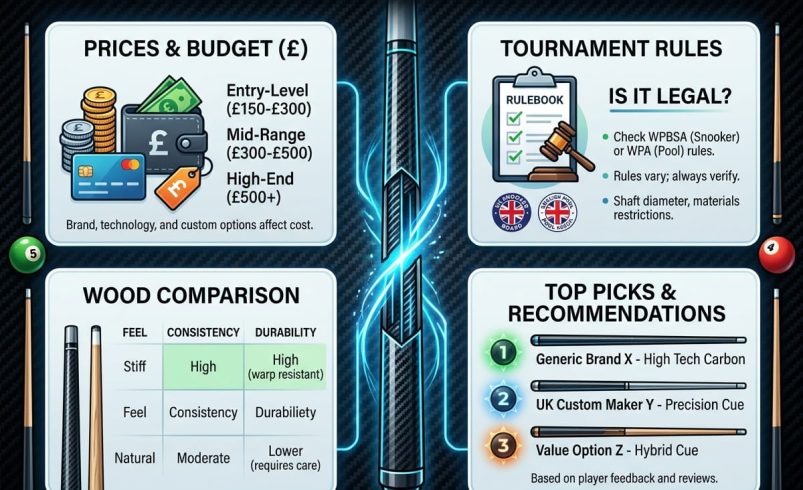
Prices vary a lot depending on whether you’re buying a full carbon cue or a hybrid with a carbon shaft and wood butt. Based on current UK retail listings:
These figures move around fairly often, especially with import costs and exchange rates affecting the cheaper Amazon and eBay listings, so it’s worth checking current pricing on the retailer’s own site before you commit to a specific model.
This is the gap most articles on this topic miss entirely, and it matters if you play in a league or club competition. There’s no rule from the WPBSA (World Professional Billiards and Snooker Association) or World Snooker Tour that bans carbon fibre shafts outright. Cue specifications for professional snooker cover length, and there’s no material restriction written into the rules that would stop a carbon fibre cue being used at the table.
In pool, the World Pool-Billiard Association’s general equipment rules focus on cue length (a minimum of 40 inches) and weight limits rather than material, so carbon fibre shafts pass without issue there too, which is exactly why you’ll see low-deflection shafts like the Predator REVO used openly on the professional pool circuit.
For UK club and league snooker, individual clubs and leagues can technically set their own house rules, but in practice almost none restrict shaft material. If you’re playing in an EASB (English Association of Snooker and Billiards) affiliated league, it’s worth a quick check with your league secretary before turning up with an unusual cue, purely because local rule sheets do occasionally include unexpected clauses, but material bans on carbon fibre are not something we found any evidence of currently in force.
The two aren’t quite the same product, even though they’re both marketed under “carbon fibre cue.”
Snooker cues typically carry a smaller tip, around 9mm to 10mm, and a longer overall shaft to suit the bigger table and tighter pockets. English pool cues tend to be a touch shorter with a smaller tip still, closer to 8mm to 9mm, matched to the smaller balls used in English eight-ball pool. American pool cues, the type most carbon fibre shaft brands like Predator and Cuetec are built for, use a larger 12mm to 13mm tip and different joint threading entirely.
If you play snooker at a UK club, look specifically for cues marketed as snooker cues with the correct tip diameter, rather than assuming a carbon fibre pool cue from Predator will suit your game. Several generic carbon fibre cues sold on Amazon UK and eBay are genuinely dual-purpose and state clearly which tip sizes and games they suit, so check the listing carefully rather than guessing from the product photo.
Start with your joint type. If you already own a cue and just want to upgrade the shaft, you’ll need a carbon fibre shaft that matches your existing joint (commonly 3/8×8, 5/16×18, or the UK’s traditional brass-to-brass snooker joint), not a whole new cue.
Check the tip diameter against your usual cue. Going up or down even half a millimetre changes how the cue feels in your bridge hand, and it’s easy to end up with something that plays completely differently to what you’re used to.
Decide whether you want a full carbon cue or a hybrid. Hybrids with a wood butt tend to keep more of the traditional weight and balance that UK snooker players expect, while full carbon cues are lighter and often cheaper but feel noticeably different in the hand.
Buy from a retailer that accepts returns. Cue feel is genuinely subjective, and a model that reads well in a spec sheet might not suit your stroke at all. UK sellers like Cue & Case, Home Leisure Direct, and larger marketplaces with standard consumer return rights give you a way out if it’s not for you.
Wipe the shaft with a dry, soft cloth after every session to remove chalk dust and hand oils. Avoid household cleaning sprays or anything abrasive, since these can dull the finish over time.
Store it in a proper cue case rather than leaning it against a wall or radiator. Carbon fibre won’t warp from heat or damp the way wood does, but the joint and tip are still vulnerable to knocks if the cue falls or gets trapped in a car boot.
Check the ferrule and tip condition regularly, just as you would on a wood cue. Carbon fibre solves the shaft-warping problem, not tip wear, so you’ll still need to re-tip eventually.
Neither is objectively better, they suit different priorities. Carbon fibre gives you less deflection and no warping over time, while wood gives you a softer, more traditional feel that many long-time players still prefer.
A small but growing number of players, particularly in American pool, have adopted carbon fibre or low-deflection shafts. In snooker specifically it remains far less common, and most top professionals still play with traditional wood cues, though this is shifting as more players experiment.
Yes, in almost all UK club and league snooker, since there’s no material restriction in place at the WPBSA or EASB level that we found evidence of. If you’re unsure, ask your league secretary before your first match with it.
Budget full carbon cues start around £25 to £30 on marketplaces like Amazon UK, while mid-range hybrid cues from specialist retailers typically run £80 to £200, and branded professional-grade shafts can reach £300 to £550 or more.
No, this is one of their biggest selling points. Carbon fibre doesn’t absorb moisture or react to temperature changes the way wood does, so a straight carbon shaft should stay straight indefinitely with normal care.
Often, yes, provided the joint type matches. Many brands sell carbon fibre shafts separately specifically so players can upgrade an existing butt without buying a whole new cue, though you’ll need to confirm your joint thread size first.
Not always. Reviews on budget imports vary considerably, and while many buyers report good results, quality control on sub-£50 cues is noticeably less consistent than on branded mid-range or professional models.
Most UK snooker players use a 9mm to 10mm tip, noticeably smaller than the 12mm to 13mm tips common on American pool cues, so check this specifically before buying, since many listings default to pool sizing.