Wood Rail Fence: Complete UK Guide to Types, Costs & Rules
- August 20, 2026
- 0
If you’re weighing up a wood rail fence for your garden, paddock, or boundary, here’s the quick answer: it’s a fence built from horizontal timber rails fixed between



9621 Agnes Crossing, Lake Suzanneview, New Mexico Island 84604-9295.
If you’re weighing up a wood rail fence for your garden, paddock, or boundary, here’s the quick answer: it’s a fence built from horizontal timber rails fixed between
If you’re weighing up a wood rail fence for your garden, paddock, or boundary, here’s the quick answer: it’s a fence built from horizontal timber rails fixed between upright posts, prized for being cheap, quick to install, and open enough to keep sightlines and airflow rather than blocking them entirely. It’s the traditional choice for large gardens, fields, and rural boundaries, and it’s having a bit of a moment in residential gardens too, where the open, rustic look suits a more relaxed style than a solid panel fence.
This guide covers every style of post and rail fencing sold in the UK, what you’ll actually pay per metre in 2026, the planning permission rules that catch people out, which timber and treatment to choose, and how to install one properly so it lasts.
A wood rail fence, more often called post and rail fencing in the UK trade, consists of vertical timber posts with horizontal rails fixed between them, either nailed to the face of the posts or slotted into mortised holes. Unlike panel fencing, there’s no solid infill, so it defines a boundary without creating a wall.
It’s the standard choice for agricultural land, paddocks, and large country gardens, where the priority is marking land rather than blocking views. Increasingly, homeowners are also choosing this style for front boundaries and open-plan gardens, since it gives a defined edge without the heavier, enclosed feel of closeboard or panel fencing.
Not all post and rail fencing looks or performs the same way. Here’s what’s actually available from UK suppliers right now.
This is the cheapest and most common version. Rails are nailed straight onto the flat face of the posts, using either square-sawn or half-round timber, and it’s fast to install, which is why most garden centre and DIY kits use this construction.
A stronger, more traditional build where rails are shaped with a scarfed (tapered) end and slotted directly into a mortised hole cut through the post. This gives a cleaner, more rigid fence than nailing alone, but costs more and takes longer to install.
Made from split, rather than sawn, sweet chestnut, this is a particularly durable rural style thanks to chestnut’s naturally high tannin content, which resists rot without needing pressure treatment. It’s commonly supplied in 1.83m (6ft) or 2.75m (9ft) bays with 2 or 3 rails, and it has a distinctly rustic, uneven look that some gardens suit better than others.
Uses full-round or half-round machined posts and rails rather than square timber, typically an 88mm pointed round post paired with a 100mm x 50mm half-round rail. It’s popular for paddocks and equestrian boundaries, since the rounded edges are gentler if livestock lean against them.
Not strictly rail fencing, but worth a mention: this pairs timber posts with strained wire rather than rails, a cheaper way to secure a large rural boundary where full timber rails would cost too much.
[Table suggestion: comparing standard nailed, mortised, cleft chestnut, and round rail styles by typical price, lifespan, and best use case]
Prices for post and rail fencing vary a fair bit depending on style, rail count, and whether it’s materials alone or a full installation job. As a rough benchmark from current UK suppliers:
A typical 10 to 15 metre domestic boundary in this style usually costs less overall than the same length in closeboard or composite fencing, one reason it remains popular for larger plots where cost per metre adds up fast.
Prices shift with timber costs and supplier promotions, so treat these as a starting guide and get a written quote before committing to a job.
The single biggest factor in how long a fence like this lasts isn’t the style, it’s the timber treatment. A lot of buyers get caught out by cheap kits that look identical to quality ones in a photo.
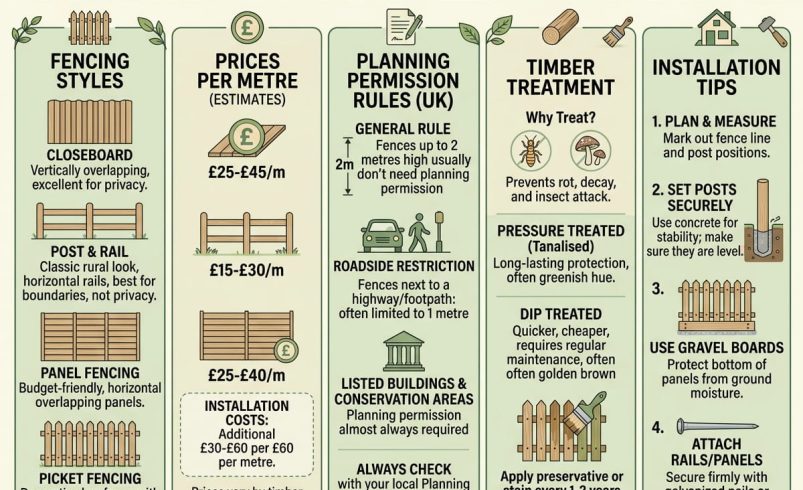
Any timber going into the ground, meaning every post, should be treated to Use Class 4 (UC4) standard. This British Standard classification for wood in permanent ground contact requires kiln drying to a moisture content of 28% or below before pressure treatment, so the preservative penetrates deep into the wood rather than sitting on the surface.
Posts treated to UC4 and correctly incised (given small uniform cuts that let the preservative penetrate further) typically last 15 to 30 years in the ground, compared with as little as 5 years for untreated timber in a typical UK garden. Rails, which sit above ground, generally only need UC3 treatment, though many suppliers treat both to UC4 for consistency and extra peace of mind.
You’ll often see timber described as tanalised or tanalized. This just refers to preservative treatment using Tanalith, a specific branded treatment technology, and it can be applied to either UC3 or UC4 grade timber. Tanalised alone doesn’t guarantee ground-contact durability, so check the actual use class stated on the product listing rather than assuming from the word “tanalised” alone.
Most UK post and rail fencing uses pressure treated softwood (usually redwood pine), which offers the best value once properly treated. Cleft chestnut needs no chemical treatment at all thanks to its natural tannins, making it a genuinely low-maintenance option, though it costs more upfront. Oak post and rail sits at the top of the price range, valued for its strength and longevity, but it’s a significant step up in cost and usually reserved for period properties or premium rural boundaries.
Garden Fence Height Rules: Do You Need Planning Permission?
This catches out more people than any other part of fence buying, so it’s worth being precise.
In England and Wales, you generally don’t need planning permission for a new or replacement fence as long as it’s no more than 2 metres high on a rear or side boundary. If the fence runs alongside a road used by vehicles, or forms a boundary next to a public footpath, that limit drops to 1 metre without permission.
Height is measured from ground level on your side of the boundary, and this catches people out on sloping plots, since a fence that looks fine from your side can appear taller from a neighbour’s lower garden. If your property is a listed building, or the boundary touches the curtilage of one, you’ll usually need permission regardless of height. The same applies in conservation areas and other protected zones, where local authorities can apply stricter design and height rules on top of the national limits.
Post and rail fencing rarely runs into height problems in practice, since most styles sit naturally under 1.2 metres, well within the general limits. It’s worth checking anyway if you’re planning a taller version with added trellis or infill panels, since the full structure counts toward the height limit, not just the solid section.
Replacing an existing fence like-for-like, at the same height, generally doesn’t need permission even close to the limit. Increasing the height above what was there before is what typically triggers the need to apply. If you’re at all unsure, a quick call to your local planning department settles it faster than guessing.
A genuinely common question, and one that causes more neighbour disputes than almost anything else in garden fencing.
There’s no automatic UK-wide rule that says which side of a boundary “owns” the fence, contrary to the common myth about the left- or right-hand boundary always being yours. Ownership and maintenance responsibility are usually set out in the property’s title deeds, so the only reliable way to check is to look at your deeds or search the boundary on the Land Registry, rather than relying on which way any existing fence posts happen to face.
If the deeds don’t specify, or you can’t get a clear answer, the fence is generally treated as a shared boundary, and it’s good practice, if not a legal requirement, to talk to your neighbour before replacing or altering it. Even where you’re within your rights, a taller replacement could affect light or views into next door, so a quick conversation beforehand tends to save a lot of friction later.
You don’t need a contractor for a straightforward post and rail run, though it’s worth knowing what you’re taking on before starting.
Mark out and check for services. Check for buried pipes or cables along the run, and confirm your boundary line against your deeds if there’s any doubt.
Set post spacing correctly. Standard kits are typically supplied in 1.8m to 2.75m bays, so plan your run length around whole bays to avoid awkward cuts at the end.
Dig to the right depth. As a rough rule, bury roughly a third of the post’s total length, so an 1.8m post goes around 600mm into the ground, deep enough to resist wind without excessive digging.
Concrete or ram the posts in. Concreting gives a more rigid fix, particularly on exposed sites, while ramming (compacting soil and hardcore around the post) is quicker but generally shorter-lived.
Fix or slot the rails. For nailed styles, use galvanised or stainless fixings, since standard steel nails rust and stain the timber over time. For mortised styles, the scarfed rail ends slot directly into the post with no fixings needed at each joint.
Treat cut ends. Any timber cut to length on site exposes untreated wood at the cut end, so apply an end-grain preservative before installation to stop rot starting there.
This style needs less upkeep than a solid panel fence, simply because there’s less surface area exposed, but it still benefits from regular attention.
It’s almost always called post and rail fencing in the UK, with “wood rail fence” used more informally or in general search terms. Both describe the same construction of horizontal rails fixed between vertical posts.
Materials alone typically run from around £13 per metre for standard nailed timber, rising for 3 or 4 rail versions or premium timbers like chestnut and oak. Fully installed with labour, most straightforward post and rail jobs land somewhere between £30 and £60 per metre, though this varies by region and site access.
Usually not, since most post and rail styles sit well under the general 2 metre limit for rear and side boundaries in England and Wales. You’ll only likely need permission if you’re near a highway (1 metre limit), on a listed property, or in a conservation area with stricter local rules.
Properly treated posts (UC4, ground contact rated) typically last 15 to 30 years, while above-ground rails with regular staining or sealing can last just as long if maintained. Untreated timber, by contrast, can start rotting within 5 years in a typical UK climate.
Post and rail uses open horizontal rails with no solid infill, giving visibility and airflow through the fence, while panel fencing uses solid pre-made sections between posts for full privacy. Post and rail is generally cheaper per metre and suits large boundaries, while panel fencing suits smaller gardens where privacy matters more.
Yes, this is one of its main traditional uses, particularly 3 and 4 rail versions built with wider spacing for larger animals or tighter spacing for smaller livestock. Round rail and cleft chestnut styles are especially common on equestrian boundaries and paddocks for exactly this reason.
Not typically, since post and rail fencing has no solid lower panel that would otherwise sit directly on soil and rot from ground contact. Gravel boards are more relevant to closeboard and panel fencing, where a solid timber section runs along the base of the fence.
There’s no automatic UK rule assigning responsibility to one side, despite the common belief about left- or right-hand boundaries. Check your property’s title deeds or the Land Registry entry for your boundary, since maintenance responsibility, where it’s specified at all, is usually set out there rather than by convention.