To define defence lawyer simply: it’s a legal professional who represents someone accused of a crime, protecting their rights and putting forward the strongest possible case on their behalf throughout the police, court, and (where needed) trial process. In England and Wales, that role is split between two professionals working as a team: a solicitor, who advises you, manages your case, and deals with the Crown Prosecution Service, and a barrister, who’s brought in to argue your case in front of a judge, particularly in the Crown Court. Together they make up what most people simply call a defence lawyer.
This guide sets out how to define defence lawyer properly for the UK system, what one actually does at every stage from a police station interview through to trial, what the difference between a solicitor and barrister means in practice, whether you’re entitled to one for free, and what it costs if you’re not.
[Image suggestion: simple flowchart showing the journey from arrest to court, with the solicitor and barrister roles marked at each stage]
How to Define Defence Lawyer: The Straightforward Version
At its simplest, a defence lawyer is the person on your side. They act for the accused, not the state, and their entire job is to make sure you’re treated fairly, that the case against you is properly tested, and that you get the best outcome the facts and law allow.
In UK criminal law, “defence lawyer” isn’t a formal job title in the way “solicitor” or “barrister” is. It’s a general term that covers anyone providing legal representation to a defendant, whether that’s a duty solicitor at a police station, a private criminal solicitor running your case, or the barrister who stands up for you in the Crown Court. Some people also use “defence attorney” or “defence counsel”, terms borrowed from American and older legal English, but they mean the same thing in this context.
This is different from a prosecution lawyer, who works for the Crown Prosecution Service (CPS) and presents the case against you. Both sides play a necessary role in a fair trial, but a defence lawyer’s duty is to you specifically, not to the court or the state.
Solicitor vs Barrister: What’s the Actual Difference?
This trips up almost everyone who’s never been through the criminal justice system, so it’s worth being precise.
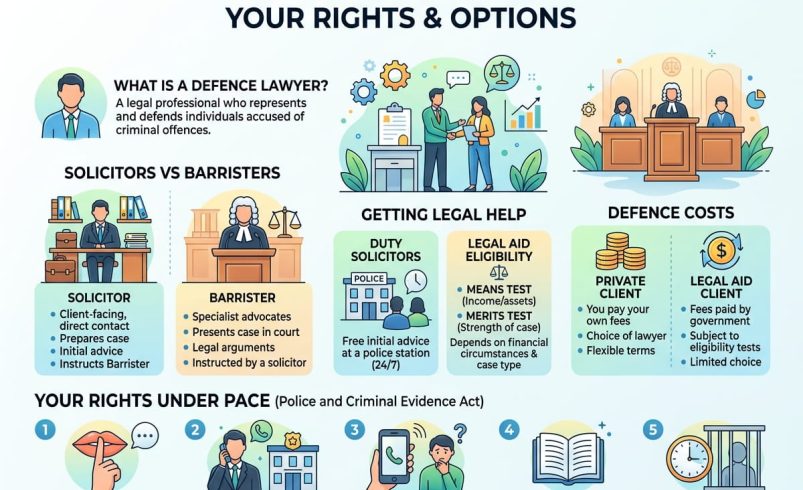
A solicitor is usually your first point of contact and stays involved throughout. They take your instructions, advise you on your options, correspond with the CPS, gather evidence, prepare your defence, and represent you directly in most Magistrates’ Court hearings. High street criminal firms are almost always solicitors’ practices.
A barrister is a specialist advocate instructed by your solicitor, most commonly for Crown Court trials where the case is more serious and the courtroom advocacy more demanding. Barristers focus on presenting arguments, cross-examining witnesses, and speaking directly to the judge and jury. Your solicitor keeps running the case behind the scenes while the barrister leads in the courtroom.
For many Magistrates’ Court matters, a solicitor handles the whole case without a barrister ever being instructed. For Crown Court cases, it’s normal for both to be involved, working closely together so your defence is consistent from the first police interview through to the verdict.
[Table suggestion: solicitor vs barrister, showing typical role, where they appear (Magistrates vs Crown Court), and how you access each one]
What Does a Defence Lawyer Actually Do?
The work varies by stage, but a defence lawyer’s core responsibilities generally cover the following.
Advising you at the police station. This is often the single most important intervention in a case, since what you say (or don’t say) during an interview under caution can shape everything that follows.
Reviewing the evidence. Your lawyer examines everything the prosecution has, from witness statements to CCTV and forensic reports, looking for weaknesses, inconsistencies, or grounds to challenge admissibility.
Building your defence strategy. This might mean gathering your own evidence, identifying witnesses, instructing an expert, or negotiating with the CPS over the charges themselves.
Managing bail. If you’re released on bail with conditions, your lawyer can apply to vary or challenge those conditions if they’re unreasonable or unworkable.
Representing you in court. Whether that’s a solicitor at a Magistrates’ Court hearing or a barrister at Crown Court trial, someone from your defence team speaks for you at every hearing.
Advising on plea and sentence. If you’re considering a guilty plea, your lawyer explains the realistic consequences, including any sentencing discount for pleading early, and prepares mitigation to put before the court if you’re convicted or plead guilty.
Your Right to a Defence Lawyer at the Police Station
If you’re arrested in England or Wales, you have a legal right to free and independent legal advice under section 58 of the Police and Criminal Evidence Act 1984 (PACE). This right applies the moment you’re held in custody, and it isn’t means tested. It doesn’t matter what you earn or own, this specific advice is free for everyone.
The same right extends to anyone attending a voluntary interview under caution, even if that interview happens somewhere other than a police station, such as your own home.
Once you ask for a solicitor, the police must arrange it without delay, and in most cases they can’t start questioning you until your solicitor has arrived or you’ve spoken to one by phone. You can ask for a specific solicitor or firm you already know, or the custody officer can contact the duty solicitor on your behalf.
What Is a Duty Solicitor?
A duty solicitor is an independent criminal defence solicitor from a local law firm, working on a rota funded by the Legal Aid Agency, who provides free advice to anyone arrested or held for questioning who doesn’t already have their own solicitor. They also cover first appearances at the Magistrates’ Court for anyone who turns up unrepresented.
Duty solicitors don’t work for the police, the courts, or the CPS. They’re bound by the same professional duties as any other solicitor regulated by the Solicitors Regulation Authority, and their only job is to protect your interests. You can request the duty solicitor through the Defence Solicitor Call Centre, and for less serious matters you may instead be routed to telephone-only advice through Criminal Defence Direct.
It’s worth knowing that the duty solicitor system in England and Wales has come under real pressure in recent years. The Law Society has reported that the number of duty solicitors working outside London fell by around 7% between 2018 and 2021, and several local schemes now have only one or two solicitors covering an entire area. This can mean longer waits in some parts of the country, though your right to advice itself doesn’t change.
Legal Aid for a Criminal Defence Lawyer: Are You Eligible?
Beyond the free police station advice everyone gets, ongoing legal aid for the rest of your case works differently and does involve a financial assessment.
In the Magistrates’ Court, criminal legal aid uses a strict means test, and it’s binary: you either pass and get full funding, or you don’t qualify at all. There’s no partial contribution system at this level, unlike the Crown Court. The Legal Aid Agency publishes updated financial thresholds each April in a document called the Keycard, so exact figures shift year to year, and you should check the current thresholds on GOV.UK before assuming you will or won’t qualify.
In the Crown Court, the system allows for income-based contributions, meaning some defendants with moderate earnings still get legal aid but pay something towards the cost, with the amount scaling to income and, in some cases, capital assets too.
Alongside the means test, applicants must also pass an Interests of Justice test, which considers factors like whether you risk losing your liberty, livelihood, or reputation, and whether the case involves a substantial legal or factual question you couldn’t reasonably handle yourself. Anyone under 18, or receiving certain benefits such as Universal Credit or Income Support, is automatically passported through the means test and only needs to satisfy the Interests of Justice test.
Legal aid thresholds haven’t kept pace with inflation since 2009, and the Law Society has been vocal that this is pushing more people just above the cut-off, even when they genuinely can’t afford private representation. If you’re unsure whether you’d qualify, most criminal firms will check for you free of charge before you commit to anything.
How Much Does a Private Defence Lawyer Cost in the UK?
If you don’t qualify for legal aid, or you’d simply rather instruct your own solicitor privately, costs vary considerably depending on the seriousness of the case, where you’re based, and the experience of the solicitor.
As a general guide from current UK criminal firms:
- Police station attendance: roughly £500 to £800 plus VAT for a private interview, though this specific stage is free for everyone via legal aid regardless of income
- Straightforward Magistrates’ Court matter (guilty plea, single hearing): typically £500 to £1,500 plus VAT
- Contested trial in the Magistrates’ Court: often £1,500 to £5,000 plus VAT, depending on length and complexity
- Crown Court case: costs climb sharply here, commonly £5,000 to £20,000 plus VAT or more for a multi-day trial, once solicitor and barrister fees are combined
- Hourly rates: most criminal solicitors charge somewhere between £150 and £395 plus VAT per hour, depending on seniority, with senior partners in London and the South East typically at the top end
If you’re privately paying and you’re acquitted in the Magistrates’ Court, you may be able to recover some costs through a Defendant’s Costs Order, though this is usually capped at legal aid rates rather than what you actually paid.
Prices vary a lot between firms and change over time, so always ask for a written estimate before instructing anyone, and clarify upfront whether it’s a fixed fee or hourly rate.
[Table suggestion: cost ranges by case type, showing Magistrates’ Court vs Crown Court, guilty plea vs trial]
Do You Actually Need a Defence Lawyer?
Technically, no. You have the right to represent yourself at any stage of criminal proceedings in England and Wales.
In practice, this is rarely a good idea beyond the most trivial matters, and even solicitors representing themselves in their own cases will usually instruct someone else instead. Criminal procedure, evidence rules, and sentencing guidelines are complicated, and a solicitor who does this work daily will spot issues and options you’d likely miss. Since police station advice is free for everyone regardless of income, there’s rarely a good reason to go into an interview without one.
FAQs
How do you define defence lawyer in the UK system? A defence lawyer is defined as a solicitor or barrister who represents someone accused of a crime, protecting their legal rights and presenting their case to the police, prosecution, and court. In the UK, this role is usually split between a solicitor who manages the case and a barrister who argues it in the more serious Crown Court hearings.
Is a defence lawyer the same as a solicitor? Not exactly. A solicitor is a specific type of qualified lawyer, and most solicitors who handle criminal cases act as defence lawyers, but “defence lawyer” is a broader, informal term that also covers barristers and duty solicitors working on the same side of a case.
Is legal advice at a police station really free? Yes, completely, and it isn’t means tested. Under section 58 of PACE, anyone arrested or interviewed under caution has the right to free and independent legal advice regardless of income, savings, or the seriousness of the alleged offence.
How do I get a duty solicitor? If you’re arrested, tell the custody officer you want legal advice and they’ll contact the Defence Solicitor Call Centre, which either passes your case to the duty solicitor on the local rota or routes simpler matters to telephone advice through Criminal Defence Direct. At court, a duty solicitor is also available for anyone appearing unrepresented at their first Magistrates’ Court hearing.
Can I choose my own defence lawyer instead of the duty solicitor? Yes. You can name a specific solicitor or firm at the point of arrest, and the police must try to contact them. If that solicitor isn’t available or you don’t have one in mind, you can still use the duty solicitor free of charge.
What’s the difference between legal aid and a private solicitor? Legal aid is government funding that covers some or all of your legal costs if you pass a means test (and, in most cases, an Interests of Justice test), while a private solicitor is one you pay for directly, with no financial eligibility requirement but full responsibility for the fees. Police station advice is free either way, but ongoing case representation depends on which route you take.
Do I need a barrister as well as a solicitor? Not always. Many Magistrates’ Court cases are handled entirely by a solicitor, but for Crown Court trials it’s standard practice for the solicitor to instruct a barrister to lead the courtroom advocacy while continuing to manage the case itself.
What happens if I can’t afford a lawyer? Police station advice is free regardless of your finances, so you’re never without representation at that stage. For the rest of your case, you may qualify for legal aid depending on your income, savings, and the type of case, and it’s worth asking a criminal solicitor to check your eligibility before assuming you can’t get help.