
What Does OFC Mean in Text? Full OFC Meaning Explained
- August 10, 2026
- 0
Someone’s just replied to your message with “ofc” and you want to know exactly what does ofc mean in text before you reply back. Here’s the short version:



9621 Agnes Crossing, Lake Suzanneview, New Mexico Island 84604-9295.
Someone’s just replied to your message with “ofc” and you want to know exactly what does ofc mean in text before you reply back. Here’s the short version:
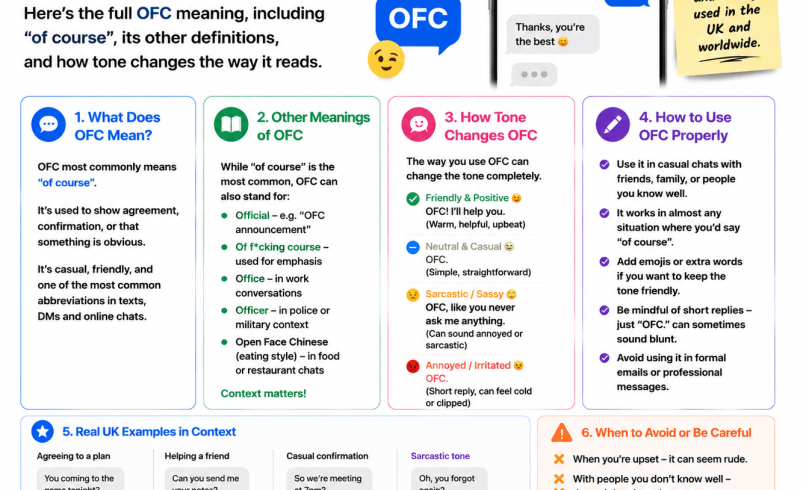
Someone’s just replied to your message with “ofc” and you want to know exactly what does ofc mean in text before you reply back. Here’s the short version: ofc almost always stands for “of course”, used to confirm something quickly or show enthusiastic agreement. In the vast majority of texts, DMs, and comments, that’s all it is.
Where it gets slightly trickier is tone, since ofc can read as warm and supportive in one message and a bit sharp or dismissive in another, depending entirely on what’s around it. There’s also a completely separate meaning used in fanfiction and writing communities that has nothing to do with texting at all.
This guide covers everything worth knowing about ofc meaning in text: where it comes from, how tone changes it, its other definitions, and how to reply without misreading someone’s intent.
OFC stands for “of course.” It’s one of the most common texting abbreviations in the UK and beyond, used to agree with something, confirm a plan, or answer a question with confident, friendly certainty.
Rather than each letter mapping to a separate word in the usual acronym style, ofc simply drops the middle sounds out of “of course” to make it quicker to type. That’s the whole story behind what does ofc mean in text: shorthand for a phrase people already say constantly out loud.
If you see it written o f c, letter by letter, it means exactly the same thing as ofc written together: “of course.” Spacing doesn’t change the meaning, it’s usually just a typing quirk from voice-to-text or someone typing quickly on a phone keyboard.
Like most internet shorthand, ofc grew out of early texting and instant messaging culture, when character limits and slow keypads made shortening common phrases genuinely useful. “Of course” was an obvious one to compress, since it’s said so often in casual conversation to confirm, reassure, or agree.
Once smartphones took over, the abbreviation didn’t disappear, it simply moved across to WhatsApp, Instagram comments, and group chats, where speed still matters more than typing full sentences. What does ofc mean today is exactly what it meant a decade ago, the meaning has barely shifted at all.
This is the part that trips people up most, because the same three letters can land very differently depending on context. What does ofc mean in a given message often comes down to what’s said just before or after it.
Friend: “Will you still come even if it’s raining?” You: “Ofc, always.”
Here, ofc adds warmth and reassurance, similar to saying “of course I will, don’t even worry about it.”
Friend: “You up for pizza tonight?” You: “Ofc 😄”
This use is upbeat and relaxed, working almost like a confident, happy yes.
Friend: “Did you forget your charger again?” You: “Ofc…”
Trailed off with no exclamation or emoji, ofc can read as a resigned, mildly frustrated “yeah, obviously” rather than a friendly confirmation.
[Table: How tone changes OFC meaning]
| Message style | Likely OFC meaning |
| “Ofc!” or “Ofc 😊” | Enthusiastic, friendly agreement |
| “Ofc, always” | Reassurance or emotional support |
| “Ofc…” (trailing off) | Slightly resigned or sarcastic |
| “Ofc, why wouldn’t I?” | Mild annoyance at an obvious question |
What does ofc mean stays consistent everywhere, but how often it turns up, and in what tone, shifts a bit depending on where you’re chatting.
WhatsApp is where ofc probably gets the most everyday use in the UK, since it’s the default messaging app for friends and family. It usually appears as a quick, warm confirmation to a plan or a favour.
On Instagram DMs and Snapchat, ofc tends to show up in short, punchy exchanges, often paired with emojis to keep the tone clearly friendly rather than flat.
On apps like Hinge, Bumble, and Tinder, ofc crops up a lot once a chat’s already flowing, usually confirming plans or reassuring the other person about something they’ve asked. Here, tone matters more than usual, since a bare “ofc” can read as less enthusiastic than intended.
In group chats, ofc often appears as a fast way to agree with a plan without slowing the conversation down, especially when several people are replying at once and nobody wants to type a full sentence.
Texting isn’t the only place these three letters turn up. Knowing the other meanings helps avoid confusion if you spot ofc somewhere unexpected.
In fanfiction and fan writing communities, OFC stands for “original female character”, meaning a character invented by the author rather than one taken from the source material. If someone in a writing forum asks for feedback on their OFC, they mean their invented character, not “of course.”
In more heated or emphatic messages, some people use ofc as shorthand for a stronger phrase with an inserted swear word for emphasis, roughly “of [expletive] course.” It’s used to add extra intensity to an agreement or a frustrated reaction, and context makes this version fairly obvious since it usually follows something dramatic or exaggerated.
OFC also refers to a couple of unrelated official bodies, including the Oceania Football Confederation and the Oxford Farming Conference. These uses are rare in everyday chat and almost never what someone means when they text you “ofc.”
Not by default. What does ofc mean depends heavily on tone, but in the overwhelming majority of texts it’s simply a fast, friendly way of saying yes or confirming something without any edge to it at all.
Sarcasm tends to come from context rather than the abbreviation itself. A one-word “ofc” with no punctuation, sent after an obvious or slightly annoying question, can read as short. Adding a smiley, an exclamation mark, or a follow-up word (“ofc, no worries”) clears up the tone instantly.
A few other bits of slang cover similar ground to ofc, so it’s worth knowing how they differ.
YW means “you’re welcome” and is used as a reply to thanks, not as a confirmation. The two get confused occasionally because both are short, friendly responses, but they answer completely different things.
NP stands for “no problem”, used to brush off thanks or reassure someone their request wasn’t a bother. Ofc leans more towards agreement or confirmation, while NP leans towards reassurance that something wasn’t a hassle.
FS means “for sure”, a near-identical alternative to ofc used to confirm or agree with something. The two are largely interchangeable in casual UK texting, with FS feeling very slightly more emphatic to some people.
There’s no strict rulebook here, but a few habits keep things feeling natural rather than clipped.
Not really. While ofc is closely associated with teen and Gen Z texting habits, plenty of adults use it too, particularly in WhatsApp group chats, on dating apps, and among colleagues who text casually outside of formal channels.
A quick guide to when it fits:
A handful of small slip-ups come up often enough with ofc to be worth flagging.
Assuming it’s always sarcastic. Most uses of ofc are genuinely warm or neutral. Reading sarcasm into every instance can create tension in a conversation where none was intended.
Sending a bare “ofc” after a sensitive question. If someone’s asked something a bit vulnerable, like “will you still like me if I mess this up?”, a single flat “ofc” can feel underwhelming. A slightly longer reply lands better in emotionally loaded moments.
Using it in professional writing. CVs, cover letters, and client emails should stick to “of course” written out properly, since ofc reads as too casual for anything formal.
Mixing it up with the fandom meaning. Someone discussing their “OFC” in a writing forum almost certainly means their original female character, not “of course”, so it’s worth checking the setting before assuming.
OFC means “of course.” It’s used to confirm something, agree with a plan, or answer a question with quick, friendly certainty in texts, DMs, and social media comments.
It carries the exact same meaning as ofc written together: “of course.” Spacing the letters is just a stylistic quirk and doesn’t change the meaning at all.
In fanfiction and writing communities, OFC stands for “original female character”, a character created by the author rather than taken from an existing story. It can also refer to the Oceania Football Confederation or the Oxford Farming Conference in rarer, unrelated contexts.
Not by default. Most of the time ofc is friendly and confirms something warmly, though a flat, punctuation-free “ofc” after an obvious question can occasionally read as slightly resigned or sharp.
In texting, ofc almost always stands for “of course”, used to say yes, agree, or reassure someone quickly. The other meanings, like original female character, only apply outside everyday chat.
No. While it’s associated with younger texting habits, adults use ofc regularly too, especially in relaxed group chats, on dating apps, and with colleagues they know well.
Both mean roughly the same thing, “of course” versus “for sure”, and are used interchangeably to confirm or agree with something in casual UK texting. Neither is more correct, they’re just alternative shorthand for the same idea.
It’s best avoided in formal writing. Stick to “of course” written out properly in work emails, cover letters, or anything you want to read as professional.