

StE500 Steel Explained: Specification, Uses and UK Equivalent
- August 18, 2026
- 0
If you’ve searched StE500, you’re probably trying to work out exactly what steel grade this is and whether you can still order it in the UK. The honest



9621 Agnes Crossing, Lake Suzanneview, New Mexico Island 84604-9295.
If you’ve searched StE500, you’re probably trying to work out exactly what steel grade this is and whether you can still order it in the UK. The honest
If you’ve searched StE500, you’re probably trying to work out exactly what steel grade this is and whether you can still order it in the UK. The honest answer is a bit more nuanced than most supplier pages let on: StE500 is marketed by several steel mills, mostly based in China, as a high-strength low-alloy structural plate, but it doesn’t actually appear as a standard grade in the official DIN 17102 specification it’s supposedly part of.
This guide sets out what StE500 is claimed to be, why that claim doesn’t quite hold up against the official standard, what the properties would mean if genuine, and which current European grade you should actually be specifying for UK and EU projects today.
StE500 is a designation used by a number of steel suppliers, largely exporters based in China, to describe a high-strength low-alloy (HSLA) structural steel plate. It’s typically advertised with a minimum yield strength of around 500 MPa and a tensile strength range of roughly 610 to 780 MPa, positioned for use in bridges, cranes, heavy vehicles, and pressure vessels.
On paper, that sounds like a perfectly normal structural steel grade. The catch is in where that “StE” naming convention actually comes from, and that’s the gap most pages selling StE500 don’t cover.
Here’s the detail worth being upfront about: StE500 does not appear in the official DIN 17102 grade list. DIN 17102 is the German standard for normalised weldable fine-grain structural steels, and its genuine grades run StE 255, StE 285, StE 315, StE 355, StE 380, StE 420, and StE 460, according to steel mill comparison charts published by producers such as Dillinger. There’s no StE 500 step in that sequence.
That doesn’t necessarily mean every supplier listing StE500 is being dishonest. It’s more likely that some export-focused mills have extended the naming pattern themselves, or that “StE500” has been used loosely to describe a steel with a 500 MPa class yield strength without it referring to a genuine, standardised DIN grade. If a quote or datasheet uses this exact name, it’s worth asking the supplier directly which recognised standard (DIN, EN, or otherwise) the material is actually certified against, rather than taking the StE500 label at face value.
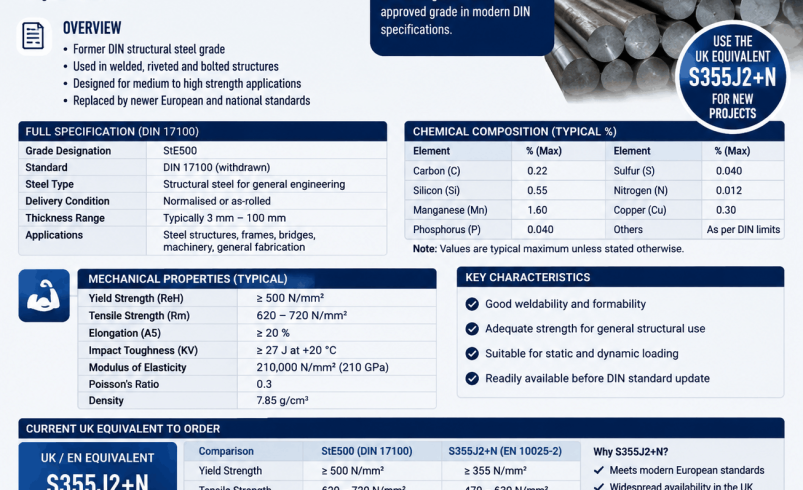
Where suppliers do provide a specification sheet for StE500, the figures generally quoted are:
These figures sit neatly between the genuine DIN 17102 StE460 grade and the next tier up in EN 10025-3, which is worth bearing in mind if you’re trying to match an old drawing or specification that references StE500 to a real, currently available material.
Suppliers marketing StE500 typically describe it as suitable for the following applications:
These are exactly the same applications the genuine DIN 17102 grades and their EN successor grades are used for, which reinforces that StE500 is being marketed as sitting within that same family, even without appearing in the official standard itself.
For UK and EU projects, DIN 17102 has been withdrawn and replaced by BS EN 10025-3, which covers normalised and normalised-rolled weldable fine grain structural steels. The genuine DIN grade closest to StE500’s claimed properties is StE460, and its confirmed modern equivalent under BS EN 10025-3 is S460N (or S460NL for improved low-temperature toughness).
S460N has a minimum yield strength of 460 MPa for thinner plate, a tensile strength range of roughly 540 to 720 MPa, and a maximum carbon equivalent value (CEV) of 0.45%, which keeps it easily weldable without special preheating for most thicknesses. If a spec sheet, drawing, or supplier quote says StE500, the safest move for a current UK project is to ask your structural engineer whether S460N or S460NL is the grade actually intended, since that’s the standard genuinely available and certified today.
If you’re working from an older German drawing and need to match different DIN 17102 grades to current EN 10025-3 equivalents, the mapping generally runs like this:
If you’re sourcing plate from a supplier quoting StE500 specifically, a few practical checks are worth doing before you commit to an order.
Prices for structural steel plate change often depending on global steel markets, so always get a current quote from the supplier rather than relying on older published price lists.
StE500 is a name used by some steel suppliers, mostly export-focused mills, to describe a high-strength low-alloy structural steel plate with a claimed yield strength of around 500 MPa. It’s marketed as part of the DIN 17102 family, though that exact grade doesn’t appear in the official standard.
No, not officially. The real DIN 17102 standard runs from StE255 up to StE460, with no StE500 step in between, according to published steel mill comparison charts. Treat any StE500 datasheet as a supplier’s own extension of the naming system rather than a recognised standard grade.
The closest confirmed UK and EU equivalent is S460N, or S460NL for better low-temperature toughness, both specified under BS EN 10025-3. This is the standard you should ask your supplier or engineer about if you’re trying to match older StE-branded material.
Suppliers typically market it for bridge structures, overhead cranes, pressure vessels, and heavy vehicle or machine tool components. These are the same applications covered by the genuine StE460 grade and its S460N successor.
Only if the supplier can provide proper certification against a recognised standard such as BS EN 10025-3, and your structural engineer confirms it’s suitable. Building Regulations sign-off generally requires traceable, standard-certified material rather than a grade name with no official specification behind it.
It’s most likely a naming choice by export-focused mills extending the familiar StE pattern to describe a steel in the 500 MPa yield class, rather than a deliberate attempt to mislead. That said, it still means the label alone tells you less than a proper mill certificate would.
StE460 is a genuine DIN 17102 grade with a confirmed 460 MPa minimum yield strength and a clear EN 10025-3 successor in S460N. StE500 is a higher claimed figure, around 500 MPa, but without the same standardised backing, so the two shouldn’t be treated as equally verifiable.