If you’ve just watched Scarlett Johansson turn into a wall-melting superbeing and thought “hang on, what am I actually watching?”, you’re not alone. The lucy film genre question comes up constantly, because Luc Besson’s 2014 film refuses to sit still in one box. The short answer: Lucy is a science fiction action thriller, with heavy doses of philosophy and a fair bit of gangster-movie DNA thrown in for good measure.
That’s the label on the tin, but it doesn’t tell you whether the film’s any good, whether the science makes sense, or whether it’s safe to watch with your teenager. This review covers all of that, using UK ratings, UK release details, and the cast list, so you don’t need to open five more tabs afterwards.
Quick answer: what genre is Lucy?
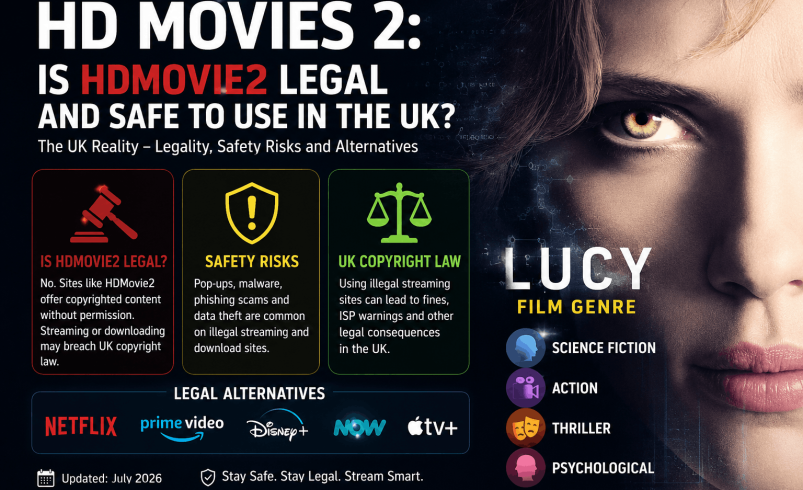
Lucy is officially classed as a science fiction action film. Rotten Tomatoes and most UK listings tag it as Action, Sci-Fi and Thriller, and that three-word combination is genuinely the most accurate description going.
The official genre breakdown
Here’s how the major databases categorise it:
- Rotten Tomatoes: Action, Mystery & Thriller, Sci-Fi
- IMDb: Action, Sci-Fi, Thriller
- BBFC: no genre tag, but certified 15 for strong violence
- AllMovie and Wikipedia: French-American science fiction action film
Luc Besson wrote and directed it for his own studio, EuropaCorp, and it was produced by his wife, Virginie Besson-Silla. That matters for genre because Besson’s back catalogue (Léon, The Fifth Element, Nikita) all share the same DNA: European arthouse instincts bolted onto Hollywood-scale action. Lucy is that formula pushed to its most extreme.
Why Lucy blends so many genres
The first act plays like a Taipei-set crime thriller, complete with a Korean gangster boss and a terrified drug mule. Once the drug leaks into Lucy’s bloodstream, the film shifts gears into body-horror-adjacent sci-fi, then spends its final third as a trippy, almost art-house meditation on consciousness and time.
One reviewer on TV Tropes even called it a “science fiction/superhero/action/gangster film”, and honestly, that’s fair. Lucy is a 2014 science fiction, superhero, action and gangster film directed by Luc Besson, starring Scarlett Johansson and Morgan Freeman. It’s rare for a 90-minute film to touch that many genres without feeling like a mess, though plenty of critics would argue it does become one by the final act.
[Table: Genre comparison across IMDb, Rotten Tomatoes, and AllMovie]
Lucy (2014) at a glance
| Detail | Info |
| Director | Luc Besson |
| Writer | Luc Besson |
| Starring | Scarlett Johansson, Morgan Freeman, Choi Min-sik, Amr Waked |
| UK release date | Friday, 22 August 2014 |
| BBFC rating | 15 |
| Runtime | 89 minutes |
| Budget | $40 million |
| Worldwide box office | Over $469 million |
| Genre | Science fiction, action, thriller |
Worth noting: the US release was three weeks earlier, on 25 July 2014, which is why some American reviews will feel slightly out of step with the UK cinema dates if you’re checking anniversaries or box office windows.
Plot summary (no major spoilers)
Lucy, played by Johansson, is an American student living in Taipei who gets tricked by her boyfriend into delivering a briefcase to a supposed business contact. That contact turns out to be a brutal gang boss, and Lucy is abducted and surgically implanted with a package of a powerful synthetic chemical so she can be used as a drug mule.
The package leaks. What follows is Lucy gradually shedding her physical, mental and emotional limits, and Morgan Freeman turning up as a neuroscientist to explain, at length, what’s happening to her brain. A French police captain gets pulled into the chase too, and things escalate from a gritty thriller into something closer to full-blown metaphysics.
It’s a simple premise dressed up in increasingly wild visuals. That’s part of the charm and part of the problem, depending on your patience for exposition-heavy dialogue.
Full review: is Lucy actually any good?
Short version: yes, if you switch your brain off (ironic, given the plot). It’s a genuinely entertaining 89 minutes, but it’s held together by style rather than logic.
What works
The pacing is relentless. Besson doesn’t waste time on scene-setting, and the film’s lean runtime means it never overstays its welcome, something a lot of modern blockbusters could learn from. Johansson is doing something quietly interesting here too, playing a woman becoming less human scene by scene, which she’d go on to explore again in later roles.
Roger Ebert’s site put it well, describing the film as stranded somewhere between a stranger-in-a-strange-land action thriller and apocalyptic science fiction. That in-between quality is exactly what makes it distinctive rather than forgettable.
The car chase through Paris is the standout action sequence. It’s shot with real stunt work rather than wall-to-wall CGI, and it gives the film a physical weight that some of the later “Lucy becomes a god” scenes lack.
What doesn’t work
The villains are paper-thin. Once Lucy starts gaining powers, the Korean gang chasing her stops feeling like a real threat and becomes little more than target practice, which drains the tension out of the second half.
The dialogue between Lucy and Professor Norman gets repetitive fast. Morgan Freeman spends a lot of screen time essentially narrating the plot to the audience, which works for the first two conversations and then starts to feel like padding. Critics were split hard on this: Rotten Tomatoes sums up the consensus as enthusiastic and silly, powering through the movie’s logic gaps with cheesy thrills and Johansson’s charm, which is about as balanced a take as you’ll find.
The science: fact or fiction?
This is the gap most reviews skip past quickly, and it’s worth slowing down on. The entire plot hinges on the idea that humans only use 10% of their brain, and that unlocking the rest grants superhuman abilities.
That premise is a myth. Neuroscientists have debunked it repeatedly: the film’s focus on the ten-percent-of-the-brain myth was a major point of criticism from critics who otherwise praised its themes, visuals and Johansson’s performance. Brain scans show we use virtually all of our brain over the course of a day, just not all at once, and different regions light up for different tasks.
So if you’re watching Lucy expecting hard science fiction grounded in real neurology, you’ll be disappointed. It’s closer to fantasy wearing a lab coat. That’s not necessarily a criticism, plenty of great sci-fi bends real science for effect, but Lucy leans on the myth so heavily that it’s worth going in knowing the premise is fiction dressed up as fact.
Cast and performances
Scarlett Johansson carries the film almost single-handedly. Her performance shifts from panicked, frightened student in the opening scenes to an eerily calm, near-emotionless being by the final act, and that transformation is the most convincing thing in the movie.
Morgan Freeman plays Professor Norman, the neuroscientist whose lectures give the plot its (shaky) scientific backbone. It’s a role he could do in his sleep, and by his own admission it’s mostly exposition, but his voice adds gravity the script doesn’t always earn on the page.
Choi Min-sik, best known internationally for Oldboy, plays Mr Jang, the gang leader. He’s genuinely menacing in the early scenes, though the script doesn’t give him much to do once Lucy’s powers kick in.
Other names worth knowing: Amr Waked as Captain Pierre Del Rio, Julian Rhind-Tutt as an underworld contact, and Analeigh Tipton as Lucy’s flatmate Caroline.
Where does Lucy sit in the sci-fi action genre?
If you’re trying to place Lucy against other films for comparison, it sits closest to Limitless (the “unlock human potential” premise) crossed with the trippy final act of a film like Akira. One blogger made this exact comparison, arguing Lucy started off like Luc Besson’s version of 2001: A Space Odyssey or The Tree of Life, with an early scene of a prehistoric human drinking from a pond before jumping through fast-forwarded images of human evolution.
Where it differs from something like Limitless is commitment. Limitless keeps its hero recognisably human throughout. Lucy goes all the way, turning its lead into something closer to a deity by the credits, which is either the film’s boldest choice or its biggest overreach, depending who you ask.
Fans of hard sci-fi (Arrival, Annihilation) will likely find Lucy too silly. Fans of action-first blockbusters with a sci-fi coat of paint will probably have a great time.
BBFC rating: is Lucy suitable for kids?
No. Lucy carries a BBFC 15 certificate, meaning it’s rated 15 by the British Board of Film Classification, so it’s not legal to sell or rent to anyone under that age in the UK, and cinemas should have enforced the same rule on release.
The content justifying that rating includes strong violence (people impaled, surgical scenes, a fatal car chase with numerous crashes), some strong language, and one unsettling early scene involving recently killed bodies. There’s nothing sexual beyond a brief lead-up moment before Lucy’s abduction, but the violence is frequent enough that it’s genuinely not one for younger teens, whatever the pace and spectacle might tempt you to think.
Critic and audience scores
Scores are mixed, which tracks with everything above. On Rotten Tomatoes, Lucy holds a 67% Tomatometer score from critics, against a noticeably lower 47% audience score from over 100,000 ratings. That gap is unusual, critics were generally more forgiving of the film’s silliness than the general public.
On Metacritic, reviews describe it in similarly divided terms, with one critic noting that the film’s junk doesn’t entirely eclipse the moments when the weirdness genuinely works. It’s very much a love-it-or-hate-it film rather than a consensus pick, and IMDb’s own comment section backs that up, describing it as movie marmite, where you’ll either love it or hate it.
Where to watch Lucy in the UK
Streaming availability shifts often, so treat this as a starting point rather than gospel. As of writing, Lucy is available on Netflix UK, confirmed as available to watch on Netflix in the UK, with the standard subscription covering it.
If it’s not on your Netflix account when you check, JustWatch UK is the quickest way to confirm current options: it also lists it as available to buy on Amazon Video, Sky Store, Apple TV Store and Rakuten TV, or to rent through Apple TV Store, Rakuten TV and Amazon Video. Rental prices for a film this age typically sit in the £3.49 to £4.99 range in the UK, with buying usually costing a bit more, but always check the actual price before you commit, since these change regularly and vary by platform.
FAQs
What genre is the film Lucy?
Lucy is a science fiction action film with strong thriller elements. It’s officially tagged as Action, Sci-Fi and Thriller by Rotten Tomatoes and IMDb, and it’s produced by French studio EuropaCorp, giving it a European arthouse edge you don’t always get in Hollywood blockbusters of the same type.
Is Lucy based on a true story?
No. The film’s central idea, that humans use only 10% of their brain and can unlock superhuman powers by accessing the rest, is a popular myth with no basis in neuroscience. Lucy uses this as a jumping-off point for fiction, not fact.
Is Lucy appropriate for a 13 year old?
No, not officially. The BBFC rated Lucy 15 for strong violence, meaning it’s not suitable, or legally sellable, to anyone under 15 in the UK. The violence includes surgical scenes, a fatal car chase and a stabbing sequence.
How long is the film Lucy?
Lucy runs for 89 minutes in its UK theatrical cut, making it one of the shorter mainstream action films of the 2010s. Some listings round this up to 90 minutes, but the official UK runtime is 89.
Who plays Lucy in the 2014 film?
Scarlett Johansson plays the title role of Lucy, opposite Morgan Freeman as Professor Norman. Choi Min-sik and Amr Waked round out the main cast as the gang leader and the French police captain respectively.
Is Lucy worth watching in 2026?
Yes, if you enjoy stylish, fast-paced sci-fi action and don’t mind logic gaps. It’s aged reasonably well as a piece of pure entertainment, even though its core science premise has been thoroughly debunked since release.
Did Lucy do well at the box office?
Very well. Made on a $40 million budget, it grossed over $469 million worldwide, making it one of the more profitable original (non-franchise) action films of the mid-2010s.
Is there a Lucy 2 sequel?
No official sequel exists as of this update. There’s been occasional talk from fans and in comment sections about a follow-up, but nothing has been confirmed by Besson, EuropaCorp or Universal.