
JFC Meaning: What Does JFC Mean in Text and Online Slang?
- August 10, 2026
- 0
If you’ve just seen “JFC” in a text, a comment or a group chat and you’re wondering what it means, here’s the answer straight away. The jfc meaning



9621 Agnes Crossing, Lake Suzanneview, New Mexico Island 84604-9295.
If you’ve just seen “JFC” in a text, a comment or a group chat and you’re wondering what it means, here’s the answer straight away. The jfc meaning
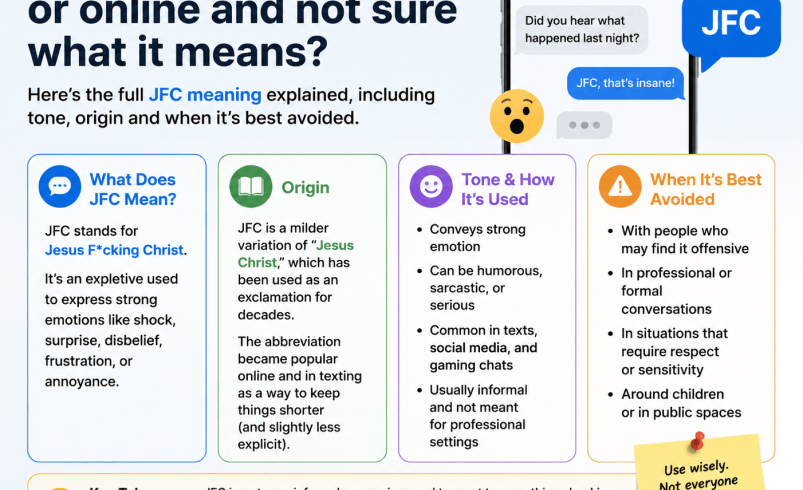
If you’ve just seen “JFC” in a text, a comment or a group chat and you’re wondering what it means, here’s the answer straight away. The jfc meaning is “Jesus f***ing Christ,” a strong, exasperated exclamation used to express shock, frustration or disbelief. It’s blunt and it swears, so it’s the kind of phrase reserved for informal chats with people who won’t mind the language. Below, we’ll cover the full jfc meaning, where it came from, and when it’s worth reaching for something milder instead.
The jfc meaning is direct: it stands for “Jesus fing Christ,“a strong exclamation used when something’s genuinely frustrating, shocking or hard to believe. It works similarly to “oh my God,” just noticeably more forceful because of the swear word built into it.
You’ll usually see it written as:
Whichever way it’s written, the underlying jfc meaning stays the same.
In texting, the jfc meaning shows up as a quick, emotional reaction to something unexpected, annoying or genuinely shocking, rather than a considered response.
Examples:
It’s a fast way of expressing a strong reaction without needing to explain the feeling in full sentences, similar to how someone might mutter under their breath in person.
The phrase “Jesus f***ing Christ” itself has been recorded as an exclamation of frustration, disgust or anger since at least the 1920s, well before texting existed. The shortened jfc slang version came later, spreading through online forums from at least the early 1990s, with an Urban Dictionary entry appearing as early as 2003.
As texting and social media grew, jfc carried across naturally from early internet forums into everyday messaging, joining other emotionally charged abbreviations like “wtf” and “omg.” It’s remained popular for the same reason those have: it packs a strong reaction into just a few characters.
Not necessarily. While the jfc meaning is rooted in frustration, the exact tone shifts depending on the situation it’s used in.
Example: “JFC, this queue is never ending” is annoyed but light hearted, while “JFC, are you serious?” after genuinely bad news carries a much heavier tone. Reading the rest of the message usually makes the intended emotion clear.
Because the jfc meaning is built from a swear word combined with a religious reference, it carries real weight and can come across as offensive in the wrong setting. It’s considered vulgar slang rather than mild texting shorthand, and some people find the religious element disrespectful regardless of the context it’s used in.
It’s generally fine among close friends who swear casually and won’t take issue with the language. It’s a different story in family group chats, workplace messages, or conversations with people who hold religious beliefs that make this kind of phrase genuinely upsetting rather than just a bit much.
The jfc meaning is fine for personal texting between friends, but it’s best avoided entirely in professional settings. Typing “JFC, this meeting is dragging on” in a work Slack or Teams channel can come across as unprofessional and disrespectful, even among colleagues who know each other well.
If frustration needs expressing at work, milder alternatives like “honestly, this is dragging” or a simple “unbelievable” get the point across without the swearing or the religious reference.
If the jfc meaning fits the moment but the language doesn’t suit the setting, there are a few softer options that carry a similar tone:
These work well in mixed company, family chats, or any setting where the full jfc phrase would feel like too much.
Beyond one to one texting, the jfc meaning shows up constantly in online comment sections, particularly on platforms like Reddit and X, where it’s often used as a standalone reaction to a post, screenshot or piece of news. It functions almost like a punchline or a quick gut reaction, similar to replying with just “wow” but with considerably more force behind it.
In meme culture specifically, jfc often gets used slightly tongue in cheek, reacting to something mundane as if it were genuinely dramatic. “JFC, the bus was two minutes late” plays on the gap between the phrase’s real intensity and a fairly minor complaint, which is part of why it’s stuck around as a joke format as well as a genuine exclamation.
JFC sits alongside a handful of other exclamations that borrow religious language to express strong emotion, and it’s worth knowing how they compare:
Because JFC combines both a swear word and a religious reference, it tends to land as one of the stronger options in this family of exclamations, which is exactly why context matters so much before using it.
[Table: Term | Meaning | Typical tone | Example]
JFC stands for “Jesus f***ing Christ,” a strong exclamation used to express frustration, shock or disbelief. It’s common in casual texting and social media but carries real weight because of the swearing and religious reference.
It carries the same meaning regardless of who sends it. Between friends who swear casually, it’s usually just a quick, emotional reaction to something annoying or surprising.
Yes, it can be, since it combines a swear word with a religious reference. It’s generally fine among close friends comfortable with that kind of language, but it can genuinely offend people in more formal or religious contexts.
As slang, JFC works similarly to “oh my God” but with far more intensity, thanks to the profanity built into it. It’s used to react to frustrating, shocking or unbelievable situations.
It depends entirely on the family. Some households swear casually and wouldn’t blink at it, while others, particularly those with religious beliefs, may find the phrase genuinely disrespectful.
“Unbelievable,” “seriously?” or “OMG” all express similar frustration or shock without the swearing or religious reference, making them safer for mixed company or formal settings.
No, the tone can range from irritated to shocked to jokingly exaggerated, depending on the situation and the rest of the message. It’s rarely used calmly, but the specific emotion behind it varies.
The full phrase has been used as an exclamation of frustration since at least the 1920s, while the shortened jfc slang version spread through internet forums from the early 1990s onwards, becoming common in texting as messaging apps grew.