If you’re searching “barndominium Michigan,” you probably want a straight answer on price first. A finished barndominium in Michigan typically runs $85 to $200 per square foot, with most owners landing somewhere between $180,000 and $400,000 for a 2,000 to 2,500 square foot home once land, foundation, and finishes are included. A bare kit shell alone costs far less, usually $20 to $50 per square foot, but that number doesn’t cover interior work, utilities, or the land itself.
Michigan has become one of the more active barndominium markets in the Midwest, thanks to cheap rural land in the north, a strong DIY culture, and a state building code that’s a bit more forgiving of post-frame construction than people expect. This guide covers real cost numbers, where to buy land, which builders operate here, how financing actually works, and the permit rules that trip up first-time buyers.
What Exactly Is a Barndominium?
A barndominium (or “barndo”) is a home built on a post-frame or metal-frame structure, the same basic system used for agricultural pole barns, but finished out as a full residence with bedrooms, bathrooms, a kitchen, and HVAC. Many designs keep an attached shop, garage, or barn section alongside the living space, which is part of the appeal for buyers who want a workshop, horse stalls, or an RV bay under the same roof.
They’re not the same as a converted actual barn, and they’re not a commercial pole building with a bed shoved in the corner. Lenders and insurers care about that distinction, so it’s worth getting the terminology right from day one.
How Much Does a Barndominium Cost in Michigan?
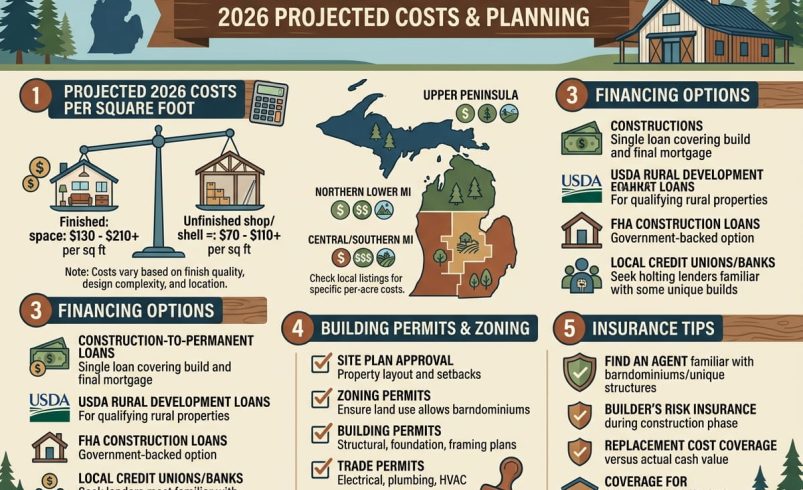
Nationally, barndominium costs sit in the $65 to $200+ per square foot range for a finished home, with a rough national average total cost around $230,000. Michigan tends to sit in the middle to upper part of that range rather than the bottom, mainly because of two things: deeper frost-depth foundations and a heavier insulation spec for the state’s winters. Both add real cost that a builder in a warmer state simply doesn’t carry.
Here’s a rough breakdown by size, based on current 2026 national cost data adjusted for the extra foundation and insulation work Michigan requires:
- Kit versus finished build. A shell kit is $20 to $50 per square foot. Adding plumbing, electrical, drywall, cabinets, and flooring is what pushes the total up toward $150 to $200+.
- Shop or garage space. Unfinished shop square footage costs a lot less than living space, since it skips insulation and interior finish work. This is one of the real financial advantages of the format.
- Foundation depth. Michigan’s frost line means footings need to go down a minimum of 42 inches below finished grade, deeper than in most southern states, which adds concrete and labour cost.
- Roofing choice. Metal roofing runs $6 to $25 per square foot versus $4 to $6 for asphalt shingles, but it holds up better against Michigan snow load.
Land, site work, well, septic, and a driveway are separate from all of the above, so budget those on top rather than assuming the kit price is your finish line.
Land Prices for a Barndominium in Michigan
Where you buy matters almost as much as what you build. Michigan land prices swing hugely by region:
[Table: Michigan region vs typical land price per acre – suggested rows: Upper Peninsula: $1,000-$4,500 | Northern Lower Peninsula: $1,800-$4,500, more for lakefront or river frontage | Mid-Michigan (Gladwin, Clare area): $2,550-$4,078 | Southern Michigan farmland (Lenawee, Hillsdale): $6,000-$15,000 | West Michigan near Grand Rapids: rising fast due to metro growth]
Statewide, the average asking price across all listed land is around $30,921 per acre, though that figure is skewed upward by smaller, developed parcels near cities. The median is closer to $12,679 per acre, and a nice wooded 10-acre parcel up north typically sells in the $35,000 to $58,000 range, or roughly $3,500 to $5,800 per acre. If you’re set on the Upper Peninsula, remote non-agricultural land can still be found for close to $1,000 to $1,200 per acre, though you’ll trade that low price for distance from services.
If you’d rather buy a barndominium that’s already built with land included, there were 46 such listings across Michigan at the time of writing, averaging $803,593. That figure includes some larger acreage and luxury builds, so smaller starter properties do exist below that average.
Michigan Barndominium Builders and Kit Companies
A handful of companies specialise in this style of build across the state:
- DC Structures builds custom barndominiums designed around Michigan’s four-season climate, using kiln-dried lumber and upgraded insulation packages.
- Michigan Barndominium Co, based in the Lansing area, focuses on custom design and financing help, and can be reached directly for a quote.
- Michigan Barndominiums (run by the McGuckin family, a Southeast Michigan construction business with decades of history) quotes custom builds from around $250,000 up to $1.5 million and beyond depending on size and finish.
- My Barndo Plans / Post-Frame.com and similar kit suppliers sell pre-engineered packages aimed specifically at Michigan’s snow and wind loads.
- Local licensed post-frame builders, some with 30-year track records, work county by county and are often a better fit for buyers who want a smaller, simpler build without the marketing gloss of the bigger firms.
Get at least three quotes before committing. Ask each builder directly whether their plans have already been stamped by a Michigan-licensed engineer, since that single question saves weeks at the permit office later.
Building Codes, Permits, and Zoning in Michigan
This is the part most barndominium guides skip, and it’s exactly where buyers get stuck.
Permits You’ll Actually Need
Michigan runs on a version of the Michigan Residential Code, enforced locally by your township or county building department. A barndominium built as a full-time residence needs a building permit, plumbing permit, electrical permit, and mechanical permit, plus a zoning compliance permit before any of that. You’ll also need a Certificate of Occupancy before you can legally move in, and occupying the home without one is technically a violation of state law. Temporary Certificates of Occupancy are available if part of the home is finished and safe to live in while work continues elsewhere.
Small detached accessory structures of 200 square feet or less are exempt from needing a building permit under the Michigan Residential Code, but that exemption does not apply once the structure becomes a lived-in home, and zoning rules still apply either way.
Frost Depth and Foundations
Michigan requires foundations to extend a minimum of 42 inches below finished grade to get below the frost line. Skipping this is the single most common mistake in DIY post-frame builds, since a shallow footing will heave and crack as the ground freezes and thaws every winter.
Post-Frame Construction and Engineering
Here’s the detail almost nobody mentions: Michigan’s Building Code was written around conventional light-frame construction, and post-frame (pole barn) buildings don’t fit neatly into it. In practice, this means most local building departments will require your barndominium plans to carry the stamp of a licensed Michigan engineer or architect, with full structural calculations, before they’ll issue a permit. Some Michigan building officials have said openly that the code simply can’t be applied to post-frame construction without that extra engineering step, so don’t expect to submit a generic kit brochure and get a same-day approval.
Budget for this. An engineer’s stamp and calculations are a real line item, not a formality, and skipping ahead without one is the fastest way to get a plan rejected at review.
Financing a Barndominium in Michigan
Getting a mortgage for a barndominium is harder than for a standard house, mostly because appraisers struggle to find comparable sales nearby and some big banks simply don’t have a policy for metal-frame or mixed-use homes. It’s not impossible, though.
USDA Loans
If your land sits in a USDA-eligible rural area (a lot of Michigan does), a USDA construction loan is often the strongest option. It requires no down payment, carries a 1% upfront guarantee fee plus a 0.35% annual fee, and rolls straight into a 30-year mortgage once the build is done, using a single closing rather than two separate loans. The catch is household income limits, generally capped at 115% of your area’s median income, and not every lender offers this product, so you’ll need to shop around.
Conventional and Construction-to-Permanent Loans
Most barndominium buyers end up with a construction-to-permanent loan from a local bank, credit union, or Farm Credit lender rather than a national chain. Expect to put down at least 20%, sometimes more if you’re buying raw land and building at once. A detailed, itemised cost breakdown and a licensed builder on paper both improve your approval odds noticeably.
FHA, VA, and Other Routes
FHA loans are possible for buyers with lower credit scores or a smaller deposit, and VA loans can work for eligible veterans, though both depend on finding a lender willing to underwrite the property type. Home equity loans and personal loans exist as fallback options too, though personal loans carry higher interest rates and shorter terms.
Insurance for a Michigan Barndominium
Barndominiums aren’t uninsurable, but they do confuse some agents who hear the word “barn” and picture an agricultural building rather than a finished home. The fix is documentation: photos, floor plans, and a clear statement of use (full-time residence, not a working farm) go a long way with underwriters.
Companies like Foremost (a Farmers Insurance subsidiary) and American Family have more experience writing policies for non-traditional homes than a standard local agent might. During construction, you’ll likely need builder’s risk insurance to cover materials and the unfinished structure, and many lenders require proof of it before releasing funds. If your shop space gets used for a side business or houses farm equipment, mention that upfront, since undisclosed commercial use is a common reason claims get denied later.
Best Places in Michigan to Build
Climate suits barndominium construction well across the whole state, provided the insulation and roofing spec matches the season swing from humid summers to sub-zero winters. That said, a few regions stand out for different reasons:
- Northern Lower Peninsula (Gladwin, Clare, Oscoda) offers the best balance of affordable acreage and reasonable drive times to towns, popular with hunters and lake-adjacent buyers.
- Southeast Michigan (around Lansing and the Detroit exurbs) has the most established barndominium builders and the shortest wait times for permits, but land costs more.
- West Michigan near Grand Rapids is seeing rapid price growth as the metro area expands, so buy sooner rather than later if that’s your target.
- Upper Peninsula wins on price alone, with land as cheap as $1,000 to $1,200 per acre in remote spots, but expect longer waits for materials, fewer local contractors, and a harsher build season.
Buying an Existing Barndominium vs Building New
Buying one already built sidesteps the permit and engineering headache entirely, and with an average of $803,593 across the 46 Michigan listings live at the time of writing, there’s a real market to browse. The tradeoff is choice: you’re picking from what’s on the market rather than designing your own layout, and financing an existing barndo purchase can still hit the same appraisal-comp problem as new construction.
Building new gives you full control over layout, shop size, and finish level, plus the option to phase the interior work over time to spread out cost. It also means living through the permit and engineering process described above, which realistically adds two to four months before you break ground.
FAQs
Is it legal to build a barndominium in Michigan?
Yes. Barndominiums are legal across Michigan, but they must meet the Michigan Residential Code, local zoning rules, and typically require engineer-stamped structural plans since standard code sections were written for conventional framing, not post-frame construction.
How much does a barndominium cost to build in Michigan?
Expect $85 to $200 per square foot for a finished home, or roughly $180,000 to $400,000 for a 2,000 to 2,500 square foot build once land, foundation, and interior finishes are included. Kit shells alone run $20 to $50 per square foot.
Can you get a USDA loan for a barndominium in Michigan?
Yes, provided the land falls within a USDA-eligible rural area and your household income sits at or below 115% of the local median. USDA construction loans need no down payment but carry a 1% upfront fee and 0.35% annual guarantee fee.
Do barndominiums hold their value in Michigan?
They can hold or grow in value, particularly in rural areas where demand for spacious, affordable rural housing is strong. Resale depends heavily on finding buyers who understand the format, which is easier now than it was five years ago.
Is it hard to insure a barndominium in Michigan?
It can take more effort than insuring a standard house, mainly because some agents aren’t familiar with the property type. Working with an insurer experienced in non-traditional or rural homes, and documenting the build clearly, usually solves the problem.
What’s the frost depth requirement for a Michigan barndominium foundation?
Foundations must extend a minimum of 42 inches below finished grade to get below Michigan’s frost line. Shallower footings risk cracking and heaving as the ground freezes each winter.
Do I need a permit for a barndominium in Michigan?
Yes, if it’s used as a residence. You’ll need a building permit, zoning compliance permit, and separate plumbing, electrical, and mechanical permits, plus a Certificate of Occupancy before you can legally move in.
Where is the cheapest land in Michigan for a barndominium?
The Upper Peninsula offers the lowest prices, with remote non-agricultural parcels available from around $1,000 to $1,200 per acre, though you’ll trade that for distance from towns and a shorter building season.