
Baking Soda for a Pool: Does It Really Work? UK Guide
- August 20, 2026
- 0
If you’ve got a cloudy pool, stinging eyes after a swim, or a test kit reading that looks off, you might be wondering whether baking soda for a



9621 Agnes Crossing, Lake Suzanneview, New Mexico Island 84604-9295.
If you’ve got a cloudy pool, stinging eyes after a swim, or a test kit reading that looks off, you might be wondering whether baking soda for a
If you’ve got a cloudy pool, stinging eyes after a swim, or a test kit reading that looks off, you might be wondering whether baking soda for a pool is a genuine fix or just an internet myth. It’s real: baking soda, chemically known as sodium bicarbonate, raises total alkalinity and gives your pool’s pH something to hold steady against, which is why it’s the active ingredient in most shop-bought “alkalinity increaser” products.
It won’t fix chlorine problems, algae, or a filter that’s on its last legs. But when your alkalinity has dropped too low, which is one of the most common causes of pH swings, itchy skin, and metal corrosion in UK garden pools and hot tubs, baking soda is a genuinely useful, cheap tool. This guide covers exactly how it works, how much to add, and where people go wrong.
Baking soda is sodium bicarbonate (NaHCO₃), a mildly alkaline compound with a pH of around 8.3. When you add it to pool water, it raises total alkalinity, the water’s ability to resist sudden pH changes, and it gently nudges pH upward too, though far more slowly than alkalinity.
Think of total alkalinity as a buffer, almost like a shock absorber for your pool’s pH. Without enough of it, adding chlorine, rain, sweat, sun cream, or fresh tap water can send your pH bouncing up and down unpredictably. That instability is what causes cloudy water, chlorine that doesn’t work properly, and equipment that corrodes faster than it should.
This is exactly why baking soda for a pool works as a fix for low alkalinity specifically. It doesn’t sanitise the water, it doesn’t kill algae, and it won’t clear up a pool that’s green from neglect. Its whole job is stability.
Yes, in most cases. Many commercial alkalinity increaser products sold by UK pool suppliers, including Certikin’s SwimFresh range and various own-brand products, list sodium bicarbonate as their sole active ingredient. Baking soda and swimming pools have been paired together for decades for exactly this reason: it’s the same chemical, just sold under a pool-branded label with dosing instructions on the tin.
The main practical differences are granule size and packaging. Pool-grade sodium bicarbonate is usually a coarser, free-flowing granule designed to dissolve evenly without clumping, whereas ordinary bicarbonate of soda from the baking aisle is a finer powder. Both work chemically. We’ll cover the cost comparison properly further down.
Total alkalinity measures the concentration of bicarbonates, carbonates and hydroxides in your water, expressed in parts per million (ppm) or milligrams per litre (mg/l), which are the same thing. It’s a different measurement from pH, even though the two are closely linked. A pool can have a “correct” pH reading of 7.4 and still be unstable if alkalinity is too low, because there’s nothing holding that pH in place.
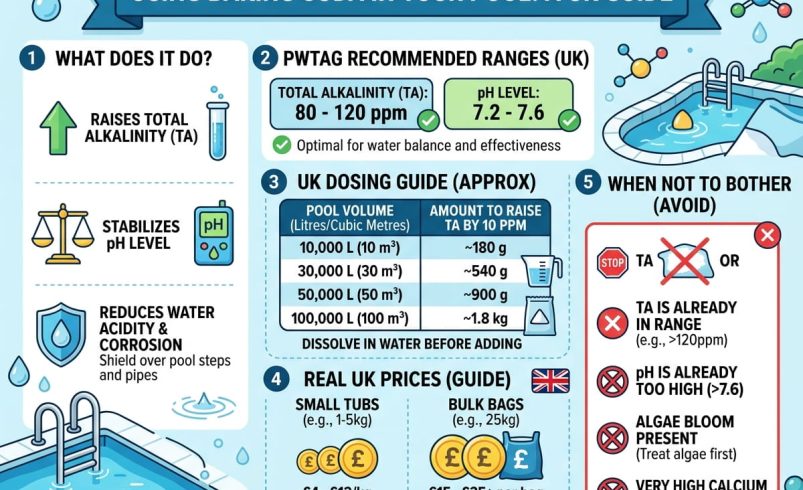
The Pool Water Treatment Advisory Group (PWTAG) is the closest thing the UK has to an official standard for pool water chemistry, and its guidance is treated as best practice by pool operators nationwide in the absence of specific legislation. <cite index=”102-1″>PWTAG recommends maintaining total alkalinity between 80 and 150 mg/l (ppm), with pH kept between 7.2 and 7.6.</cite> <cite index=”102-1″>Free chlorine should sit between 1.0 and 3.0 mg/l for outdoor pools and 1.0 to 2.0 mg/l for indoor pools, with combined chlorine kept below 0.5 mg/l.</cite>
Most UK pool chemical suppliers aim for a slightly tighter band in practice. Several products, including one 5 kg alkalinity increaser sold by Pool Pro, recommend a working range of 80 to 120 ppm for total alkalinity alongside a free chlorine target of 1.5 to 3 ppm for pools and 3 to 5 ppm for hot tubs. Both ranges sit comfortably within PWTAG’s wider guidance, so you’re not going wrong following either one.
Always test before adding anything. A basic test strip kit costs around £6 to £12 from most UK pool suppliers, while a liquid or photometer-based kit gives more accurate readings for total alkalinity specifically, since strips can be less precise at the higher end of the scale.
You need this in cubic metres or litres to dose correctly. For a rectangular pool, multiply length by width by average depth, all in metres, and that gives you cubic metres directly (one cubic metre equals 1,000 litres). A typical UK garden pool measuring 8m by 4m with an average depth of 1.35m holds roughly 43 cubic metres, or 43,000 litres.
There’s no single universal figure here, because granule size and purity vary slightly between brands, but a widely used rule of thumb converts to roughly 1 kg of sodium bicarbonate per 38 cubic metres to raise total alkalinity by about 12 ppm. Several UK pool-chemical brands quote a similar working rate of around 1 kg per 50 cubic metres as a general dosing guide, so treat any figure as a starting point rather than gospel, and always check your specific product’s label.
Dissolve the required amount in a bucket of pool water first rather than tipping powder straight in, since this helps it disperse evenly and stops it settling as a layer on the pool floor. Add it slowly around the edge of the pool with the pump and filter running.
Let the pump circulate for several hours, ideally overnight, before testing again. Total alkalinity doesn’t respond instantly, and testing too soon often leads people to over-dose because the reading hasn’t caught up yet.
This is where people sometimes go wrong. If your total alkalinity is already above 150 ppm and you add more baking soda anyway, thinking it can only help, you’ll push it higher still. High alkalinity causes its own problems: cloudy water, scale build-up on tiles and pipework, and a pH that becomes stubbornly resistant to correction with normal doses of acid.
If your alkalinity is too high, baking soda is not the answer. You’ll need a pH reducer, typically dry acid (sodium bisulfate) or muriatic acid, dosed carefully to bring both pH and alkalinity back down together. This is genuinely one of the more fiddly bits of pool chemistry, so if you’re not confident, it’s worth asking a local pool shop to check a water sample rather than guessing.
Soda ash, or sodium carbonate, is a different compound often confused with baking soda because both are white powders sold near each other in pool chemical ranges. Soda ash has a much higher pH, around 11.6 compared to baking soda’s 8.3, which means it raises pH far more aggressively while only nudging alkalinity slightly.
Use baking soda when alkalinity is low but pH is close to where you want it. Use soda ash when pH itself has crashed and needs a stronger push upward. Mixing the two up is a common reason people find their pool chemistry harder to balance than it should be.
Yes, chemically it’s identical, and this is where you can genuinely save money. Regular UK supermarket bicarbonate of soda is the same compound as pool-grade alkalinity increaser: sodium bicarbonate, full stop. The catch is quantity and cost per kilogram once you scale up to pool-sized doses.
Supermarket bicarbonate of soda typically costs around £3.25 per kg at the cheapest UK outlets, based on current pricing across major supermarkets, though smaller 200g tubs of branded bicarbonate work out considerably more expensive per kilogram. Bulk cleaning-grade bicarbonate from online retailers can come down to roughly £5 per kg in 1 kg bags, which sounds cheaper on the label but is actually pricier per kilo than the supermarket’s own-brand baking aisle stock.
Compare that with pool-specific products: a 5 kg tub of dedicated TA (total alkalinity) increaser from a UK pool supplier costs around £13.95, working out to roughly £2.79 per kg, genuinely on par with or cheaper than most supermarket bicarbonate once you account for pack size. For anyone treating a decent-sized garden pool regularly, buying a pool-labelled bulk bag or tub is usually the more practical option, since you avoid emptying a dozen small supermarket tubs and get clearer dosing instructions on the packaging.
The same chemistry applies to hot tubs, though the numbers and stakes are different because of the smaller water volume and higher temperature. Hot tubs typically run a higher chlorine target of 3 to 5 ppm compared with a standard outdoor pool, so it’s worth checking your product’s specific hot tub guidance rather than assuming pool figures apply directly.
Inflatable and small above-ground pools, hugely popular across UK gardens every summer, follow the same alkalinity principles but need much smaller doses given their modest volume. A typical 3m inflatable pool holds somewhere around 4 to 5 cubic metres, meaning even a tablespoon or two of baking soda can shift alkalinity noticeably, so measure carefully rather than guessing with a scoop.
Adding it without testing first. Guessing wastes money and can tip alkalinity too high, creating a new problem instead of solving the original one.
Confusing it with soda ash or shock treatment. Baking soda doesn’t sanitise water and won’t clear algae or kill bacteria; it only affects alkalinity and, gently, pH.
Dosing all at once for a big correction. Large single doses can overshoot the target and cause cloudiness, so splitting a big adjustment across two smaller doses over a couple of days is usually the safer approach.
Ignoring pool volume. Doses are calculated per cubic metre or per litre, so an inaccurate volume estimate throws every subsequent calculation off.
Not retesting before adding more. Alkalinity changes take hours to show fully in a test reading, and adding a second dose too early risks overcorrecting.
Baking soda, or sodium bicarbonate, raises total alkalinity in pool water, which acts as a buffer to keep pH stable. Stable pH means chlorine works more effectively, swimmers experience less eye and skin irritation, and pool surfaces and equipment corrode more slowly.
A commonly used guide is roughly 1 kg per 38 cubic metres of water to raise total alkalinity by about 12 ppm, though exact rates vary between brands and products. Always test your water first, follow the specific product’s label, and retest before adding more.
Yes, it’s chemically the same compound as pool-grade alkalinity increaser. Supermarket bicarbonate typically costs around £3.25 per kg, which is broadly comparable to dedicated pool products once pack size and bulk pricing are accounted for.
It raises pH, but only slightly and slowly compared with its effect on alkalinity. If your pH needs a stronger, faster push upward, soda ash (sodium carbonate) is the more appropriate product.
Sometimes, but only if the cloudiness is caused by low alkalinity destabilising the pH. If cloudiness is caused by algae, poor filtration, or high calcium hardness, baking soda won’t fix it and you’ll need a different treatment.
There’s no fixed schedule; it depends entirely on your test results. Most UK garden pool owners test weekly during the swimming season and only add alkalinity increaser when a reading falls below the target range.
It’s not dangerous to swimmers in the way an unbalanced chlorine level would be, but excess alkalinity causes cloudy water, scale build-up on pool surfaces and pipework, and a pH that becomes hard to adjust. If you’ve overdosed, a pH reducer is usually needed to bring both figures back down.
They do completely different jobs. Baking soda adjusts total alkalinity and pH stability, while pool shock is a strong dose of chlorine or non-chlorine oxidiser used to rapidly sanitise water and destroy algae or bacteria.