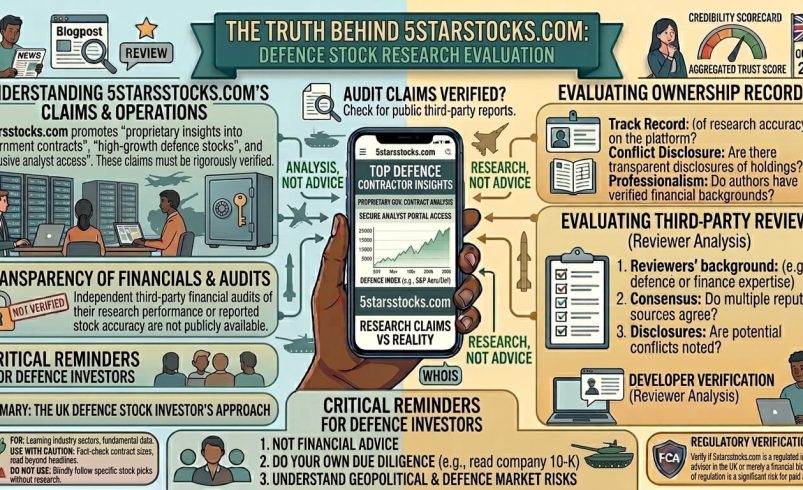
If you’ve searched 5starsstocks.com military expecting a dedicated defence stock tool, here’s the short version: 5StarsStocks.com is a general US stock-content blog, and “military” isn’t a distinct section on the site itself, it maps to the site’s broader Aerospace & Defense category. A cluster of unrelated blogs has since written near-identical “reviews” of a supposed 5StarsStocks.com Military feature, which is worth knowing before you rely on any of them.
This guide explains what’s actually on 5StarsStocks.com, why so many search results about it read the same, and then does the part none of them cover well: how a UK-based investor can actually research and access defence stocks, using real FTSE-listed companies, current spending figures, and UK-available funds rather than vague American blog content.
What Is 5StarsStocks.com?
5StarsStocks.com is a WordPress-run financial content site publishing general articles on dividend investing, growth stocks, sector overviews and trading platforms. It covers a wide range of themes including AI, healthcare, cannabis, blue chip and, under its Industry Sectors menu, Aerospace & Defense, alongside standard categories like Technology and Energy.
The site carries a disclaimer stating clearly that it is “not financial advice” and recommends readers consult a qualified financial adviser, pointing to the US Securities and Exchange Commission (SEC) and FINRA for further reading. That’s worth flagging immediately for a UK audience: those are American regulators, not the Financial Conduct Authority, and the site shows no sign of being written with UK investors, UK tax wrappers, or the London Stock Exchange in mind.
Why “5starsstocks.com military” Doesn’t Point to One Clear Page
Searching this exact phrase turns up several different websites, none of them 5StarsStocks.com itself, each presenting what reads like a “review” or “guide” to a specific military-focused feature. On the actual 5StarsStocks.com site, there’s no menu item called simply “Military”; the nearest match is the Aerospace & Defense category under Industry Sectors, alongside similarly structured pages for Healthcare, Energy and Technology.
Several of these secondary sites describe near-identical claims, such as members getting access to “exclusive reports” and a trading community, phrases that don’t appear on 5StarsStocks.com’s own about page. Treat content on sites other than 5starsstocks.com itself with some caution, since they appear to be independently written blog posts targeting the search term rather than official coverage of the platform.
What 5StarsStocks.com’s Defence Coverage Actually Looks Like
Where the site does cover defence-related content, it sits inside its Aerospace & Defense sector page and its Stocks to Invest section, formatted the same way as its other sector pages: brief company overviews, general commentary on sector trends, and links to related articles.
There’s no indication of a members-only paywall, live data feed, or proprietary rating system specific to military stocks beyond the general “5-star” branding the site uses across every category. If you were expecting a specialised defence analytics tool, that’s not what this is; it’s blog-style content, the same as the rest of the site.
How to Judge Whether Stock Tip Content Like This Is Worth Your Time
A few quick checks apply to any stock content site, 5StarsStocks.com included, before you treat its picks as more than a starting point.
- Check who’s actually regulated. Publishing stock commentary doesn’t require FCA authorisation in the UK, but giving personalised investment advice does, so a general content site isn’t a substitute for regulated advice.
- Look for a clear “not financial advice” disclaimer and be wary of any site that doesn’t have one; 5StarsStocks.com does include one, which is a reasonable sign.
- Be sceptical of language promising guaranteed growth or “explosive returns”, phrases that appear on 5StarsStocks.com’s own promotional sections for other sectors.
- Cross-check any specific stock pick against a primary source, such as the London Stock Exchange listing or the company’s own investor relations page, rather than taking a blog’s word for it.
- Remember that past share price performance, which most of these articles lean on heavily, is not a guarantee of future results, a point 5StarsStocks.com’s own disclaimer makes as well.
Real UK Defence Stocks: What’s Actually Listed on the LSE
This is where a UK reader is better served looking past 5starsstocks.com military entirely and toward the London Stock Exchange directly. Several major UK-listed companies have meaningful defence exposure, and the sector has had a strong run through 2026.
BAE Systems (LSE: BA.) is the UK’s largest defence contractor, covering military aircraft, naval systems and cybersecurity, with a market capitalisation of roughly £67 billion. It’s the lead contractor on the Tempest sixth-generation fighter programme, which received £8.6 billion in funding over four years as part of the government’s Defence Investment Plan announced in mid-2026.
Rolls-Royce Holdings (LSE: RR.) is best known for civil aviation engines but has a substantial defence division, including a central role in Britain’s submarine programme, alongside its Small Modular Reactor work, which ties into national energy security.
Babcock International (LSE: BAB) is the second-largest supplier to the UK Ministry of Defence after BAE, providing engineering support for Royal Navy ships and submarines. It returned to the FTSE 100 after a strong recovery and posted underlying operating profit up 19% to £201 million in the six months to 30 September 2025, on revenue of £2.5 billion.
QinetiQ (LSE: QQ.) focuses on defence research and technology, including work on the DragonFire laser system the Royal Navy hopes to deploy from 2027, and has a market capitalisation of around £2.5 billion.
Chemring (LSE: CHG) is the smallest of this group at around £1.5 billion market cap, specialising in sensors, countermeasures and electronic warfare technology, with customers including NASA and SpaceX alongside UK and US governments.
Why UK Defence Spending Is the Backdrop to All of This
None of the generic “5starsstocks.com military” content mentions the actual UK policy driving this sector, which is a genuine gap worth filling. Chancellor Rachel Reeves confirmed UK defence spending will rise to 2.6% of GDP by April 2027, and the government’s Defence Investment Plan announced in the summer of 2026 included a further $20 billion (roughly £15.8 billion) uplift, which lifted the FTSE 350 Aerospace & Defence index by almost 5% in a single trading session.
That’s the kind of UK-specific, dated detail that determines how these companies actually perform, and it’s simply absent from content written for a general or American audience.
Defence ETFs Available to UK Investors
If picking individual defence stocks feels like more risk than you want to take on, a defence-focused ETF spreads that risk across many companies in one trade. Several are accessible through UK brokers and listed on the London Stock Exchange.
The VanEck Defense UCITS ETF (ticker DFNS) tracks the MarketVector Global Defense Industry index, has a total expense ratio of 0.55% a year, and held around €6.3 billion in assets as of July 2026. The iShares Global Aerospace & Defence UCITS ETF and the newer iShares Europe Defence UCITS ETF (DFEU) offer similar diversified exposure, while the WisdomTree Europe Defence UCITS ETF focuses specifically on European names.
As with any ETF, check the total expense ratio, whether it accumulates or distributes income, and its exact index methodology before buying, since “defence ETF” isn’t a single standardised product across providers.
Risks Specific to Defence Investing
Defence stocks aren’t immune to the usual market risks, and they carry a few of their own worth knowing.
Revenue is contract-based and lumpy. Babcock’s own recent history shows how the timing of a single large contract win or loss can move results significantly, so quarter-to-quarter numbers can look choppy even when the long-term trend is positive.
Currency exposure exists even in “UK” names. Chemring generates a meaningful share of revenue in US dollars, so a UK investor holding the stock is also taking on some dollar exchange rate risk alongside the underlying business risk.
Geopolitical news cuts both ways. Defence shares fell when Israel and Hamas reached a ceasefire in October 2025, a reminder that this sector can move on news that has nothing to do with a company’s own results.
Execution risk is real. Several UK defence contractors, Babcock included, have histories of cost overruns or delivery problems on major contracts, which is a company-specific risk no amount of sector-level optimism removes.
Checking Any Platform Before You Invest Through It
Whether you’re buying an individual stock, an ETF, or acting on a tip from any content site, run the same basic check first: search the firm you plan to invest through on the FCA’s Firm Checker at register.fca.org.uk, and check the FCA Warning List at fca.org.uk/consumers/warning-list-unauthorised-firms for the platform name specifically. Dealing with an unauthorised firm means losing access to the Financial Ombudsman Service and the Financial Services Compensation Scheme if something goes wrong.
This applies regardless of where you first heard about a stock, including from a UK-authorised platform’s own research, a US blog, or a specialist ETF provider’s factsheet.
FAQ
Is 5StarsStocks.com a scam?
There’s no clear evidence it’s a scam; it’s a general stock-content blog with a standard “not financial advice” disclaimer and references to the SEC and FINRA. It isn’t a regulated broker or adviser, and it isn’t built for a UK audience, so treat its content as general reading rather than a source to act on directly.
Does 5StarsStocks.com have a dedicated military stocks section?
Not as a standalone feature; the closest match on the site itself is the Aerospace & Defense category under Industry Sectors, covered in the same blog-post format as its other sectors. Several unrelated third-party sites describe a more elaborate “military” feature that doesn’t match what’s actually on 5starsstocks.com.
What are the best UK-listed defence stocks?
BAE Systems, Rolls-Royce, Babcock International, QinetiQ and Chemring are the most commonly cited UK-listed defence companies, spanning aircraft, naval systems, submarines, defence technology and electronic warfare respectively. Each carries different risk and size characteristics, so “best” depends on your own risk tolerance and time horizon.
Is there a UK defence ETF?
Yes, several UCITS-compliant defence ETFs are available through UK brokers, including the VanEck Defense UCITS ETF, iShares Global Aerospace & Defence UCITS ETF, and WisdomTree Europe Defence UCITS ETF. Compare their expense ratios and exact holdings before choosing one, since they don’t all track the same index.
How much is the UK increasing defence spending by?
The UK government has committed to raising defence spending to 2.6% of GDP by April 2027, with a Defence Investment Plan announced in mid-2026 adding a further $20 billion (around £15.8 billion) in funding, including £8.6 billion specifically for the Tempest fighter programme. These figures come directly from government announcements rather than from any stock-tip site.
Are defence stocks a safe investment?
No investment is risk-free, and defence stocks carry sector-specific risks including lumpy contract-based revenue, currency exposure on international sales, and share price moves tied to geopolitical news rather than company performance. They’ve performed strongly through 2026 on rising government spending, but past performance doesn’t guarantee future results.
Where can I check if a stock platform is authorised in the UK?
Use the FCA’s Firm Checker at register.fca.org.uk to confirm a platform is authorised, and cross-check the FCA Warning List for any name you’re unsure about. Only authorised firms give you access to the Financial Ombudsman Service and FSCS protection if something goes wrong.