
Best E-Bike Brands 2026: The Full UK Buyer’s Guide
- August 20, 2026
- 0
Trying to work out the best e bike brands can feel harder than it should be, since the market now spans everything from £600 direct-to-consumer imports to £4,000



9621 Agnes Crossing, Lake Suzanneview, New Mexico Island 84604-9295.
Trying to work out the best e bike brands can feel harder than it should be, since the market now spans everything from £600 direct-to-consumer imports to £4,000
Trying to work out the best e bike brands can feel harder than it should be, since the market now spans everything from £600 direct-to-consumer imports to £4,000 Bosch-powered machines from established cycling names. The short answer is that there’s no single best brand, it depends on your budget and how you’ll use the bike, but Cube, Specialized and Giant lead on premium quality, Raleigh and Brompton lead on established UK reputation, and ADO, Engwe and Eskute lead on value for money.
This guide breaks the UK e-bike market into clear tiers, covers what actually separates a good brand from a risky one, explains the UK’s electric bike law in plain terms, and looks at how the Cycle to Work scheme changes the maths on a new purchase. By the end, you’ll know which tier suits your budget and which specific brands are worth your shortlist.
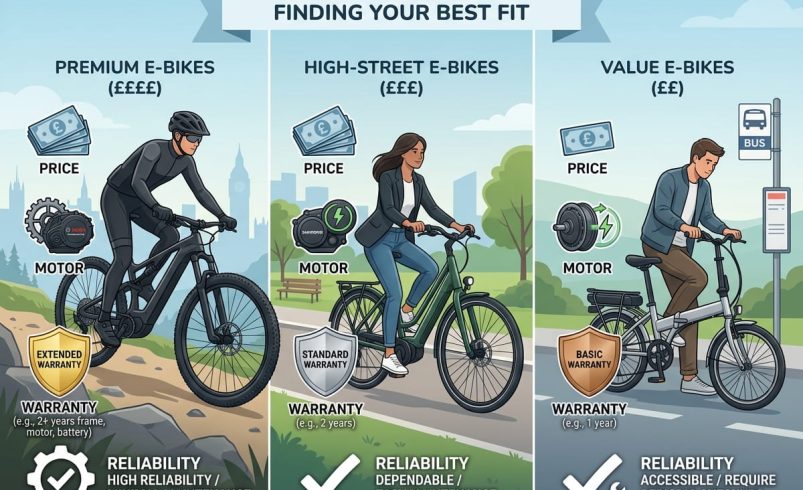
UK e-bike brands split cleanly into three groups, and understanding which one you’re shopping in makes the rest of the decision far easier.
Premium motor-brand bikes use proven Bosch or Shimano drive systems and typically start around £1,800 to £2,500. High-street brands sold through Halfords and Decathlon offer convenient in-store support at a mid-range price. Value direct-to-consumer brands sell online, often shipped from Asia-based manufacturers, and compete almost entirely on specification per pound. None of these tiers is objectively “better,” they suit different priorities, and a £700 direct-brand bike can be a genuinely good choice if you understand what you’re trading off against a £2,200 Bosch-powered one.
These names built their reputation on traditional bicycles long before electric versions existed, and it shows in frame quality and dealer support. Cube, Giant and Specialized typically start around £1,800 to £2,500, and the price buys long-term reliability, a proper UK dealer network for servicing, and a Bosch or Shimano mid-drive motor rather than a cheaper hub motor. If something goes wrong three years in, you can generally walk into a local bike shop and get it looked at, which matters more than most first-time buyers expect.
Raleigh remains one of the most recognised names in British cycling, and its e-bike range, including the Bosch-powered Motus, sits firmly in the premium bracket. It’s a sensible pick for riders who want a refined, long-distance ride and don’t mind paying for it.
For folding bikes specifically, Brompton Electric sits in a category of its own, typically priced around £3,800 to £4,200. It keeps the fold-into-train-luggage feature that made the standard Brompton famous, while adding a 250W motor and battery, making it a genuine option for commuters who combine cycling with rail travel.
Gocycle is a UK-founded brand known for carbon-fibre frames, its patented PitstopWheels, and some of the lightest, most compact folding e-bikes on the market. It’s a strong choice if portability and design matter as much as raw spec.
If you’d rather see and test a bike in person before buying, Halfords stocks Carrera, Pendleton and Voodoo e-bikes, while Decathlon sells its own B’Twin range. These brands sit in the middle price bracket and offer the convenience of in-store help, finance options and local servicing without the premium dealer markup of Cube or Specialized.
They’re a sensible middle ground for buyers who want to physically try a bike, get advice from staff, and have a nearby shop to return to if something needs adjusting, without committing to premium pricing.
This is where the UK market has changed most in the last two years. A genuinely good electric bike now costs under £1,000, with a quiet 250W motor, disc brakes, and on the better models, a torque sensor and belt drive that used to only appear on bikes twice the price. ADO in particular has built a strong reputation, with independent reviewers naming the ADO Air among the best all-round electric bikes in the UK for 2026, pairing a maintenance-free carbon belt drive with a sub-19kg weight.
Engwe and Fiido compete heavily on cargo and commuter models, often undercutting premium brands by £1,000 or more for broadly comparable range and motor power. Eskute has built a similar following around straightforward, well-specified hybrid and step-through e-bikes.
The trade-off with value brands is generally service network size and resale value, not day-one build quality, which has improved enormously across this tier. If something breaks outside warranty, you’re more likely relying on the manufacturer directly rather than a local bike shop.
A brand is a long-term relationship, not just a one-off purchase, so a few things matter more than the headline spec sheet:
Whichever brand you choose, the bike itself needs to meet the UK’s legal definition of an EAPC (Electrically Assisted Pedal Cycle) to be ridden like a normal bicycle. The rules are consistent across every legitimate brand sold in the UK:
A 2024 government consultation looked at raising the motor limit to 500W and permitting twist-and-go throttles, but this was dropped in February 2025, so the 250W EAPC limit still applies in 2026. Separately, an Electrically Assisted Pedal Cycles Bill, introduced in Parliament in January 2026, aims to crack down on illegally modified “monster bikes” and the conversion kits used to exceed these limits, so buying from an established brand with genuine EAPC compliance matters more than ever if that bill progresses.
Bikes that exceed these limits are legally classed as mopeds or motorcycles, requiring registration, tax, insurance and a driving licence, none of which apply to a compliant EAPC from any of the brands covered above.
Most premium and mid-range e-bike brands, and plenty of value ones too, qualify for the Cycle to Work scheme, a salary sacrifice benefit available to PAYE employees whose employer participates. Savings typically range from 24% to 47%, depending on your salary and tax band, with repayment usually spread over 12, 18 or 24 months.
The key requirement is that the bike must be road-legal, meaning it meets the EAPC standard covered above. Providers like Cyclescheme, Vivup and Enjoy Benefits all support electric bikes, and most also cover commuting accessories like lights, locks and panniers as part of the same package. Check with your employer’s specific scheme provider before choosing a bike, since not every retailer works with every scheme.
There isn’t a single overall winner, since the right brand depends on budget and priorities. Cube, Giant and Specialized lead on premium build quality and dealer support, Raleigh and Brompton lead on established UK reputation, and ADO, Engwe and Eskute lead on value for money in the sub-£1,000 bracket.
Many value direct-to-consumer brands, including ADO, Engwe and Eskute, now offer genuinely solid build quality, with torque sensors and belt drives that used to only appear on far pricier bikes. The main trade-off tends to be service network size and long-term resale value rather than day-one reliability.
Budget around £500 to £900 for a capable first e-bike, £1,000 to £1,800 for better sensors, brakes and range, and £2,000 or more for a premium Bosch or Shimano mid-drive system. Below £500, compromises on battery quality and build tend to add up quickly.
No, as long as the bike meets the UK’s EAPC standard: a 250W motor, pedal-assist only, cutting out at 15.5mph. Compliant e-bikes are legally treated the same as ordinary bicycles, needing no licence, tax, insurance or registration.
A hub motor is built into the front or rear wheel and tends to be cheaper, while a mid-drive motor sits at the pedals and generally offers better balance and more natural power delivery, particularly on hills. Mid-drive systems from Bosch and Shimano are common on premium brands and are a big part of why those bikes cost more.
Yes, most road-legal (EAPC-compliant) e-bikes qualify, with savings typically between 24% and 47% depending on your salary and tax band. You’ll need to check with your employer which scheme provider they use, since not every retailer partners with every scheme.
Folding brands like Brompton Electric and Gocycle suit commuters who combine cycling with rail travel, while ADO and Engwe’s commuter models offer strong range and belt-drive reliability at a lower price point for road-only commutes. The right choice depends heavily on whether portability or raw value matters more to you.
No, modifying an e-bike beyond the 250W motor limit or the 15.5mph cut-off means it’s no longer a legal EAPC and instead falls under moped or motorcycle law, requiring registration, tax, insurance and a licence. A Bill introduced in Parliament in January 2026 specifically targets illegally modified bikes and the conversion kits used to create them.