Outdoor Rated Ethernet Cable: UK Buyer’s Guide 2026
- August 20, 2026
- 0
If you’re trying to get a reliable network connection out to a garden office, CCTV camera, or garage, the short answer is this: you need outdoor rated ethernet



9621 Agnes Crossing, Lake Suzanneview, New Mexico Island 84604-9295.
If you’re trying to get a reliable network connection out to a garden office, CCTV camera, or garage, the short answer is this: you need outdoor rated ethernet
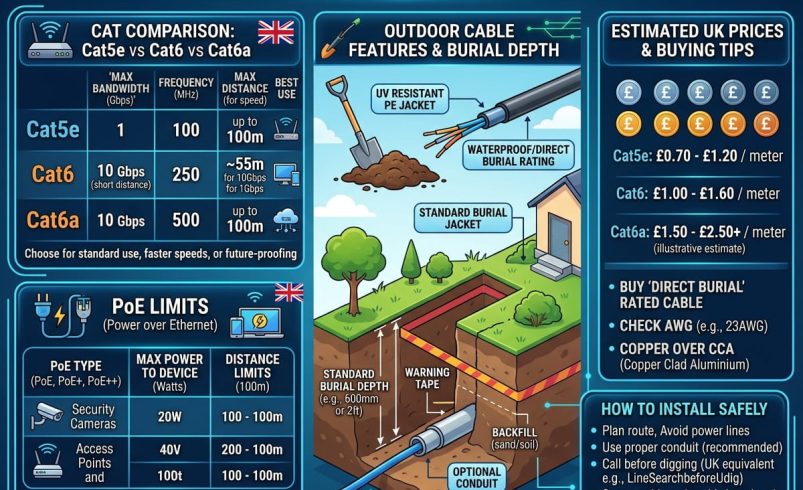
If you’re trying to get a reliable network connection out to a garden office, CCTV camera, or garage, the short answer is this: you need outdoor rated ethernet cable, not the standard cable already in your router box. Regular indoor cable uses a PVC jacket that cracks and lets in moisture within a year or two outside. Outdoor rated ethernet cable uses a UV-resistant polyethylene (PE) jacket built to survive sun, rain, and temperature swings, and it’s what every UK cabling supplier recommends for anything run outside a wall.
This guide covers how to pick the right category and construction, what it costs in the UK right now, how deep to bury it, the PoE distance limit that catches people out, and how to actually install it without a callout to an electrician. We’ll also flag the mistakes that shorten a cable’s life by years.
Why You Can’t Just Use Indoor Cable Outside
Standard indoor ethernet cable is jacketed in PVC, which is fine in a warm, dry house but breaks down quickly when exposed to UV light. Forum threads from UK installers back this up: some report indoor cable lasting 10 years outdoors if it’s out of direct sun, while others have seen the jacket crack and split within a couple of summers once it’s clipped to a wall in full sunlight.
Outdoor rated cable solves this with a low-density or high-density polyethylene (LDPE/HDPE) outer sheath, which resists UV breakdown, sheds water, and copes with the -20°C to 60°C range that a UK garden realistically sees across the year. Many outdoor cables also add a gel filling between the pairs, which stops water tracking along the inside of the cable if the jacket is ever nicked or punctured.
If your run is short, fully shielded from sun and rain (inside a sealed conduit, for instance), you can sometimes get away with indoor cable. For anything clipped to a fence, run along a wall, or buried, outdoor rated cable is the only sensible choice.
The category number tells you the maximum speed and bandwidth, and it works exactly the same way outdoors as it does indoors. The outdoor rating is about the jacket, not the category, so you can buy any of the below in an outdoor-rated version.
Cat5e supports up to 1 Gigabit and is the cheapest option. It’s perfectly adequate for a single CCTV camera or a basic garden office connection where you’re not pushing large files.
Cat6 supports up to 10 Gigabit over shorter distances (roughly 55 metres) and drops back to reliable Gigabit performance over the full 100 metre run. This is the sensible middle ground for most UK home installs in 2026, and it’s what most outdoor cabling suppliers stock as their main line.
Cat6a maintains full 10 Gigabit speeds across the complete 100 metre run and offers better resistance to interference thanks to thicker conductors and, often, additional shielding. Choose this if you’re future-proofing a long run to an outbuilding, or if the cable will run near power lines.
Unless your budget is very tight, Cat6 outdoor cable is the pick for most gardens, sheds, and garden offices. It costs a little more than Cat5e but gives you real headroom as home broadband speeds keep climbing.
Shielded vs Unshielded: Do You Need It?
Outdoor cable comes in unshielded (UTP) and shielded (F/UTP or F/FTP) versions. Shielding adds a foil layer around the pairs to block electromagnetic interference from nearby power cables, motors, or radio equipment.
For most UK garden runs, unshielded cable is fine, because you’re not usually running parallel to mains cabling for any distance. If your ethernet run does cross or run alongside an armoured power cable, particularly for more than a metre or so, shielded cable is worth the extra cost, and it’s the safer default for any commercial or long building-to-building run.
You’ve got three realistic options for getting cable from A to B outside: clip it above ground, run it through conduit, or bury it directly.
Above ground (clipped or cable-tied) is the easiest and cheapest method. Use cable clips rated for the cable diameter, keep runs away from areas where they’ll be caught by strimmers or foot traffic, and route them under eaves or fence tops where possible to reduce direct UV exposure.
Conduit protects the cable from physical damage and makes future replacement far easier, since you can pull a new cable through without digging again. It’s the recommended approach if you’re burying cable, even if the cable itself is rated for direct burial, because trunking gives you a route to add or replace cables later without another trench.
Direct burial cable is built with a gel-filled core and a thicker jacket specifically designed to go straight into the ground without conduit. It costs more per metre than standard outdoor cable, but for a one-off garden run it can work out cheaper overall once you factor in the price of conduit and fittings.
There’s no single legal depth requirement written specifically for low-voltage data cable like ethernet, unlike mains electrics. For guidance, most UK cabling installers borrow the same principle used for buried power cables under BS 7671 regulation 522.8.10: the cable should sit at a depth where it’s unlikely to be disturbed by ordinary digging, gardening, or foot traffic.
In practice, that means:
Lay a strip of warning tape roughly 150mm above the cable so anyone digging later gets a warning before they reach it, and keep the cable well clear of any water pipes or gas lines already buried in the same area. If you’re at all unsure where existing services run, use a cable avoidance tool or call before you dig.
PoE and Maximum Cable Length: The 100 Metre Limit
Whatever category you choose, ethernet has a hard limit of 100 metres per unbroken run, and this applies whether you’re carrying data alone or Power over Ethernet (PoE) to a camera or access point. Go beyond that and you’ll see data errors, and PoE devices will start losing power before they lose signal, since voltage drop over the copper becomes the limiting factor.
If your garden office or camera location is further than 100 metres from your router or switch, you’ve got three options: fit a PoE extender partway along the run (which effectively resets the 100 metre limit from that point), install a second PoE switch closer to the far end, or, for very long runs over 200 to 300 metres, switch to a fibre link with a media converter at each end.
For most UK gardens this won’t be an issue since few plots exceed 100 metres end to end, but it catches people out on larger properties, smallholdings, or when routing cable in a long loop rather than a straight line.
No. Ethernet cable carries extra-low voltage data signal (and, with PoE, a small DC current), so unlike mains power cabling it doesn’t fall under Part P of the Building Regulations and doesn’t legally require a qualified electrician to install. You can dig the trench, lay the conduit, and terminate the RJ45 connectors yourself.
That said, if your installation runs anywhere near existing mains electrical cabling, whether that’s crossing an SWA (steel wire armoured) supply to a shed or running parallel to garden lighting, it’s worth having an electrician check the layout, particularly the separation distance between the two cables, before you backfill the trench.
The cable itself is only half the job. Every join, socket, and connector exposed to the weather needs its own protection, because water ingress at a connection point is the most common failure in outdoor networking setups.
Use IP-rated enclosures at both ends of an outdoor run wherever the cable terminates into a switch, camera, or wall socket that isn’t already weatherproof. Look for IP65 or higher for anything in direct rain exposure.
Choose waterproof RJ45 connectors if you need a join partway along a run rather than one continuous cable. These use a rubber gasket and screw-down boot to seal the connection, and they’re worth the small extra cost over a standard crimped joint left exposed.
Seal cable entry points into any outdoor enclosure or building wall with silicone sealant or a proper cable gland, so water can’t track in along the outside of the cable jacket.
Prices vary by retailer and change often with stock and promotions, so treat these as a general guide rather than fixed figures, and check current pricing before you buy.
As a rough benchmark from UK cabling suppliers in mid-2026:
On top of the cable itself, budget for RJ45 connectors (a few pence to a couple of pounds each), a crimping tool if you don’t already own one (around £15 to £30), cable clips or conduit, and any waterproof enclosures at each end.
A handful of errors account for most outdoor ethernet failures reported by UK installers and forum users:
Yes, outdoor rated cable works fine indoors, though it’s usually more expensive and the thicker, stiffer jacket can make it harder to route through walls or tight spaces. Some outdoor cables also don’t meet indoor fire safety ratings for cavity or plenum spaces, so check the fire rating if you’re running it inside walls.
Cat6 is the better all-round choice for most UK installs, offering more bandwidth headroom and stronger performance for CCTV, PoE devices, and future upgrades. Cat5e is cheaper and still perfectly usable for basic connections like a single camera or a light-use garden office link.
A good quality UV-resistant outdoor cable, correctly installed, typically lasts 15 to 25 years, and buried cable in conduit often lasts even longer since it’s shielded from UV entirely. Poor quality cable, or cable installed without adequate protection from sun and physical damage, can fail within a few years.
Either works, and burying isn’t a legal requirement for data cable in the UK. Above-ground runs are quicker and cheaper to install but more exposed to physical damage and UV over time, while burying (ideally in conduit) protects the cable and keeps your garden clear, at the cost of more upfront digging.
100 metres for a single unbroken run, regardless of category or whether you’re carrying PoE power alongside data. Beyond that you’ll need a PoE extender, an additional switch, or a fibre link with media converters.
Yes, as long as the cable and connected devices support a PoE standard (802.3af, at, or bt) and the run stays within 100 metres. Choose a cable rated for PoE use, usually stated on the product listing, since not every outdoor cable is tested for the extra current.
Not usually, unless it runs alongside or crosses mains power cabling, in which case shielded (F/UTP or F/FTP) cable reduces the risk of interference. For a typical garden run with no nearby power cables, unshielded outdoor cable performs just as well.
Yes. Direct burial cable has a thicker jacket and usually a gel filling between the pairs, specifically designed to resist moisture ingress if buried without conduit. Standard outdoor cable is rated for above-ground exposure to weather but isn’t built to withstand direct contact with soil over the long term.