
Pocket Coil Mattress Guide: What It Is & How to Choose (UK)
- August 20, 2026
- 0
If you’ve been told you need a “pocket coil mattress” but nobody’s explained what that actually means, here’s the short answer: it’s a mattress built from hundreds or



9621 Agnes Crossing, Lake Suzanneview, New Mexico Island 84604-9295.
If you’ve been told you need a “pocket coil mattress” but nobody’s explained what that actually means, here’s the short answer: it’s a mattress built from hundreds or
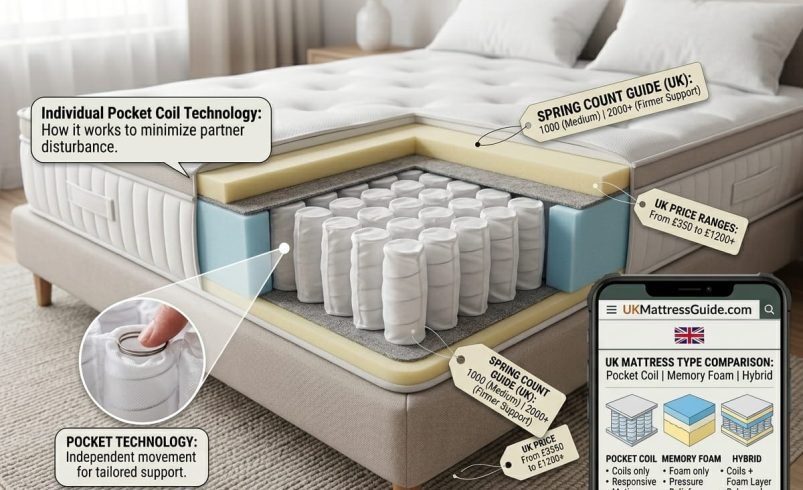
If you’ve been told you need a “pocket coil mattress” but nobody’s explained what that actually means, here’s the short answer: it’s a mattress built from hundreds or thousands of individual springs, each sewn into its own fabric pocket, so they move independently rather than as one connected unit. That independent movement is what gives a pocket coil mattress better support, less motion transfer, and a more targeted feel than older sprung mattresses. It’s also sometimes called a pocket sprung mattress, which is exactly the same thing under a different name.
This guide covers how pocket coil mattresses are made, what to look for when buying one, how they stack up against memory foam and hybrid beds, and what you’ll actually pay in the UK right now. We’ll also answer the odd questions that come up alongside this search, from Tempur’s warranty terms to whether memory foam camping mattresses are any good.
A pocket coil mattress (also called a pocket sprung or pocketed spring mattress) uses individually wrapped steel springs instead of one continuous wire frame. Each coil sits inside its own fabric pocket, and the pockets are joined together by stitching or glue along a length of fabric.
Because the springs aren’t wired to each other, they can compress on their own. Put your hip on one side of the bed and only the springs directly under your hip respond. The rest of the mattress stays flat. That’s the entire point of the design: personalised support across the whole sleeping surface, rather than one stiffness setting for two very different bodies sharing a bed.
This is different from an open coil (also called Bonnell) mattress, where springs are wired together into a single unit. Open coil beds are cheaper to make but the springs move as a group, so one person shifting position can rock the whole bed.
A pocket sprung mattress has three main parts:
The coil core. This is the support layer, made from anywhere between 600 and over 3,000 individually wrapped springs, depending on the model and mattress size. Manufacturers sometimes pack in extra “micro coils” or “mini pockets” near the surface for added contouring on top of the main support layer.
The comfort layer. Sitting above the springs, this is usually foam, wool, cotton, or latex, and it’s what determines how the mattress feels on first contact. A thin comfort layer feels firmer; a thick one feels plusher.
The cover. Most UK pocket sprung mattresses use a quilted, removable, or semi-removable cover, often finished with natural fibres like wool or cotton for breathability.
Retailers love to advertise spring counts because bigger numbers look impressive, but coil count on its own doesn’t tell you much. A king-size mattress with 1,500 well-made, correctly gauged springs will outperform one advertised at 3,000 springs of thin, low-grade wire. What actually matters is the spring gauge (thickness of the wire), the quality of the pocket fabric, and whether the tension has been matched to your body weight.
As a rough guide for a UK double or king:
This is the most searched comparison in UK mattress shopping, and honestly, neither wins outright. It depends on how you sleep and how warm you run at night.
Pocket sprung mattresses offer better airflow because the structure is mostly empty space between coils, so heat doesn’t build up the way it can with dense foam. They also give you more bounce, which makes changing position or getting out of bed easier, and many models offer stronger edge support, so the mattress doesn’t collapse if you sit near the side. They tend to suit back and stomach sleepers, heavier sleepers, and anyone who sleeps hot.
Memory foam mattresses mould closely to your body, which gives excellent pressure relief at the shoulders and hips, and they’re usually the better choice for absorbing a restless partner’s movement. The trade-off is heat retention (though gel and graphite infusions have improved this considerably) and a “stuck in the mattress” feel that some sleepers dislike.
A hybrid mattress combines a pocket coil base with a foam or latex comfort layer on top, which is why most UK bed-in-a-box brands now sell hybrids rather than pure foam or pure spring beds. If you can’t decide, a hybrid is the safer middle ground, though it usually costs more than either option alone.
On lifespan: memory foam typically holds up for 10 to 15 years, while pocket sprung mattresses more commonly last 8 to 10 years before the coils start to lose tension, although premium natural-fibre models can outlast that considerably with proper care.
UK mattress sizes are standardised, so a pocket coil mattress will come in the same sizes as any other type:
| UK size | Dimensions |
| Single | 90cm x 190cm |
| Small double | 120cm x 190cm |
| Double | 135cm x 190cm |
| King | 150cm x 200cm |
| Super king | 180cm x 200cm |
Firmness is usually rated on a scale from soft to extra firm, though there’s no legal standard behind these labels, so ratings vary between brands. As a general rule, side sleepers do better on softer to medium mattresses that cushion the shoulder and hip, while back and stomach sleepers usually need medium to firm support to stop the hips sinking out of alignment. If you’re unsure, medium-firm is the safest starting point and the most common recommendation across UK sleep guides.
You don’t need to spend four figures to get a genuinely good pocket coil or hybrid mattress in the UK. A quality double or king typically runs £300 to £700 at full price, with premium options stretching toward and occasionally past £1,000, mostly for natural-fibre fillings like wool, cashmere, or horsehair.
A few pointers that hold true across the market right now:
Because prices and promotions shift constantly, treat any figure here as a guide rather than gospel, and always check the retailer’s own site before you buy.
Tempur mattresses aren’t pocket coil mattresses. They’re built from proprietary viscoelastic foam with no springs at all, which is worth knowing if you’ve seen the brand mentioned alongside pocket coil searches. Still, the warranty question comes up often enough that it’s worth covering here.
In the UK, Tempur mattresses bought from 19 May 2016 onwards come with a 10-year quality guarantee, covering material defects that cause a visible indentation of more than 2cm in the foam. If you bought a Tempur mattress or bed base before that date, you may instead fall under the older Limited Guarantee, which requires you to pay a percentage of the replacement cost if a valid claim is made more than 5 years after purchase. In the US, Tempur-Pedic’s warranty terms differ by purchase date and can run up to 25 years on older mattresses, so don’t assume a figure you’ve read online applies to a UK purchase. Always check the guarantee documentation for the country where you bought the mattress, since terms genuinely differ between markets.
If you’ve come across the name “1-800-Mattress” while researching, it’s a US telephone mattress retailer and isn’t a brand or service available to UK shoppers. There’s no UK equivalent operating under that name, so if you’re comparing options in Britain, you’ll want to look at UK-specific retailers like John Lewis, Dreams, or the direct-to-consumer bed-in-a-box brands instead. It’s a common mix-up for anyone reading US mattress content alongside UK sources.
Slightly off the main topic, but it comes up in the same searches: memory foam camping mattresses are inflatable or foldable pads with a memory foam top layer, designed to bring some of that pressure-relieving comfort to a tent, campervan, or festival pitch.
They’re genuinely more comfortable than a basic air bed or foam roll mat, particularly for side sleepers or anyone with a bad back, and most fold or vacuum-pack down small enough to fit in a car boot. Prices in the UK start from around £50 to £60 for basic single-size pads, rising for double sizes or thicker builds. The trade-offs are weight (they’re heavier than an inflatable sleeping mat) and warmth underneath you, since memory foam alone doesn’t insulate against cold ground as well as a proper insulated sleeping mat does. If you’re wild camping in cold conditions, pair one with a groundsheet or insulating layer rather than relying on the foam alone.
A few habits noticeably extend the life of a pocket sprung mattress:
Yes. Pocket coil, pocket sprung, and individually pocketed spring mattress all describe the same construction: separate springs, each wrapped in its own fabric pocket, joined together in a single unit.
There’s no fixed minimum, but most quality UK mattresses sit between 1,000 and 2,000 coils for a double or king. Spring quality and gauge matter more than the raw number, so don’t choose on coil count alone.
Do pocket coil mattresses sleep hot or cold?
Around 8 to 10 years on average, though premium natural-fibre models with well-made springs can last considerably longer. Sagging, lumps, or springs you can feel through the surface are signs it’s time to replace it.
Most modern pocket sprung mattresses are one-sided and shouldn’t be flipped, only rotated head to foot. Check the care label, since flipping a one-sided mattress can damage the comfort layer.
Both can work, depending on your sleep position and the specific mattress firmness. Pocket sprung mattresses generally give firmer, more responsive support that suits back and stomach sleepers, while memory foam’s contouring often suits side sleepers who need extra cushioning at the shoulder and hip. A zoned hybrid, firmer at the lumbar and softer at the shoulders, is a common middle ground for lower back pain specifically.
Good-quality pocket sprung mattresses shouldn’t creak or squeak, since each spring moves independently inside its own fabric pocket rather than rubbing against a shared wire frame. Noise usually points to a worn-out or poorly made mattress rather than the pocket coil design itself.
A pure pocket coil (or pocket sprung) mattress uses springs as both the support and the near-surface comfort layer, sometimes with a thin foam or fibre topper. A hybrid specifically combines a pocket spring base with a thicker foam or latex comfort layer, usually 5cm or more, giving more of a foam feel on top of spring-based support underneath.