If you’re searching for outdoor apparel news because your usual waterproof jacket seems to have quietly changed itsfabric, or your local outdoor shop has vanished from the high street, you’re not imagining things. Two genuinely significant shifts are reshaping the sector right now: waterproof brands are phasing out PFAS “forever chemicals” from their jackets, and the UK’s outdoor retail landscape has consolidated hard, with Blacks and Millets shrinking dramatically as stores convert to Go Outdoors. Add in outdoor clothing crossing over into everyday fashion (so-called “gorpcore”), and a market that’s grown faster than almost anyone expected, and there’s a lot of real, UK-relevant outdoor apparel news to get through. Here’s what’s actually happening, with current prices and sources.
What “Outdoor Apparel News” Actually Covers Right Now
Search this phrase and you’ll mostly find American gear-review outlets covering trade shows and product launches aimed at a US audience. For UK readers, the outdoor apparel news that actually affects your next purchase falls into four areas: what your waterproofs are made of, which shops are still around to buy them from, how outdoor clothing is being worn outside of actual outdoor activities, and how much bigger (or smaller) your money goes than it did a year or two ago.
The Biggest Story: PFAS Are Being Phased Out of Waterproofs
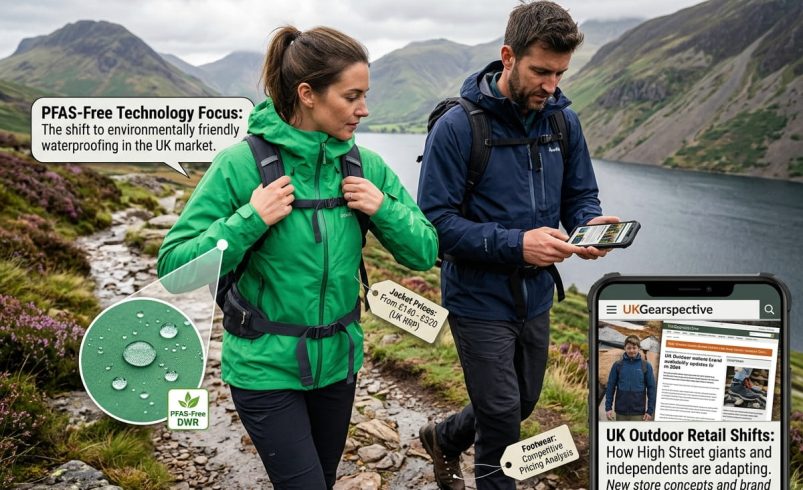
This is genuinely the most consequential outdoor apparel story running at the moment, and it affects almost every waterproof jacket you’ll consider buying. PFAS, also known as PFCs, are synthetic chemicals used in outdoor clothing for waterproofing, first developed in the 1930s and used widely in clothing since the 1960s, but their use carries a significant environmental impact.
What’s Replacing PFAS
PFAS-free jackets are no longer a niche category. In 2026 they represent the direction the outdoor industry is actively moving, driven by environmental regulations, brand commitments, and material innovations like GORE-TEX ePE. Brands have moved quickly. Rab’s Latok Mountain GTX Pro jacket uses the latest version of Gore-Tex Pro fabric, which contains no PFAS chemicals, while also being made almost entirely from recycled content. 66°North’s Tindur GTX Pro Jacket, priced at £710, is built with PFAS-free GORE-TEX Pro fabric, and Arc’teryx’s Beta SV, at £700, combines a 100-denier GORE-TEX PRO ePE shell with climbing-focused details. The North Face’s HKe Devils Thumb GTX Jacket, at £410, uses 100% recycled polyester taffeta.
Other brands that are already PFC-free include Paramo (since 2014), Alpkit, Finisterre, Fjällräven, and Lowe Alpine. If you want to check a specific brand before buying, look for a “PFC-free” or “PFAS-free” label directly on the product page.
Is There Actually a UK Ban on PFAS in Clothing?
Not yet, and this is worth being accurate about since a lot of coverage implies otherwise. The European Chemicals Agency is currently proposing to restrict the use of all PFAS across the EU, but there are no similar plans in the UK at the moment. Separately, US states including New York and California have banned the sale of apparel with intentionally added PFAS from 2025, with France passing a national ban on PFAS in clothing and textiles taking effect in 2026. So the UK move away from PFAS right now is being driven by brand choice and consumer demand rather than domestic law, which means it’s worth checking labels rather than assuming every jacket on a UK shelf is PFC-free.
UK Retail News: Consolidation on the High Street
If your local outdoor shop has disappeared or changed its signage recently, this is why. Blacks Outdoor Retail, owned by JD Sports Fashion plc, owns Blacks, Millets and Ultimate Outdoors, and as of May 2026 only 22 Blacks stores and 30 Millets stores remain open, with most having converted to Go Outdoors.
The JD Sports Numbers
JD Sports’ outdoor sector revenue came in at £502 million, down 7.6% compared to the previous year, with like-for-like revenue falling 5.8%, reflecting a challenging trading environment across both high street and online. The company has said Go Outdoors will keep expanding its larger “mega store” format, while a number of underperforming Blacks locations have been identified for closure over the medium term.
Cotswold Outdoor’s Rebrand
It’s not all contraction. Outdoor & Cycle Concepts, the British company behind Cotswold Outdoor, Runners Need and Snow + Rock, has rebranded as Cotswold Outdoor Group. The relaunch reflects a growing cultural shift where technical outdoor clothing and equipment increasingly shape everyday fashion rather than staying confined to trails and expeditions, and Blacks itself is repositioning from a traditional outdoor retailer into what it calls a curated, design-led destination.
The “Gorpcore” Trend: Why Everyone’s Wearing Hiking Gear
This ties directly into the retail shift above. Outdoor brands have noticed that a growing share of their customers are buying technical jackets and boots for city streets rather than mountains, and they’re adjusting ranges and marketing accordingly. This is part of why some long-time outdoor shoppers on forums have grumbled about ranges leaning toward plain black jackets aimed at casual buyers rather than technical colours aimed at serious hillwalkers, a genuine tension in how brands balance their two very different customer bases.
Market Size: How Big Is Outdoor Apparel Right Now
The growth behind all this isn’t small. According to Mordor Intelligence, the global outdoor apparel market was valued at USD 165.22 billion in 2025, growing to USD 174.45 billion in 2026, and is projected to reach USD 229.07 billion by 2031 at a 5.59% compound annual growth rate. A separate estimate from Grand View Research put the global market at approximately $14.8 billion with 5.4% annual growth through 2030, though the two figures likely use different market definitions, which is worth flagging honestly rather than treating either as the single definitive number.
The growth isn’t confined to one age group either. Older adults are hiking and cycling in greater numbers than previous generations did at the same age, while younger people are drawn to trail running, climbing, and backcountry camping as both physical pursuits and social activities.
New Technology Worth Knowing About
Beyond PFAS removal, a few genuinely new developments are worth tracking if you follow this space. Researchers at MIT have developed fibre computers that can be embedded in clothing for real-time health monitoring during activity, while scientists at the University of Waterloo have created fabrics that generate warmth using sunlight and change colour to signal temperature changes to the wearer. These are early-stage rather than something you’ll find on a UK shop shelf this year, but they signal where the next wave of technical fabric innovation is heading.
Second-Hand and Repair: The Other Big Shift
Alongside new materials, there’s a genuine move toward keeping existing kit going rather than replacing it. Cotswold Outdoor reported recycling more than 1,800kg of outdoor kit in a recent year as part of a wider sustainability push. This mirrors what’s happening more broadly across the sector, where repair services, trade-in schemes, and reproofing products (Nikwax being the most widely known name in the UK) are being marketed as seriously as new product launches, partly a genuine sustainability shift and partly a response to shoppers cutting back on discretionary “treat” purchases.
Where to Follow Genuine Outdoor Apparel News
Most of what ranks for this exact phrase is American gear-testing journalism, which is useful for product reviews but won’t tell you much about UK retail or UK-specific stock and pricing. For genuinely UK-relevant coverage, a few sources are consistently reliable:
- Which? publishes independent testing and consumer guidance on waterproof jackets and PFAS, including UK-specific regulatory context.
- UKHillwalking.com carries active community discussion and gear feedback from actual UK hillwalkers, which is useful for real-world durability opinions rather than marketing copy.
- OutdoorsMagic tests and reviews current-season jackets with UK pricing and UK trail conditions in mind.
- RetailTimes and similar trade publications cover the business side, store closures, rebrands, and ownership changes, which general gear sites rarely touch.
FAQS
Are UK waterproof jackets PFAS-free now?
Not universally. There’s no UK ban on PFAS in clothing at the moment, so while many major brands, including Rab, Paramo, Alpkit, and Fjällräven, have gone PFC-free voluntarily, it’s still worth checking the label on any specific jacket before assuming it’s free of forever chemicals.
Is PFAS-free waterproofing as good as traditional waterproofing?
It’s close but not always identical. Newer PFAS-free membranes like GORE-TEX ePE and Columbia’s OutDry Extreme perform well and are improving quickly, though some reviewers note they’re not quite on par with older PFAS-based treatments in the very harshest conditions, and proper care and reproofing still matters for longevity.
Why have so many Blacks and Millets stores closed?
Blacks Outdoor Retail, owned by JD Sports, has been converting underperforming Blacks and Millets stores into the larger Go Outdoors format, leaving only a small number of standalone Blacks and Millets locations open as of mid-2026. This reflects wider pressure across JD’s outdoor retail division, where revenue and like-for-like sales both declined over the past year.
What is “gorpcore” and why does it matter for outdoor apparel?
Gorpcore refers to technical outdoor clothing, hiking boots, waterproof shells, fleece being worn as everyday streetwear rather than for actual outdoor activities. It matters commercially because it’s reshaping how some retailers design and market their ranges, sometimes at the expense of the more technical options serious hillwalkers are looking for.
How big is the global outdoor apparel market?
Estimates vary depending on methodology, but one widely cited figure from Mordor Intelligence puts the global market at $174.45 billion in 2026, projected to reach $229.07 billion by 2031. Different research firms define the category differently, so treat any single figure as an estimate rather than a fixed number.
Which UK brands are PFC-free already?
Paramo has been PFC-free since 2014, and Alpkit, Finisterre, Fjällräven, and Lowe Alpine are also confirmed PFC-free by independent testing from Which?. Checking a brand’s own sustainability or materials page is the most reliable way to confirm current status, since formulations do change.
Is it worth buying second-hand outdoor clothing instead of new?
Many outdoor shoppers are already doing this, partly for cost reasons and partly for sustainability, and retailers have responded with recycling and trade-in schemes rather than resisting the trend. If you go this route, check waterproof garments carefully for worn-out DWR coating, since reproofing (with something like Nikwax) can restore performance on an otherwise sound older jacket.