


Living Room Storage Ideas for UK Homes: TV Stands & More
- August 20, 2026
- 0
If you’ve searched for living room storage because your lounge is drowning in remotes, cables, and games consoles, the fix usually comes down to two things: picking furniture



9621 Agnes Crossing, Lake Suzanneview, New Mexico Island 84604-9295.
If you’ve searched for living room storage because your lounge is drowning in remotes, cables, and games consoles, the fix usually comes down to two things: picking furniture
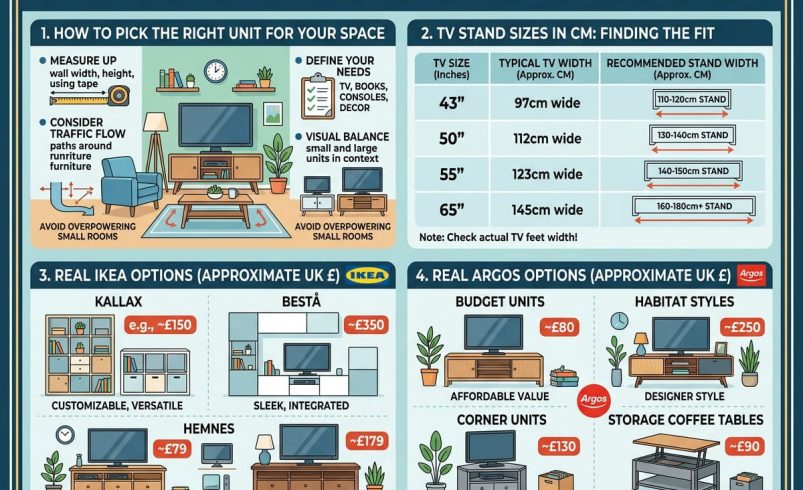
If you’ve searched for living room storage because your lounge is drowning in remotes, cables, and games consoles, the fix usually comes down to two things: picking furniture that’s genuinely the right size for your TV and your room, and using every bit of dead space you’re currently wasting. That means measuring properly before you buy (TV sizes are diagonal, not width, which trips up almost everyone), choosing between an open TV stand and a closed storage cabinet based on how much you actually want on display, and layering in smaller pieces like ottomans and floating shelves once the big furniture is sorted. Below is a proper walkthrough, with real UK sizes, prices, and specific advice for 50-inch and 75-inch TVs.
Living Room Storage Ideas for Every Type of UK Home
British living rooms tend to be smaller than their US or European equivalents, which means living room storage has to work harder per square metre. A Victorian terrace with a chimney breast, a new-build semi with an open-plan kitchen-diner, and a one-bedroom flat all need slightly different approaches, but the same core principles apply everywhere.
Look for furniture that does two jobs at once. A coffee table with a lift-up top or drawers underneath, an ottoman that hides throws and toys while doubling as extra seating, or fitted alcove cabinets either side of a chimney breast all give you storage without eating into floor space you don’t have. Wall-mounted shelving is worth prioritising in smaller rooms too, since it takes weight off the floor entirely and draws the eye upward, which makes a room feel larger rather than more cluttered.
This is the step almost everyone skips, and it’s the reason so many people end up returning furniture. Before you look at a single TV stand, measure the wall width where the unit will sit, the depth available (including any radiator or skirting board that eats into it), and the distance from your usual seating position to the screen.
TV sizes are always measured diagonally, corner to corner, not across the actual screen width, which is the single biggest source of confusion when buying a stand. Using the standard 16:9 screen ratio, here’s roughly what different TV sizes actually measure in width:
As a rule of thumb, your TV stand should be at least 5 to 10cm wider than the actual screen width on each side, both for visual balance and so the TV’s feet sit fully on the surface rather than overhanging the edge. Bear in mind some TVs use two widely spaced feet rather than a central stand, so check your exact model’s foot spacing before you commit to a narrower unit.
A 75-inch TV is genuinely large, roughly 166cm wide, and it needs furniture that matches. For a stand you’ll be happy with rather than one that looks slightly undersized, aim for something in the 175 to 210cm width range. Anything narrower than about 170cm will likely leave the TV overhanging or looking top-heavy against the unit.
Depth matters more at this size too. A shallow 30cm-deep stand can look unstable under a large screen, so look for at least 40cm of depth if you’re placing devices, a soundbar, or games consoles on top rather than wall-mounting the TV itself. If you’re working with a smaller room but still want a 75-inch screen, wall-mounting the TV and using a lower, narrower storage unit underneath purely for AV equipment is often the better trade-off than forcing in an oversized cabinet.
A low TV stand, generally anything under about 45cm tall, has become the more popular choice in UK living rooms over the past few years, and there’s a genuine reason beyond aesthetics. Modern flat-panel TVs sit much lower to the floor than old CRT sets ever needed to, and a low stand keeps the centre of the screen closer to seated eye level, which is more comfortable for longer viewing.
Low stands also tend to suit open-plan and Scandinavian-style rooms better, since they don’t block sightlines the way a taller cabinet does. The trade-off is usually storage capacity: a low, wide unit generally has less vertical space for stacking boxes or a games console upright, so if you’ve got a lot of kit, check the internal shelf height before assuming everything will fit.
A 50-inch TV is one of the most common sizes in UK homes, and it’s genuinely the easiest to buy a stand for, since almost every mid-sized TV unit on the market is designed around this range. The actual screen width comes out at roughly 111cm, so a stand somewhere between 120 and 150cm wide gives you a comfortable margin either side.
This is also the size where storage-focused units, rather than purely decorative stands, tend to offer the best value, since you get useful drawer and cabinet space without the unit dominating a small to medium living room. If your room is on the smaller side, a 120 to 130cm unit with closed cabinets on either side of an open centre shelf (for a set-top box or streaming device) is usually the sweet spot.
This comes down to how much you actually want visible day to day. A TV storage cabinet with closed doors hides consoles, cables, DVDs, and general clutter completely, which makes for a calmer-looking room, but it does mean opening a cabinet door every time you want to swap a game or check a router light.
An open TV stand, with shelves rather than doors, keeps everything accessible and lets warm air escape more easily around devices that run hot, such as games consoles or older set-top boxes. The downside is obvious: everything on show has to be at least reasonably tidy, since there’s nowhere to hide it. Many people land on a hybrid, closed cabinets for genuinely messy items like cables and controllers, with one open shelf for whatever needs day-to-day access.
Once the main TV furniture is sorted, the rest of your living room storage should fill in around it rather than compete with it.
Storage ottomans are one of the most efficient options going, since they double as seating or a footrest while hiding blankets, toys, or seasonal items underneath the lid. Coffee tables with drawers or a lift-up top work the same way for smaller items like remotes, magazines, and chargers that need to stay within reach but out of sight.
Alcove shelving either side of a chimney breast is a strong option if you’ve got a period property, since it uses awkward space that otherwise goes to waste, and floating wall shelves do a similar job in newer homes without a chimney breast to build around. A slim sideboard along a spare wall is worth considering too if you need somewhere for crockery, board games, or general household overflow that doesn’t belong in the kitchen.
Prices vary a lot depending on material and brand, but here’s a realistic sense of where things sit right now, based on current listings from IKEA UK.
At the budget end, IKEA’s BESTÅ TV bench (180 x 40 x 64cm) currently sits at £135, and the HAVSTA TV bench with plinth (160 x 47 x 62cm) comes in at £129. Stepping up, the HAUGA TV and storage combination (276 x 46 x 199cm, a tall unit rather than a low stand) is priced at £160, and a larger BESTÅ combination with glass doors runs to £200. At the higher end, the VIHALS TV bench (176 x 37 x 50cm) is listed at £328.
Beyond IKEA, Argos and Dunelm both stock TV units across a similar spread, generally from around £70 for basic small stands up to £300 plus for larger media units with multiple cabinets. Prices change fairly often with sales and seasonal offers, so treat these as a general guide and check current pricing directly before you commit to a specific model.
This is easy to overlook, but it matters if you’ve got young children or pets in the house. A large TV on an unanchored stand can tip if it’s pulled, climbed on, or knocked, and flat-panel TVs are heavier than they look, easily enough to cause serious injury to a small child.
Most TV stand manufacturers include anti-tip straps or brackets in the box, and it’s worth fitting them even if the unit feels stable on its own, since the risk comes from sudden force rather than everyday use. If your stand didn’t come with a strap, standalone anti-tip kits are inexpensive and widely available from UK retailers. It’s also worth avoiding placing anything a toddler might reach for and try to climb toward on the top shelf of a low stand.
A 65-inch TV measures roughly 144cm wide, so look for a stand between 150 and 180cm wide for good visual balance and stability. Going narrower than the TV’s actual width risks the feet overhanging the edge of the unit.
The most effective approach is combining closed storage, cabinets, drawers, and ottomans, with a small amount of open display space for things you actually want on show. Wall-mounted shelving also helps by taking items off the floor and freeing up visual space in smaller rooms.
It depends on your room and seating distance, but a low stand, generally under 45cm tall, usually keeps the TV centre closer to comfortable eye level for modern flat-panel screens. Taller units can suit rooms where you want more enclosed storage capacity rather than a minimal look.
Most modern TV stands sit between 35 and 50cm tall, a notable drop from the taller units built for older, bulkier CRT televisions. The right height ultimately depends on your sofa height and how far you sit from the screen.
Not for the TV itself, but a slim, low unit underneath is still useful for a games console, soundbar, or streaming box, along with general living room storage. Many people choose a narrower unit than they otherwise would since it only needs to hold accessories rather than support the TV.
A 50-inch TV is about 111cm wide, so a stand between 120 and 150cm wide gives a comfortable margin on both sides. This is one of the easiest sizes to shop for, since most standard TV units on the UK market are designed around this range.
A TV stand is often a simpler platform, sometimes with open shelving, while a TV storage cabinet specifically includes closed doors or drawers for hiding cables, consoles, and other clutter. Which suits you depends on whether you’d rather have things accessible on open shelves or fully out of sight.
Realistic budget options start from around £70 to £135 for smaller or mid-sized units, with larger media consoles or premium materials running £200 to £330 or more. Prices shift with sales fairly regularly, so it’s worth checking current listings before assuming a figure is fixed.