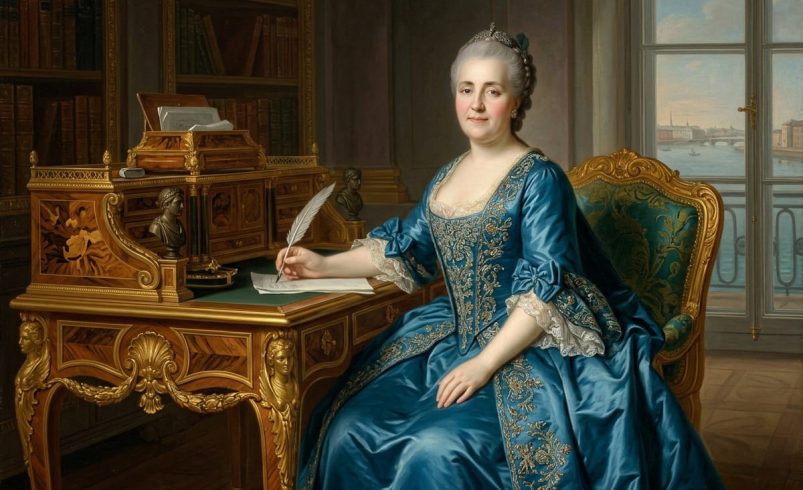
Search “Catherine the Great furniture” and you’ll get two very different answers on the same page: genuine neoclassical masterpieces from her Russian palaces, and a persistent legend about a supposed secret collection of erotic pieces. Both exist in the historical record, but only one of them is properly documented. In its real, verified form, this refers to the extraordinary pieces she commissioned for the Winter Palace, Tsarskoye Selo and Pavlovsk from some of the finest cabinetmakers and architects in 18th-century Europe.
The erotic furniture story, by contrast, rests on two grainy 1941 photographs and no surviving objects. This guide covers both sides properly: who actually made Catherine’s furniture, what happened to it, whether the scandalous rumours hold up, and where you can genuinely go to see related pieces, including several right here in the UK.
What is Catherine the Great furniture, exactly?
This covers the vast body of pieces she commissioned during her 34-year reign (1762 to 1796) for her many palaces and residences. She wasn’t just decorating rooms; she was building a visual argument for Russia’s place among Europe’s great powers, and furniture was central to that project. Chairs, desks, cabinets and consoles were as much diplomatic statements as they were functional objects.
She employed an extraordinary roster of talent to achieve this. That included the Scottish architect Charles Cameron, the German cabinetmaker David Roentgen, the French ébéniste Jean-Henri Riesener, and the St Petersburg-based Gambs family workshop, alongside countless French, Italian and Russian artisans working across her court. The result was a body of work that blended French elegance, Italian classicism and Russian scale into something genuinely distinctive.
The real furniture: palaces, architects and craftsmen
Charles Cameron and the Scottish connection
Cameron arrived at Catherine’s court in 1779 and quickly became her most trusted designer, working almost exclusively at Tsarskoye Selo and, later, Pavlovsk Palace. Once she’d handed a project to Cameron, she rarely intervened, and his authority extended well beyond architecture into the furniture itself. He oversaw everything from mantelpieces to the exact upholstery fabric, treating each room as a single unified design rather than a shell to be filled afterwards.
His most celebrated furniture commission was the Green Dining Room set at the Catherine Palace, made to his design at I. Charlemagne’s furniture factory in St Petersburg. Twenty five chairs were produced, painted white with pale green woodcut detailing and dark green silk upholstery, two of them slightly larger and reserved specifically for the palace’s most senior occupants. Several original examples survive in museum collections today, including one held by Rundāle Palace in Latvia, which has published detailed conservation notes on the piece.
The cabinetmakers behind the objects
Cameron designed the rooms, but specialist cabinetmakers built the actual furniture. David Roentgen, working from Neuwied in Germany, supplied Catherine with mechanically ingenious desks and cabinets featuring hidden compartments and elaborate marquetry, and became one of her favourite suppliers of luxury pieces. Jean-Henri Riesener, former cabinetmaker to Louis XVI of France, influenced the style adopted by Russian craftsmen working in the imperial workshops, even without every piece attributed to him being a direct commission.
The St Petersburg-based Gambs workshop became the dominant domestic furniture maker for the Russian court across several generations, eventually supplying multiple tsars after Catherine’s death. Between them, these makers established mahogany, rosewood and gilded bronze (ormolu) as the defining materials of high-status Russian furniture for the next half century.
Materials and the style itself
Her furniture typically combined exotic imported timber, mostly mahogany, rosewood and ebony, with gilded bronze mounts, inlaid marble tops and, in the grandest pieces, hardstones like malachite and jasper sourced from Russia’s own Ural mountains. Upholstery was almost always silk, often in white or pale tones early in Cameron’s career at Tsarskoye Selo, shifting toward richer violet and blue tones with the Pavlovsk commissions for her son Paul.
Stylistically, the furniture moved from an early rococo influence toward a more restrained, symmetrical neoclassicism as Cameron’s influence grew through the 1780s. Classical motifs, laurel wreaths, columns, medallions and imperial eagles, appeared consistently across pieces, reinforcing Catherine’s self-image as heir to both Roman grandeur and Enlightenment rationalism.
Her furniture’s surprising British connection
Here’s the detail most articles skip entirely, and it’s genuinely relevant for UK readers. Catherine’s most famous commission from Britain wasn’t furniture at all, but it belongs in the same story: the Wedgwood “Green Frog Service”, a 944-piece dinner and dessert service ordered from Staffordshire potter Josiah Wedgwood in 1773 for her newly built Chesme Palace.
Wedgwood displayed the finished service at his London showroom in Greek Street, Soho, in June 1774 before shipping it to Russia, charging fashionable London society a small fee just to view it. The final bill came to £2,290, a genuinely enormous sum at the time, and each of the 1,222 hand-painted views of British gardens and countryside carried a small green frog crest as a nod to the marshy site of the palace it was made for. Most of the surviving service, roughly 770 pieces, remains in the Hermitage today, but you don’t need to travel to St Petersburg to see part of it.
There’s also a direct link to one of Britain’s oldest auction houses. In 1778, James Christie, founder of Christie’s, negotiated the sale of Sir Robert Walpole’s art collection directly to Catherine the Great, and those paintings became a founding part of what is now the Hermitage Museum’s collection. It’s one of the more remarkable footnotes in British auction history: a London saleroom, still trading today from St James’s, once did business directly with the Russian imperial court.
The “erotic furniture” legend: what’s fact and what’s fiction
No discussion of Catherine the Great furniture is complete without addressing the rumour that dominates most search results on the topic, and it’s worth being straightforward about how thin the actual evidence is.
The 1941 Wehrmacht photographs
The legend centres on two photographs, said to have been taken by German Wehrmacht soldiers in 1941 during Operation Barbarossa, allegedly showing a table and chair carved with explicit sexual imagery, supposedly discovered in a hidden room at Gatchina Palace or, according to other versions, at Tsarskoye Selo. No verified photographs of this furniture have ever surfaced publicly, and the objects themselves, if they ever existed, were reportedly destroyed when the palaces were bombed during the war.
Historians have never found contemporary 18th-century documentation connecting this furniture directly to Catherine, and the story wasn’t formally recorded until roughly 150 years after her death. That timing matters: a rumour that surfaces generations later, filtered through wartime propaganda and Cold War intrigue, is a very different kind of historical evidence to a contemporary court inventory or bill of sale.
Has anyone actually verified it?
The most concrete thing connected to this legend isn’t a surviving original at all, but a modern replica. Sotheby’s included a painted plywood table, described explicitly as a copy of the piece “supposedly delivered to Catherine the Great”, in its 2017 “Erotic: Passion & Desire” sale in London, complete with a catalogue note referencing the 1941 photographs and the enduring uncertainty around the story’s origins. That a major auction house felt it necessary to hedge the attribution so carefully tells you most of what you need to know about how seriously historians take the legend.
Whether the story began as genuine wartime discovery, Nazi-era fabrication designed to discredit a powerful female ruler, or simply an old rumour that calcified into apparent fact, remains unresolved. What’s certain is that it says more about two centuries of discomfort with female sexuality and power than it does about any documented piece of furniture.
Catherine the Great furniture at auction
Genuine, fully authenticated furniture directly commissioned by Catherine rarely appears on the open market, since almost everything that survives sits in Russian state collections, primarily the Hermitage, Tsarskoye Selo and Pavlovsk. When pieces with a credible connection to her court do surface, they tend to appear at the very top end of the decorative arts auction calendar.
Sotheby’s “Treasures, Princely Taste” sale in London included furniture and decorative pieces commissioned by or associated with European rulers including Catherine the Great and Napoleon, with individual lots at that level routinely estimated between £300,000 and £1.2 million depending on rarity and provenance. Porcelain connected to her reign, particularly pieces from the Arabesque and Yachting services she commissioned, has also performed strongly at auction; one set of 24 dinner plates from the Arabesque service sold for well over four times its presale estimate at a New York sale of a major private collection.
If you’re browsing rather than bidding at that level, reproduction pieces “in the manner of” Catherine’s court furniture do appear regularly on dealer platforms like 1stDibs, generally priced from a few hundred pounds for smaller decorative items up to several thousand for larger reproduction case pieces. These aren’t investment pieces, but they’re a genuinely accessible way to bring the aesthetic into a room without chasing museum-grade provenance.
Where to see Catherine the Great furniture today
In Russia, and an important current warning
The largest collections of authentic pieces remain exactly where you’d expect: the State Hermitage Museum in St Petersburg, the Catherine Palace at Tsarskoye Selo, and Pavlovsk Palace. Under normal circumstances, these three sites would be the obvious pilgrimage for anyone serious about the subject.
That’s genuinely not straightforward for UK travellers right now. The Foreign, Commonwealth and Development Office advises against all travel to Russia, a warning most recently reconfirmed in May 2026, citing the ongoing risks from the war in Ukraine, the possibility of arbitrary detention of British nationals, and severely limited consular support if something goes wrong. Travelling against this advice can also invalidate travel insurance, so it’s worth being honest with yourself about that risk rather than treating it as a minor inconvenience.
In the UK
You don’t have to travel to Russia to see something connected to Catherine’s collecting, though. The Victoria and Albert Museum in London holds a Frog Service dinner plate in its permanent collection, painted with a view of the Thames between Richmond and Isleworth, complete with the distinctive green frog crest. The V&A Wedgwood Collection at World of Wedgwood in Barlaston, Stoke-on-Trent, holds a significantly larger group of pieces from the same service and displays them as part of its permanent galleries.
The Salisbury Museum in Wiltshire also holds an individual Frog Service plate, acquired with support from the V&A Purchase Grant Fund and the National Art Collections Fund, showing a view of Mount Edgcumbe in Cornwall. None of these are furniture in the strict sense, but they’re the closest tangible connection most UK visitors will get to Catherine’s personal commissions without leaving the country, and they’re a genuinely good afternoon out if you’re anywhere near Staffordshire, Wiltshire or South Kensington.
FAQ
What is Catherine the Great furniture?
Catherine the Great furniture refers to the pieces commissioned during her reign from 1762 to 1796 for palaces including the Winter Palace, Tsarskoye Selo and Pavlovsk. It was designed and built by leading European craftsmen of the period, including Charles Cameron, David Roentgen and Jean-Henri Riesener, using materials like mahogany, gilded bronze and inlaid hardstones.
Did Catherine the Great really own erotic furniture?
There’s no verified physical evidence that she did. The legend rests entirely on two disputed photographs said to have been taken by German soldiers in 1941, with no surviving objects and no contemporary 18th-century documentation, so historians treat the story as unproven rather than confirmed fact.
Who designed Catherine the Great’s palace interiors?
Scottish architect Charles Cameron was her most influential designer from 1779 onward, working primarily at Tsarskoye Selo and Pavlovsk Palace. He oversaw both the architecture and the accompanying furniture, working alongside cabinetmakers including David Roentgen and the Gambs family workshop in St Petersburg.
Can you buy authentic Catherine the Great furniture?
Genuine, documented pieces almost never reach the open market, since the overwhelming majority remain in Russian state museum collections. When items with credible court provenance do appear at major auctions like Sotheby’s, they typically sell for hundreds of thousands of pounds; reproduction pieces in a similar style are far more affordable and widely available.
What is the Wedgwood Green Frog Service?
It’s a 944-piece dinner and dessert service commissioned by Catherine the Great from English potter Josiah Wedgwood in 1773 for her Chesme Palace, decorated with hand-painted British garden and countryside views and a small green frog crest on every piece. Most of it remains in the Hermitage, but individual pieces are on display at the V&A in London and at World of Wedgwood in Staffordshire.
Can UK visitors see Catherine the Great’s furniture in Russia right now?
The FCDO currently advises against all travel to Russia due to the ongoing war in Ukraine and the risk of British nationals being detained, a warning last reconfirmed in May 2026. Travelling against this advice can also void your travel insurance, so it’s worth checking the latest gov.uk guidance before planning any trip.
Was Catherine the Great’s furniture French, Russian or British in style?
It was genuinely a blend of all three, with strong Italian influence too. French cabinetmaking technique, Italian and Roman classical motifs, and Russian scale and materials combined under British-trained architect Charles Cameron’s direction to create a distinctly imperial Russian neoclassical style.