
Exercises for Triceps with Weights: 10 Moves That Work
- August 20, 2026
- 0
If you want bigger, stronger arms, the fastest route is a solid set of exercises for triceps with weights, since the triceps make up roughly two-thirds of your



9621 Agnes Crossing, Lake Suzanneview, New Mexico Island 84604-9295.
If you want bigger, stronger arms, the fastest route is a solid set of exercises for triceps with weights, since the triceps make up roughly two-thirds of your
If you want bigger, stronger arms, the fastest route is a solid set of exercises for triceps with weights, since the triceps make up roughly two-thirds of your upper arm, more than the biceps most people focus on. A handful of dumbbell moves done properly, twice a week, will do more for your arm size and pushing strength than endless curls ever will.
This guide covers the best exercises for triceps with weights, how to structure sets and reps, sample workouts for home and gym, and what decent dumbbells actually cost in the UK right now. Whether you’ve got a full rack or a single pair of adjustable dumbbells at home, you’ll find a routine that fits.
Why Train Triceps with Weights
The triceps brachii has three heads (long, lateral, and medial), which is where the name comes from. Each head responds slightly differently depending on arm position, which is why a good tricep routine mixes overhead moves, pressing moves, and extensions rather than repeating the same angle.
Training with weights rather than just bodyweight dips or push-ups matters because it lets you progressively add resistance. Your triceps also play a supporting role in almost every pushing exercise, bench press, shoulder press, push-ups, so stronger triceps tend to improve those lifts too.
The NHS recommends adults aged 19 to 64 do muscle-strengthening activities that work all major muscle groups, arms included, on at least 2 days a week, alongside 150 minutes of moderate aerobic activity. Dumbbell tricep work ticks that box easily as part of a wider upper body session.
For building visible size (hypertrophy), aim for 3 to 4 sets of 8 to 15 reps per exercise, leaving 1 to 2 reps in reserve rather than always training to complete failure. Rest around 60 to 90 seconds between sets.
If your main goal is strength rather than size, you can drop to 5 to 8 reps with slightly heavier weight, though single-joint isolation moves like tricep extensions don’t respond as well to very heavy, very low-rep training as compound lifts do. Most people get the best results treating tricep work as a hypertrophy-focused accessory rather than a pure strength lift.
Two sessions a week is enough to see progress within 6 to 8 weeks, provided you’re gradually increasing weight or reps over time, a principle known as progressive overload.
These ten exercises cover every angle your triceps need, from bodyweight-supported moves for beginners through to heavier compound presses.
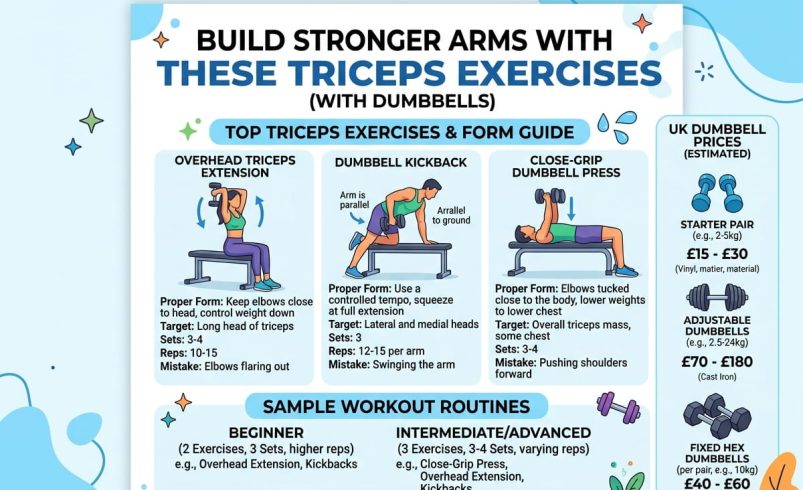
Hold a single dumbbell with both hands, arms extended overhead. Bend at the elbows to lower the weight behind your head, keeping your upper arms still, then extend back up. This targets the long head of the triceps particularly well because of the overhead arm position.
Do this seated on a bench if you struggle to keep your lower back stable while standing.
Lie flat on a bench holding two dumbbells above your chest, palms facing each other. Bend your elbows to lower the weights toward your forehead (not literally touching), then press back up. Keep your upper arms fixed and let only your forearms move.
This is one of the more technical moves on the list, so start light until your elbow tracking feels controlled.
Hinge forward at the hips with a dumbbell in each hand, elbows bent at 90 degrees and tucked close to your ribs. Straighten your arms back behind you, squeeze at the top for a full second, then return under control. Kickbacks are lighter-weight, higher-rep territory since leverage makes them harder to load heavily.
Lying on a bench, press two dumbbells up with your palms facing each other and elbows tucked in close to your body, rather than flared out to the sides. This compound move lets you lift heavier than isolation exercises and hits the triceps alongside your chest and shoulders.
The same movement as the two-handed overhead extension, but performed one arm at a time. This is useful for spotting and fixing strength imbalances between your left and right arm, which is common if one side is naturally dominant.
Sit on the edge of a bench with your hands beside your hips, legs extended, and a weight plate or dumbbell resting on your lap for added resistance. Lower your body by bending your elbows, then press back up. Keep your shoulders down and elbows pointing backward rather than flaring outward, to protect your shoulder joints.
Lying on the floor rather than a bench, press two dumbbells up with elbows tucked close, letting your upper arms rest on the floor at the bottom of each rep. The floor limits your range of motion slightly, which reduces shoulder strain and puts more emphasis on the triceps lockout.
A hybrid between a close-grip press and a skull crusher, lower the dumbbells toward your chin rather than your chest, keeping elbows tucked. It’s a more advanced move that rewards good elbow control, so build up to it once your form on the basic press and extension is solid.
From a plank position holding two dumbbells, perform a row, then extend the working arm straight back into a kickback before returning to plank. It’s a combination move that adds core stability work alongside the tricep isolation, useful for time-efficient full-body sessions.
Lying on a bench with a single dumbbell held overhead with both hands, lower it back behind your head (pullover), then bend at the elbows to bring it toward your forehead before pressing back up (extension). This combined move stretches both the lats and triceps, giving you more range of motion per rep.
Here’s a straightforward routine using the moves above, split by experience level.
Beginner tricep workout with dumbbells (twice a week):
Intermediate tricep workout with dumbbells (twice a week):
Rest 60 to 90 seconds between sets on isolation moves, and up to 2 minutes on the heavier close-grip press. Both routines take roughly 25 to 35 minutes including warm-up.
If you’re training at home with just a pair of adjustable dumbbells, prioritise the overhead extension, kickbacks, and weighted bench dips, since these need the least space and no bench is strictly required for the first two. A sturdy chair works fine for bench dips if you don’t have proper gym equipment.
In a gym setting, add the close-grip press and skull crushers using a flat bench, and consider a cable tricep pushdown as a supplement once or twice a month for variety, since cables offer constant tension that dumbbells can’t quite replicate at full extension.
Getting these details right matters more than chasing heavier weight too soon.
If you’re building a home setup, here’s what current UK pricing actually looks like.
| Dumbbell type | Typical UK price | Where to check |
| Light PVC or vinyl pair (1kg to 2kg) | £4 to £13 | Decathlon, Argos |
| Neoprene pair (2kg to 4kg) | £10 to £35 | Argos |
| Fixed hex dumbbell, single (5kg) | £23 | Decathlon |
| Cast iron hex set (2 x 27.5kg) | Around £88, often discounted from £110 | Argos |
| Adjustable dumbbell (single, up to 25kg) | Around £149 | Argos |
| Adjustable dumbbell (single, up to 36kg) | Around £146 to £219 | Argos |
[Table: UK dumbbell price comparison across Decathlon, Argos and Pro Fitness ranges]
Prices change fairly often and vary by retailer, so treat these as a rough guide rather than a fixed quote, and check current stock and pricing before buying. For most people starting out with tricep work specifically, a single adjustable dumbbell pair covering roughly 2kg to 15kg per hand is enough to progress through months of training before you need anything heavier.
The close-grip dumbbell press is generally considered the most effective single exercise, since it’s a compound movement that lets you lift heavier weight while still placing most of the load on the triceps.
Twice a week is enough for most people to see steady progress, in line with NHS guidance to strengthen all major muscle groups at least 2 days a week, with a rest day between sessions to allow recovery.
Yes. Dumbbells allow enough range of motion and progressive overload to build meaningful tricep size and strength without needing a cable machine or barbell, provided you increase weight or reps over time.
Yes, since the triceps are heavily involved in the lockout portion of a bench press, stronger triceps from close-grip presses and extensions typically translate into a stronger bench press over several weeks of consistent training.
They can be, provided you keep the weight controlled and don’t let your elbows flare or drift forward during the movement, but they’re one of the more technical tricep exercises and worth starting light until your form feels solid.
Most people notice strength improvements within 3 to 4 weeks of consistent training, with visible size changes typically taking 8 to 12 weeks alongside adequate protein intake and progressive overload.
It’s not recommended, since muscles need recovery time between sessions to repair and grow. Two to three sessions a week with rest days in between will produce better results than daily training.