

Be1Crypto.com Security: Is It Safe? UK Guide 2026
- August 19, 2026
- 0
If you’ve searched for be1crypto.com security, you’re likely trying to decide whether to trust the platform with your money. Here’s the direct answer: the site makes strong claims



9621 Agnes Crossing, Lake Suzanneview, New Mexico Island 84604-9295.
If you’ve searched for be1crypto.com security, you’re likely trying to decide whether to trust the platform with your money. Here’s the direct answer: the site makes strong claims
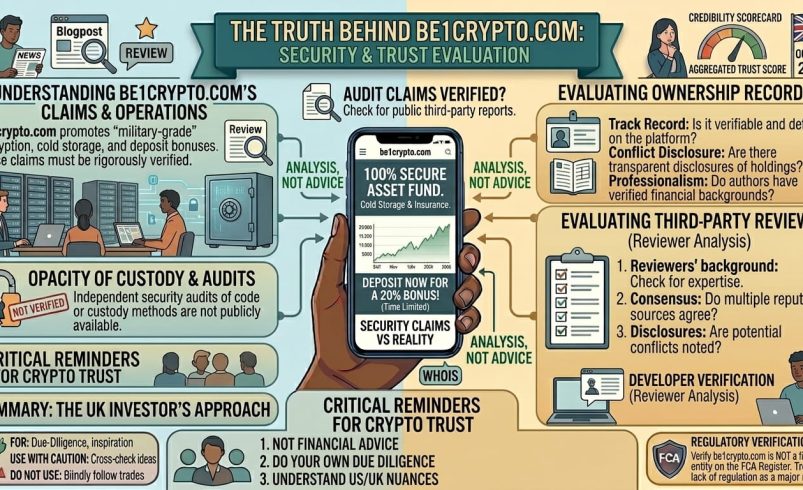
If you’ve searched for be1crypto.com security, you’re likely trying to decide whether to trust the platform with your money. Here’s the direct answer: the site makes strong claims about encryption, two-factor authentication, and cold storage, but independent trust scanners consistently flag be1crypto.com and its related domains as high risk, and there’s no publicly available FCA registration or company ownership record to back up those claims.
That gap between marketing language and verifiable fact is exactly what this guide covers. We’ve checked what be1crypto.com says about its own security, what independent reviewers and scam-detection tools actually found, whether it meets UK regulatory requirements, and what you should do whether you’re just researching or you’ve already put money in.
Be1Crypto.com presents itself as a cryptocurrency trading platform offering markets, charting tools, staking, and educational content aimed at both beginner and experienced traders. Some versions of its marketing describe features like a crypto debit card and low trading fees around 0.075%.
The problem starts almost immediately: the platform operates across a confusing spread of near-identical domains, including be1crypto.com, be1crypto.org, be1crypto.co, be1crypto.it.com, and be1crypto.com.co. This kind of domain sprawl, where a brand appears under several slightly different web addresses, is a pattern more commonly associated with scam operations than established financial firms.
Content associated with the platform describes a fairly standard list of security features: SSL encryption for data in transit, two-factor authentication (2FA) for logins, cold storage for the majority of user funds, AI-driven fraud monitoring, and periodic security audits. On paper, these are the same building blocks used by genuinely secure exchanges.
The trouble is that having a list of security features on a website isn’t proof they’re implemented properly, audited independently, or even real. Plenty of fraudulent platforms describe identical features because the language itself has become a template. Genuine platforms back these claims up with named audit firms, public bug bounty programmes, and regulatory registration. Be1crypto.com’s promotional material doesn’t point to any of that.
This is where independent research diverges sharply from the platform’s own marketing.
Scamadviser’s automated review gave be1crypto.com a low trust score, stating the site “may be a scam.” The same tool separately flagged be1crypto.org with a low score, noting it shares registrar infrastructure with other low-scoring websites. Related domains like be1crypto.co and be1crypto.com.co received similarly poor ratings, with reviewers noting recent registration dates and a Tranco ranking low enough to suggest very little genuine traffic.
None of this proves fraud with certainty, but the pattern across five or six near-identical domains, all scoring poorly on independent checks, is not something a legitimate financial platform typically produces.
Nobody knows, at least not publicly. There’s no disclosed company registration number, no named executive team, and no verifiable physical office address anywhere in the platform’s public materials. Reputable exchanges, by contrast, routinely publish this information because regulators require it.
Several independent reviews reference user complaints about difficulty withdrawing funds from be1crypto.com, sometimes tied to demands for additional “fees” before a withdrawal would be processed. One review also described high-pressure tactics encouraging users to deposit more money. Both patterns are textbook features of investment fraud schemes, not glitches or teething problems.
If you’ve searched this topic already, you’ve probably noticed something odd. A large number of articles on unrelated blogs use almost identical phrasing, praising be1crypto.com’s “security-first mindset,” its “digital shield,” and its “seamless trading experience,” often word for word.
This is a hallmark of coordinated content marketing, sometimes called reputation laundering, where a platform commissions large volumes of generic, glowing articles across low-authority websites to push genuine scam warnings further down the search results. The presence of dozens of near-identical promotional pieces is, on its own, a reason for extra caution rather than reassurance.
We found no record of be1crypto.com on the FCA’s register of cryptoasset businesses. That matters more than it might seem.
Since 10 January 2020, any firm providing cryptoasset exchange or custodian wallet services to UK customers has been legally required to register with the FCA under the Money Laundering Regulations 2017. As of 19 June 2026, this requirement remains firmly in force, and a wider regime under the Financial Services and Markets Act 2000 is due to begin from 25 October 2027, following an application window that opens 30 September 2026 and closes 28 February 2027.
Registration under the MLRs isn’t a stamp of quality even for firms that have it. The FCA is explicit that registration is a legal anti-money laundering requirement, not an endorsement of a platform’s products or safety. But a firm with no registration at all, serving UK customers, is operating outside the law entirely, and that means you’d have no FCA protection, no Financial Ombudsman Service access, and no Financial Services Compensation Scheme cover if things go wrong.
Go to register.fca.org.uk and search the firm’s name directly. It takes under a minute and costs nothing. If a platform claims regulation but you can’t find it on the register, that claim is false, and you should treat it as an active warning sign rather than an oversight.
Regardless of what any single platform claims, these patterns show up again and again in crypto fraud cases reported to UK authorities:
If two or more of these apply to a platform you’re considering, treat it as a serious red flag rather than a coincidence.
Stick to exchanges that appear on the FCA’s cryptoasset business register, such as Coinbase, Kraken, and Gemini’s UK operations. Registration doesn’t guarantee zero risk, since crypto itself carries market risk regardless of platform security, but it does mean the firm has passed a real regulatory check and is subject to ongoing supervision.
For any significant holding, moving funds off an exchange entirely and into a hardware wallet, such as a Ledger or Trezor device, removes the risk of an exchange hack or insolvency affecting your coins. This is genuinely one of the strongest security steps an individual can take.
Use an authenticator app like Google Authenticator or Authy rather than SMS-based 2FA, since SIM-swap attacks can intercept text messages. Never share a 2FA code with anyone, including someone claiming to be platform support staff.
Always type a platform’s web address directly rather than clicking links in emails or messages, and double-check the domain spelling carefully. Given how many near-identical be1crypto domains exist, this single habit alone would protect you from a large share of copycat scam attempts.
Stop depositing further funds immediately, even if you’re told this is required to unlock a withdrawal. Gather every piece of evidence you have, including screenshots, transaction IDs, and any messages from the platform.
Report the matter to Action Fraud at actionfraud.police.uk or by calling 0300 123 2040, since this is the UK’s national reporting centre for fraud and cybercrime. If you paid by card, contact your bank about a chargeback claim, and check whether Section 75 of the Consumer Credit Act applies if the payment was over £100 and under £30,000 on a credit card. Recovering crypto sent directly via wallet transfer is far harder, so acting quickly matters.
If you want to hold or trade crypto with a reasonable degree of confidence, look at FCA-registered options such as Coinbase UK, Kraken, and Gemini, all of which publish clear company details, registration numbers, and named leadership. Combine any exchange choice with your own hardware wallet for long-term storage, rather than leaving significant funds sitting on any platform indefinitely.
Independent scanners including Scamadviser have flagged be1crypto.com and its related domains with low trust scores, and there are user reports of withdrawal difficulties and undisclosed ownership. These are the same warning signs seen in confirmed crypto investment scams, so treat the platform with serious caution rather than assuming it’s safe.
Promotional content associated with the platform describes SSL encryption, two-factor authentication, cold storage for user funds, and AI-based fraud monitoring. These claims aren’t independently verified or backed by a named security audit firm, so they should be treated as unconfirmed marketing rather than proven fact.
We found no record of be1crypto.com on the FCA’s cryptoasset business register. Any firm offering crypto exchange services to UK customers is legally required to register, so an unregistered platform serving UK users is operating outside the current regulatory framework and offers you no FCA-backed protection.
A large number of near-identical articles across low-authority websites use the same promotional phrasing about the platform’s security features. This pattern is typical of coordinated content marketing designed to push genuine warning signs further down search results, and it should be read as a caution flag rather than evidence of trustworthiness.
It depends on how you paid. Card payments may be eligible for a chargeback through your bank, and purchases between £100 and £30,000 on credit cards may qualify for Section 75 protection, but funds sent as direct cryptocurrency transfers are extremely difficult to recover once sent.
Stop sending any further funds immediately, even if asked to pay extra fees to “unlock” a withdrawal. Report the incident to Action Fraud at actionfraud.police.uk or 0300 123 2040, and contact your bank or card provider as soon as possible to ask about a chargeback claim.
Search the firm’s name directly on the FCA Register at register.fca.org.uk, which is free and takes under a minute. If the platform claims regulation but doesn’t appear, that claim is false and should be treated as a serious warning sign.
A hardware wallet, such as a Ledger or Trezor device, keeps your private keys offline and away from exchange hacks or platform insolvency. It’s widely considered one of the most effective single steps an individual can take to protect long-term crypto holdings.