
Acamento Meaning: What It Actually Is (and Isn’t)
- August 11, 2026
- 0
If you’ve searched “acamento” and found a different definition on every page you clicked, you’re not imagining it. Acamento isn’t a recognised English word, and it doesn’t appear



9621 Agnes Crossing, Lake Suzanneview, New Mexico Island 84604-9295.
If you’ve searched “acamento” and found a different definition on every page you clicked, you’re not imagining it. Acamento isn’t a recognised English word, and it doesn’t appear
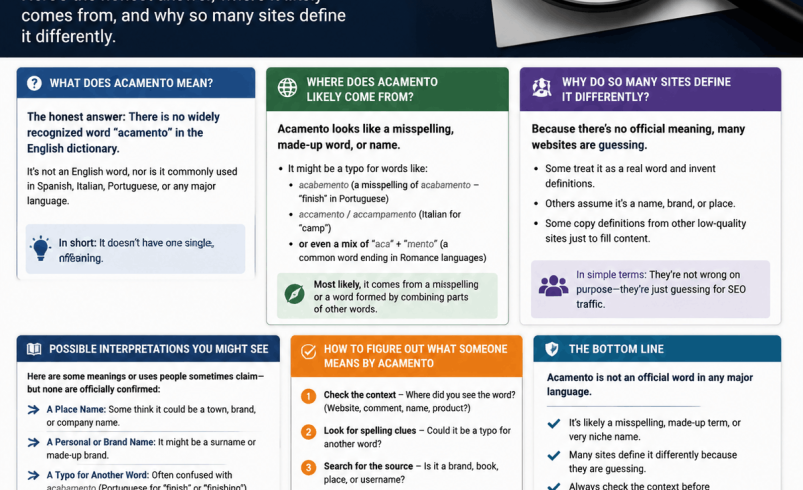
If you’ve searched “acamento” and found a different definition on every page you clicked, you’re not imagining it. Acamento isn’t a recognised English word, and it doesn’t appear in any standard dictionary. The most likely explanation is that it’s a variation, or possibly a simple typo, of the Portuguese word “acabamento,” which means “finish” or “finishing.”
That single origin has somehow spawned a genuinely confusing mix of online content, some sites use acamento to describe finishing touches in construction and design, others use it for a digital productivity platform, and a few stretch it into a vague business or life philosophy about doing things “with care and purpose.” Below, we’ll sort out what’s actually behind the word, why the definitions online contradict each other so badly, and what’s worth taking from all this if you’ve genuinely come across the term somewhere specific.
The most consistent thread running through everything written about this term traces back to the Portuguese word “acabamento,” meaning finish, finishing, or final touch. In Portuguese, it’s a completely ordinary, real word used in construction, manufacturing, fashion and design to describe the final stage of a job, the painting, polishing, stitching or detailing that happens after the main structural work is done.
“Acamento” itself, without the second “b,” doesn’t appear in Portuguese dictionaries either. It looks very much like a dropped letter that then got picked up and treated as a standalone word by content writers who either didn’t notice the discrepancy or ran with it anyway because it made for an interesting-sounding blog topic.
This is genuinely the most useful thing to understand if you’ve landed here confused. Search results for acamento currently include at least four distinct, unrelated definitions:
None of these four descriptions link back to a shared, verifiable source, a company, a dictionary entry, or an official brand. That’s a strong sign the word has been picked up by multiple content writers independently, each building their own definition around a term that sounded plausible but wasn’t actually established anywhere first.
Based on everything publicly available, there’s no verified company, app, or registered brand called Acamento with a consistent identity across its own website, app stores, or company registries. Descriptions of it as a “digital management platform” don’t point to a downloadable app, a company registration, or any independent review beyond the blog post making the claim.
If you’ve heard about acamento specifically as software or a productivity tool, it’s worth checking directly for a company name, an app store listing, and independent reviews before assuming it’s a genuine product you can use or buy. The same caution applies here as with any unfamiliar brand name you come across online: a real tool has a consistent presence, not just a single blog post describing it.
If you’ve encountered “acamento” in the context of building, renovation or product design, you’re almost certainly looking at a reference to “acabamento,” the standard Portuguese term for finishing work. This is the one interpretation with an actual linguistic basis, even if the spelling used online has dropped a letter along the way.
In that context, the word refers to whatever final treatment gives a project its finished look and feel:
This is genuinely useful vocabulary if you’re dealing with Portuguese-language building specifications, property listings, or manufacturing documents, since “acabamento” (correctly spelled) shows up regularly in that context.
If you’re writing or speaking in English, there’s no established, dictionary-recognised reason to use “acamento” rather than plain English words like “finish,” “finishing touch,” or “polish.” Using it in professional or formal writing risks confusing your reader, given how inconsistently it’s currently defined online.
If you’re working with Portuguese-language material and need the correct term for finishing work, use “acabamento” (with the “b”) rather than the truncated spelling, since that’s the word with an actual, verifiable meaning in the Portuguese dictionary.
Acamento isn’t the only word that’s ended up with wildly inconsistent definitions splashed across the internet. A few quick checks can help you work out whether you’re looking at a genuine term or a content-farming keyword:
Acamento isn’t a recognised English or Portuguese dictionary word. It most likely comes from the Portuguese term “acabamento,” meaning finish or finishing, though it’s also been used online to describe entirely unrelated things like productivity software.
No, not in any standard dictionary. It appears to be a variant spelling or typo of “acabamento,” the genuine Portuguese word for finishing or final touches.
There’s no verified company, registered brand, or app store listing behind any of the “acamento as software” descriptions found online, so it doesn’t appear to be an established, purchasable product.
Because there’s no single verified source for the term, multiple content writers appear to have built their own independent definitions around a word that sounded plausible, resulting in several unrelated meanings circulating at once.
Acabamento is the correct Portuguese word for finish or finishing, commonly used in construction, fashion and manufacturing. Acamento appears to be a dropped-letter variation of it with no independent, verified meaning of its own.
It’s best avoided in English writing, since it isn’t a recognised term and readers may find it confusing. If you need the correct Portuguese word for finishing work, use “acabamento” instead.
Some websites use it loosely to describe finishing touches that increase a property’s value, but this appears to be an extension of the “acabamento” finishing concept rather than an established real estate term in its own right.
It’s possible, since language does evolve and terms sometimes gain real meaning through repeated use. As of now, though, there’s no dictionary recognition or single authoritative source confirming a specific, agreed meaning.