


Mannacote: What It Is, Where It Comes From and How to Make It
- August 11, 2026
- 0
If you’ve come across “mannacote” on a recipe blog or a food video and had no idea what you were looking at, you’re not alone. Mannacote is a



9621 Agnes Crossing, Lake Suzanneview, New Mexico Island 84604-9295.
If you’ve come across “mannacote” on a recipe blog or a food video and had no idea what you were looking at, you’re not alone. Mannacote is a
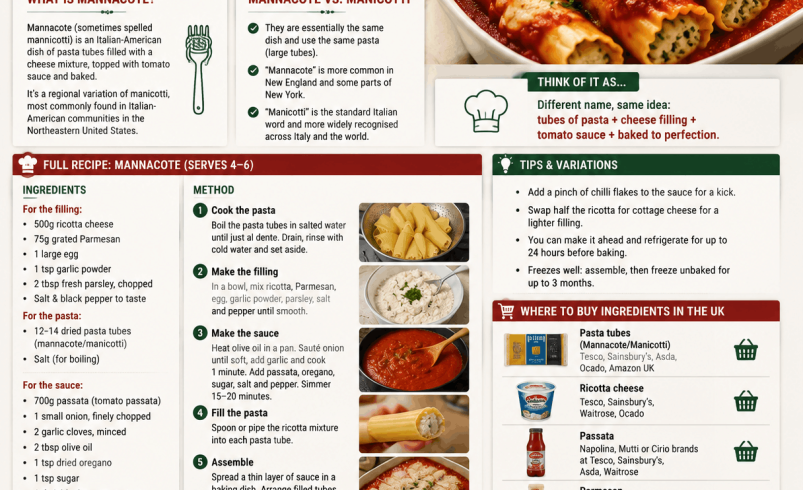
If you’ve come across “mannacote” on a recipe blog or a food video and had no idea what you were looking at, you’re not alone. Mannacote is a baked stuffed pasta dish, essentially a spelling and pronunciation variation of manicotti, the classic Italian-American dish of large pasta tubes filled with cheese, covered in sauce, and baked until bubbling.
It isn’t a traditional Italian term you’ll find in an old cookbook from Naples or Rome. Instead, mannacote grew out of the way Italian-American families said “manicotti” out loud over generations, and that spoken version eventually made its way into writing. Below, we’ll cover exactly what mannacote is, how it differs from similar dishes, a full recipe adapted for UK kitchens, and where to pick up the ingredients here.
Mannacote is best understood as a baked pasta dish made from wide pasta tubes, filled with a creamy mixture of ricotta, mozzarella and Parmesan, then covered in tomato sauce and baked until the cheese is golden and the sauce is bubbling. It’s essentially the same dish as manicotti, just with a name that’s shifted through years of home cooking and oral tradition rather than formal spelling.
You won’t find mannacote listed in classic Italian culinary references, since it isn’t a recognised regional pasta name from Italy itself. It’s an Italian-American invention in the truest sense, a dish (and a word) shaped by immigrant families adapting both language and cooking to a new country.
The word “manicotti” comes from the Italian “manicotto,” meaning “little sleeve,” a fitting description for the tube-shaped pasta. As Italian immigrant families settled across the United States, pronunciation naturally drifted depending on region, dialect and generation, the same way “manicotti” is sometimes shortened to “manigot” in parts of the American Northeast.
Mannacote appears to be one of those drifted spellings, likely originating as a spoken family pronunciation that eventually got written down and shared online. It’s not an official culinary term, but it’s become genuinely popular across food blogs and recipe sites over the past couple of years, enough that plenty of home cooks now search for it directly rather than for manicotti.
Mannacote vs Manicotti: Are They the Same Dish?
Yes, in every practical sense, mannacote and manicotti refer to the same or a very similar dish. The pasta shape, the cheese filling, the tomato sauce and the baking method are all identical between the two names.
The only real distinction is spelling and where you’re likely to encounter each term. “Manicotti” is the standard, widely recognised name you’ll see in shops and classic recipe books, while “mannacote” tends to show up more in casual, family-style recipe blogs and social media posts, often from people who grew up hearing the dish’s name spoken rather than written.
It’s worth mentioning cannelloni here too, since it’s often confused with manicotti and, by extension, mannacote. Cannelloni uses smooth pasta tubes (or thin pasta sheets rolled by hand), while manicotti tubes tend to be ridged, which helps sauce cling to the outside. In authentic Neapolitan cooking, the earliest stuffed pasta of this style actually used crespelle, thin savoury pancakes rolled around a filling, rather than dried pasta tubes at all.
A classic mannacote filling and sauce is fairly simple, built from ingredients that are easy to find in any UK supermarket. Here’s what you’ll typically need for four generous portions:
You can bulk up the filling with cooked spinach or add browned minced beef or Italian sausage to the sauce for a heartier version. Either works well, and neither strays far from how most home cooks make it.
How to Make Mannacote at Home: Step by Step
Here’s a straightforward method that should take around an hour from start to finish, including baking time.
Mannacote is genuinely flexible, so don’t feel tied to one version:
Once cooled to room temperature, mannacote keeps well covered in the fridge for up to 3 days. The pasta will keep softening in the sauce the longer it sits, so it’s at its best within the first day or two.
To reheat, cover with foil and warm through in the oven at 160°C for about 20 minutes, or microwave individual portions in short bursts. It also freezes well before baking, assembled but uncooked, for up to 3 months, just add an extra 15 to 20 minutes to the baking time from frozen.
Since mannacote isn’t a term UK shops use, you’ll want to shop for manicotti or cannelloni tubes instead, both of which are stocked at most major supermarkets including Tesco, Sainsbury’s, Waitrose and Asda, usually priced somewhere between £1 and £2 for a standard box. Ricotta, mozzarella and passata are all easy to find in the same shops, and Italian delis are worth a visit if you want a better quality Parmesan or a fresher ricotta than the supermarket versions.
Prices do shift from store to store and month to month, so it’s worth checking current prices online before you shop if you’re working to a specific budget.
Mannacote is made from large pasta tubes filled with a mixture of ricotta, mozzarella and Parmesan cheese, then covered in tomato sauce and baked until golden and bubbling.
Yes, mannacote and manicotti refer to the same dish. Mannacote is simply a spelling and pronunciation variation that developed within Italian-American families over generations.
UK shops don’t typically stock anything labelled mannacote, so look for manicotti tubes or cannelloni tubes instead, both widely available at major supermarkets for around £1 to £2 a box.
Yes, if you use no-boil or oven-ready manicotti tubes, you can fill them directly and simply add a little extra sauce and baking time to ensure they cook through properly.
Not formally. It isn’t a recognised term in classic Italian cooking, and it’s better understood as an Italian-American variation of manicotti that emerged through regional pronunciation and family tradition.
Yes, you can freeze it assembled but unbaked for up to 3 months. Bake from frozen at the same temperature, adding roughly 15 to 20 minutes to the cooking time.
Cannelloni typically uses smooth pasta tubes or thin pasta sheets, while manicotti (and by extension mannacote) tends to use ridged tubes, which hold sauce slightly differently.
Yes, the classic cheese filling is already vegetarian. Just make sure any pre-made sauce you use doesn’t contain hidden meat stock, and swap in a vegetarian Parmesan-style cheese if needed.