
Spotify to MP3: Why It’s Not Official (and What Actually Works)
- August 11, 2026
- 0
You want your Spotify playlists as proper MP3 files you can keep forever, put on a USB stick, or play on an old MP3 player. The honest, short



9621 Agnes Crossing, Lake Suzanneview, New Mexico Island 84604-9295.
You want your Spotify playlists as proper MP3 files you can keep forever, put on a USB stick, or play on an old MP3 player. The honest, short
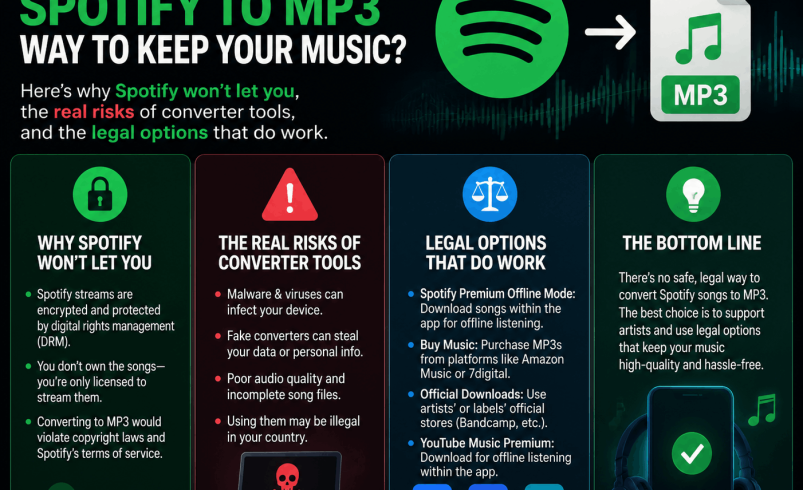
You want your Spotify playlists as proper MP3 files you can keep forever, put on a USB stick, or play on an old MP3 player. The honest, short answer: there’s no official spotify to mp3 option, and Spotify never lets you export tracks as real, unprotected audio files, not even with a Premium subscription.
That’s not a technical oversight, it’s how the whole service is licensed. Spotify pays labels and artists for streaming rights, not for handing out downloadable copies, so every track you hear, including anything saved for offline listening in the app, stays locked behind encryption that only Spotify’s own app can decode.
This guide explains exactly why a spotify to mp3 downloader can’t do what it claims safely or legally, what the risks actually are if you try one, and which routes genuinely work if you want MP3 files of music you love.
Every track on Spotify is protected by DRM (Digital Rights Management), a form of encryption that stops audio files being copied, edited, or played outside the app they were licensed for. Spotify streams music using this protection specifically so tracks can’t be extracted and shared as ordinary files.
This applies to both Spotify Free and Premium accounts. Offline downloads within the Spotify app are still encrypted, cached files, not standard MP3s. They only play inside the Spotify app itself, and they stop working entirely if your subscription lapses or you’re offline for too long without reconnecting.
Spotify Premium, which costs £11.99 a month for an individual UK plan as of 2026 (prices change fairly often, so check Spotify’s own pricing page before signing up), lets you download up to 10,000 tracks across 5 devices for offline listening. This is genuinely useful for train commutes or areas with poor signal, but it isn’t a spotify to mp3 solution in any real sense, since the files can’t be moved, copied, or played anywhere except inside the app.
A lot of the searches around this topic (spotify download mp3, mp3 download from spotify, download spotify song to mp3) are really asking the same underlying question in different words: can Spotify audio become a normal file you own? The honest answer stays the same across every version of that phrase: not directly from Spotify, and not without breaching its terms if you use a converter to force it.
It’s worth separating out two different needs people usually have here, since the right answer depends which one you actually mean.
“I want to listen offline without signal.” Spotify Premium’s built-in offline downloads solve this properly and legally, no converter needed.
“I want a permanent file I can keep even if I cancel Spotify, or move to another device.” This is the need a spotify to mp3 downloader is trying to answer, and it’s also the one that can’t be solved safely through Spotify itself, since that’s not the product Spotify sells.
If what you actually want is the second scenario above, permanent ownership, the process is genuinely simple once you’re using a proper download store instead of a converter.
This takes a little longer than pasting a Spotify link into a converter, but it’s the only route that gets you a genuinely legal, permanent, DRM-free file with no risk to your Spotify account.
Search “spotify mp3 downloader” or “spotify music to mp3” and you’ll find plenty of tools and websites claiming to convert Spotify tracks into standard MP3 files. Some of these do technically produce a working file, since they strip out or bypass the encryption Spotify applies. That doesn’t mean using them is a good idea.
Spotify’s terms of service explicitly ban copying, ripping, converting, or redistributing tracks from the service. Removing DRM protection to convert Spotify music to MP3 falls squarely into this, regardless of which tool does it or how the tool describes itself. Spotify has suspended accounts it’s identified as using this kind of software in the past, so there’s a genuine risk to your account, not just a theoretical one.
Beyond breaching Spotify’s terms, converting protected streams into downloadable MP3s can also infringe the copyright the labels and artists hold over that music, since it creates a permanent copy nobody’s licensed you to have. The legal picture varies a bit by country and use case, and it’s genuinely unclear in places, so this is one of those situations where it pays to be cautious rather than assume a grey area works in your favour.
Beyond the legal side, there are a few very ordinary risks that come up constantly with this kind of software.
| Method | Legal? | Works properly? |
| Spotify Premium offline downloads | Yes | Only inside the Spotify app |
| Third-party DRM removal / converter tools | No, breaches terms and likely copyright | Sometimes, with real risks attached |
| Buying MP3s from a legal store | Yes | Yes, fully yours to keep |
| Free, licensed downloads (Bandcamp, artist sites) | Yes | Yes, where the artist allows it |
If what you’re really after is music you can own, keep permanently, and play on any device, there are proper routes that get you there without any of the risk above.
Services like Amazon Music, 7digital, and Bandcamp sell downloadable MP3 or high-quality audio files outright, usually for somewhere between £0.79 and £1.29 per track, or roughly £7 to £10 for a full album, though prices vary by artist and release. These files are genuinely yours, DRM-free, and can be moved to any device, USB stick, or MP3 player without restriction.
Plenty of independent artists offer free or pay-what-you-want downloads on Bandcamp or their own websites, particularly for singles, EPs, or older back catalogue material. This is completely legal, since the artist has explicitly chosen to allow it, and it often supports them more directly than a stream does.
If having proper local MP3 files matters more than Spotify’s catalogue or interface, buying tracks outright from a download store will always beat trying to convert a streaming service that was never designed to let files out. This is really the underlying issue with any spotify to mp3 search: streaming and ownership are two different products, and no converter changes that cleanly.
If your actual goal is capturing something like your own singing, a podcast, or original audio rather than commercial Spotify tracks, standard recording apps and free software like Audacity are the right (and entirely legal) tool for that, since you’re not touching anyone else’s copyrighted, DRM-protected stream.
It depends on the exact method and your country’s copyright law, and this is genuinely one of those areas where the legal picture isn’t crystal clear everywhere. What is clear is that it breaches Spotify’s terms of service regardless of legality, which puts your account at risk on its own, separate from any copyright question.
If you’re in the UK, ripping or converting copyrighted streamed content without the rights holder’s permission generally falls foul of UK copyright law, even for personal use, since UK law doesn’t have a broad “personal copying” exception the way some other countries do. When in doubt, the safest and simplest route is buying the track properly instead.
Technically, some third-party tools can strip Spotify’s DRM protection and produce an MP3 file, but doing so breaches Spotify’s terms of service and can infringe copyright, with real risks to your account and device.
Not directly from Spotify itself. Spotify’s own downloads, even on Premium, stay locked inside the app. The legal route to owning MP3s is buying tracks from a proper download store like Amazon Music or Bandcamp instead.
Spotify tracks are protected by DRM encryption specifically to prevent this. Even downloaded offline tracks in the app are encrypted cache files, not standard MP3s, and they won’t play outside Spotify.
Spotify can suspend or ban accounts it identifies as using unauthorised downloading or conversion tools, since this breaches its terms of service. Some users have had accounts reinstated after contacting support, but this isn’t guaranteed.
Many of these tools carry real risks, including bundled malware, unwanted software, and poor audio quality, on top of breaching Spotify’s terms. There’s no way to guarantee safety with an unofficial tool, so it’s genuinely a gamble.
Individual tracks typically cost around £0.79 to £1.29 from stores like Amazon Music or 7digital, with albums often working out at £7 to £10, though prices vary by artist and release and do change from time to time.
Not directly, since Spotify’s app and its downloads only work within Spotify’s own software. Some Android-based MP3 players can run the Spotify app itself, letting you stream or use offline downloads on that device, but this still isn’t the same as having transferable MP3 files.
Spotify lets you export a list of your playlist’s track and artist names as data, through its own account settings or various third-party playlist tools, but this only exports metadata, not the actual audio files themselves.