

What Does HY Mean in Text? Full Meaning Explained
- August 6, 2026
- 0
Got a message that just says “hy” and you’re not sure whether it’s a greeting or something else entirely? If you’ve searched what does HY mean in text,



9621 Agnes Crossing, Lake Suzanneview, New Mexico Island 84604-9295.
Got a message that just says “hy” and you’re not sure whether it’s a greeting or something else entirely? If you’ve searched what does HY mean in text,
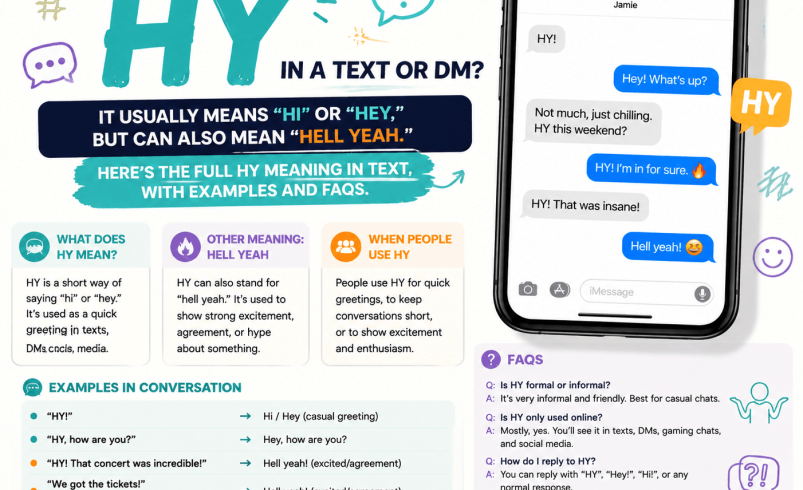
Got a message that just says “hy” and you’re not sure whether it’s a greeting or something else entirely? If you’ve searched what does HY mean in text, the short answer usually comes down to one of two things: it’s either a quick, casual way of typing “hi” or “hey,” or it’s short for “hell yeah” (or the more polite “heck yeah”), used to show enthusiastic agreement. Both meanings are common, and which one applies depends entirely on where HY sits in the message.
If it opens a conversation, it’s almost certainly a greeting. If it’s replying to a question or an invite, it’s probably enthusiasm. This guide breaks down both meanings properly, how HY is used across WhatsApp, Snapchat, Instagram and TikTok, the less common meanings you might stumble across, and exactly how to tell which one someone means.
What Does HY Mean in Text?
HY has two genuinely common meanings in texting, and neither one is wrong. It comes down to position in the sentence and the tone of the surrounding conversation.
As a greeting: HY is a shortened, stylised way of typing “hi” or “hey.” It’s a one-letter swap from “hi” that some people simply prefer, similar to writing “u” instead of “you.”
As enthusiasm: HY stands for “hell yeah” or the softer “heck yeah,” used to express strong agreement, excitement, or approval, usually right after someone’s asked a question or shared good news.
The easiest way to work out which meaning applies is to look at where HY sits in the conversation.
Starting a message? It’s a greeting. “Hy! How’s your day going?” reads exactly like “Hi! How’s your day going?”
Replying to a question or plan? It’s almost certainly enthusiasm. “Fancy the pub later?” → “HY, been ages since we went” clearly means “hell yeah.”
Capital letters and punctuation matter too. “HY!!” with extra exclamation marks after good news leans towards excitement, while a plain “hy” at the start of a chat is almost always a hello.
You might also see it written “h y,” fully capitalised “HY,” or lower case “hy.” None of these change either meaning. The h y meaning stays the same whichever way it’s styled, it’s down to personal typing habit, autocorrect, or the mood of the message rather than any deliberate difference.
As a greeting:
As enthusiasm:
Reading each pair together makes the meaning obvious almost instantly, which is exactly why context matters more than the letters themselves.
The two core meanings stay consistent everywhere, though how often each one turns up shifts slightly by platform.
WhatsApp: Both meanings appear regularly, greetings at the start of chats and enthusiasm in reply to plans or news within a conversation.
Snapchat: Leans more towards the greeting use, since Snapchat conversations often open cold with a quick “hy” before anything else is said.
Instagram: Comments and DMs use both, though “hell yeah” style HY shows up a lot in reaction to posts, competitions, or announcements.
TikTok: Comments frequently use HY as enthusiastic agreement, especially reacting to a video or a caption asking a yes-or-no style question.
If you’ve seen “hy the” and wondered whether it’s a specific phrase, it isn’t, it’s simply “hy” as a greeting followed by the next word in someone’s sentence, such as “hy the meeting got moved” or “hy the parcel’s arrived.” There’s no separate meaning attached to “hy the” as a combined phrase. It just reflects how naturally “hy” slots in at the start of an ordinary message.
No, HY isn’t rude in either meaning. As a greeting, it’s simply a shorter, more casual “hi.” As enthusiasm, “hell yeah” style HY can sound a bit blunt in very formal company because of the word it’s short for, but among friends it reads as upbeat and positive rather than crude. The only real risk is confusion rather than offence, mixing up a friendly hello with an enthusiastic yes rarely causes any harm either way.
A few unrelated meanings of HY exist outside of casual chat, worth knowing so you’re not thrown by them elsewhere.
High yield (finance): In investing and bond markets, HY is shorthand for “high yield,” referring to higher-risk, higher-return bonds, sometimes called junk bonds. UK readers following financial news or investment platforms may spot “HY bonds” used this way.
Postal and travel codes: HY doesn’t correspond to a standard UK postcode area, but abbreviations like it do turn up on shipping labels, ticketing systems, or airline codes depending on the company, so it’s always worth checking the specific context if it appears somewhere official.
Names and usernames: HY is also commonly used as initials or a short username, particularly for anyone with a first name starting with H and a surname starting with Y, or vice versa.
None of these have anything to do with the texting slang meaning, and the setting usually makes it obvious which one you’re looking at.
HY is casual by nature, so it’s worth thinking twice before using it in:
Typing “hi” or “hell yeah” in full only costs a few extra keystrokes and removes any chance of the message being misunderstood.
Replying depends entirely on which meaning was intended. Once you know what does HY mean in text for that particular conversation, replying gets much easier. If someone’s opened with “hy” as a greeting, a simple “hey! how’s it going” keeps things moving naturally. If HY was used to agree enthusiastically with something you suggested, a quick “great, let’s do it” or a matching bit of energy back works well. Where you’re genuinely unsure which one was meant, it’s completely normal to just ask, “haha which do you mean” clears it up in seconds without any awkwardness.
Like most texting abbreviations, there’s no single documented first use behind what does HY mean in text today. The greeting sense follows the same pattern as other simple respellings, such as “u” for “you” or “ur” for “your,” where a common word gets shortened purely to save a keystroke or two. The “hell yeah” sense fits a different, older pattern of abbreviating swear-adjacent phrases for casual online use, similar to how “wtf” or “stfu” work.
Both uses have grown alongside the general rise of fast, informal messaging since the 2000s, and neither shows signs of being tied to a single platform or trend that might date it quickly.
A handful of full exchanges makes the two meanings even clearer than examples alone.
Opening a chat: “hy, you about this weekend?” → “yeah, what’s the plan?” Reacting to plans: “Thinking of booking that trip we talked about” → “HY, do it” Checking in: “hy, everything alright? haven’t heard from you” → “yeah sorry, been mad busy” Agreeing to something small: “Want me to grab you a coffee too?” → “hy, cheers” Group chat energy: “We’re actually going to the final!” → “HYYY let’s gooo”
That last example shows something worth noting too, people often stretch out the letters, “hyyy” or “HYYYY,” when the enthusiasm meaning is intended. Greetings almost never get stretched out the same way, which is another small but useful clue if the context alone isn’t quite enough.
HY most commonly means either “hi” or “hey” as a casual greeting, or “hell yeah” as an enthusiastic reply to something. Which one applies depends on where it sits in the conversation, greetings open a chat, while enthusiasm replies to a question or plan.
On Snapchat, HY usually appears as a quick greeting at the start of a chat, though it can also mean “hell yeah” if it’s replying to a question. The meaning doesn’t change from other platforms, only how often each version turns up.
When it’s used to open a conversation, yes, HY is simply a shorter, stylised way of typing “hi” or “hey.” It carries the exact same friendly, casual tone.
No, that’s only one of its two common meanings. Context decides which one applies, a message starting a conversation almost always means a greeting, while a message reacting to something usually means “hell yeah.”
Hy the” isn’t a separate phrase, it’s just “hy” used as a greeting followed by the next word in an ordinary sentence, such as “hy the bus is late.” There’s no combined meaning attached to those two words together.
No, HY isn’t considered rude in either meaning. It’s informal, so it’s best avoided in professional messages, but among friends and family it reads as friendly or enthusiastic rather than impolite.
Outside of slang, HY is used in finance as shorthand for “high yield,” referring to higher-risk bonds, and can also appear as someone’s initials or a username. Neither of these has any connection to the texting meaning.
Check where it appears in the message. HY at the very start of a conversation is almost always a greeting, while HY replying to a question, plan, or piece of news usually means “hell yeah.” If it’s genuinely unclear, just ask.