
BTW Meaning: What Does BTW Mean in Text and Chat?
- August 4, 2026
- 0
Someone’s just sent you a message with “btw” in it and you want a straight answer before you reply. The btw meaning is “by the way”, a short



9621 Agnes Crossing, Lake Suzanneview, New Mexico Island 84604-9295.
Someone’s just sent you a message with “btw” in it and you want a straight answer before you reply. The btw meaning is “by the way”, a short
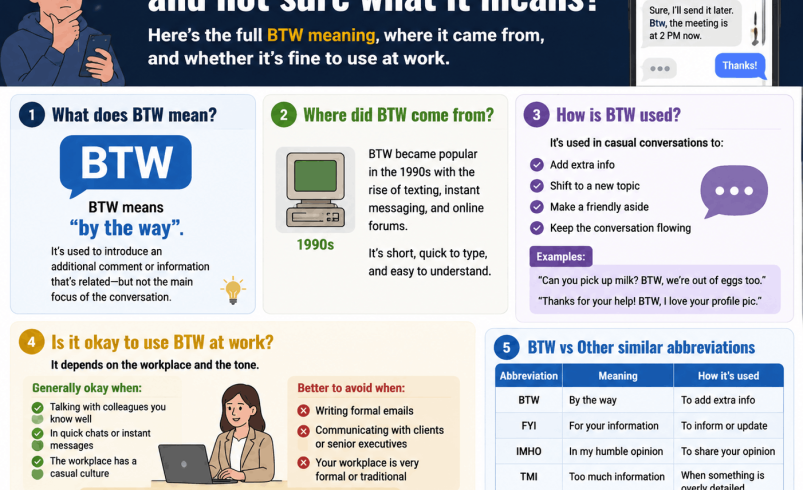
Someone’s just sent you a message with “btw” in it and you want a straight answer before you reply. The btw meaning is “by the way”, a short phrase used to add an extra comment, question or bit of information that isn’t the main point of the conversation. It’s one of the oldest and most widely used abbreviations in texting, and you’ll see it in messages, emails and social media posts alike. Below, we’ll go through exactly how it’s used, where it came from, and when it’s fine (or not) to use it yourself.
BTW stands for “by the way“. People use it to introduce something extra, a side note, a related question, or a bit of information they nearly forgot to mention. It’s not the main topic of the message, it’s the afterthought tacked on.
A typical example: “See you at 7. Btw, can you bring your charger?” The main point is the time, and “btw” flags that the charger question is a smaller, secondary ask.
In texting, btw almost always keeps its full meaning of “by the way” with no variation. Unlike some slang that shifts depending on the platform, btw has stayed consistent since it first appeared, which is part of why it’s understood by almost everyone, from teenagers to grandparents.
You’ll usually see it in one of two positions:
Both uses mean the same thing. It’s just a matter of where the extra information naturally fits in the sentence.
When btw shows up at the end rather than the start, it usually means the sender thought of something after they’d already written the main message. Rather than send a second text, they’ve bolted the extra thought onto the first one. It’s a small habit that saves a bit of back and forth.
BTW isn’t a recent invention. It first appeared in text-based chat rooms and bulletin board systems (BBS) around 1989, well before mobile texting existed. Early internet users typing on slow connections needed shortcuts, and “by the way” was common enough in speech to be an obvious one to abbreviate.
It carried over into instant messaging in the 1990s and 2000s, then into SMS texting once mobile phones became widespread. On old flip phones, where every message had to be typed out on a number pad, three letters instead of eleven made a real difference, which likely helped cement btw as one of the abbreviations that stuck.
It’s related to an older, less common phrase: “by the by” or “bye the bye”, sometimes shortened to BTB. Btw effectively replaced it in everyday use, though you might still hear “by the by” from older speakers or in more old-fashioned writing.
What’s kept btw alive for over three decades, while plenty of other early chatroom abbreviations have faded, is how naturally it maps onto normal speech. People genuinely say “by the way” constantly in conversation, so shortening it to three letters never felt like it was creating new slang, it was just compressing something everyone already said. That’s a big part of why it crossed generations so easily, unlike newer abbreviations that tend to stay within one age group.
The meaning doesn’t change much between settings, but how appropriate it is to use does.
This is where btw feels most natural. Between friends and family, it reads as completely normal, no different to writing “by the way” in full. Nobody’s going to think twice about seeing it in a WhatsApp message or text.
Here it’s more of a judgement call. In UK workplaces, btw tends to be fine in informal internal messages, Slack or Teams chats with colleagues you know well, but it can read as too casual in an email to a client, a manager you don’t know, or anyone outside your immediate team. If you’re unsure, spelling out “by the way” costs you nothing and avoids any risk of looking careless.
A few examples of where it typically sits:
No, btwmeaning isn’t rude on its own, it’s simply informal. The issue isn’t politeness, it’s tone. Using it in the wrong setting, like a first email to a new client, can come across as underprepared rather than impolite.
In most UK office environments, btw has become accepted enough in internal chat tools that plenty of people use it without a second thought. The safest approach is matching the formality of whoever you’re writing to: if they use abbreviations, you can too; if their messages read more formally, mirror that back.
There’s also a generational element worth flagging. Younger colleagues, particularly those who joined the workplace after remote and hybrid working became standard, tend to use btw and similar shorthand far more freely in Slack, Teams and internal messaging than they would in a formal document. Older colleagues or clients from more traditional sectors, like law or finance, may still expect fuller phrasing even in day-to-day messages. Reading the room, or in this case the inbox, matters more than any hard rule.
Btw and FYI (for your information) both introduce extra information, but they’re not quite interchangeable. FYI tends to flag something the recipient genuinely needs to know, often factual or important, while btw introduces something more minor or tangential, sometimes just a passing thought.
Compare these two:
FYI reads slightly more formal than btw, which is why you’ll spot it more often in work emails, while btw stays firmly in casual territory.
Texting slang isn’t the only thing BTW stands for. A handful of other meanings are worth knowing so you don’t get caught out by context:
If BTW appears somewhere that has nothing to do with a message or chat, like a receipt or a formal document, it’s worth checking the context before assuming it means “by the way”.
Using btw well comes down to two things: placement and audience. Here’s the short version.
Examples that work well:
When btw turns up in a message from a friend or partner, it’s rarely anything to overthink. It’s just how the sender decided to sequence what they wanted to say, main point first, smaller point after. If a btw message feels loaded with meaning, that’s more likely down to what follows it than the abbreviation itself.
| Meaning | Where it’s used | Example |
| By the way | Texts, chats, casual emails | “Btw, don’t forget your keys” |
| Belasting toegevoegde waarde (VAT) | Dutch and Belgian receipts | “21% BTW” |
| British Traditional Wicca | Wiccan community references | “practises within BTW traditions” |
| Buckfast Tonic Wine | Informal UK conversation | “grabbing a bottle of BTW” |
What does btw mean in a text?
Btw means “by the way”, used to add a side comment, question or extra bit of information that isn’t the main focus of the message. It’s one of the most common and longest-running texting abbreviations, understood across pretty much every age group.
What does b t w mean when written with spaces or full stops?
B.T.W or b t w means exactly the same as btw: by the way. The punctuation or spacing doesn’t change the meaning, it’s just a stylistic choice some people make when typing.
Is btw appropriate to use at work?
It depends on the setting. Btw is generally fine in casual internal chats with colleagues you know well, but it’s worth spelling out “by the way” in formal emails or first messages to clients and managers you don’t know.
What’s the difference between btw and fyi?
FYI (for your information) usually flags something factual and worth knowing, while btw introduces something more minor or tangential. FYI also reads slightly more formal, so it turns up more often in work emails.
Where did btw come from?
Btw first appeared in text-based chat rooms and bulletin board systems around 1989, long before mobile texting existed. It carried over into instant messaging in the 1990s and then into SMS once phones became widespread.
Does btw mean anything other than “by the way”?
Yes. In the Netherlands and Belgium, BTW stands for “belasting toegevoegde waarde”, their term for VAT, and it also appears as shorthand for British Traditional Wicca and Buckfast Tonic Wine in some UK contexts.
Is it rude to use btw in a message?
No, btw isn’t rude, it’s simply informal. The only real risk is using it somewhere too formal, like a first email to a new client, where it can come across as underprepared rather than impolite.
What does btw mean at the end of a sentence rather than the start?
It usually means the sender thought of the extra point after writing the main message and added it on rather than sending a second text. The meaning stays the same wherever it sits in the sentence.