
ASL Meaning: What Does ASL Mean in Texts and Slang?
- August 4, 2026
- 0
You’ve just been sent “asl?” and you have no idea what to say back. The depends entirely on where you saw it: in a chatroom or DM it



9621 Agnes Crossing, Lake Suzanneview, New Mexico Island 84604-9295.
You’ve just been sent “asl?” and you have no idea what to say back. The depends entirely on where you saw it: in a chatroom or DM it
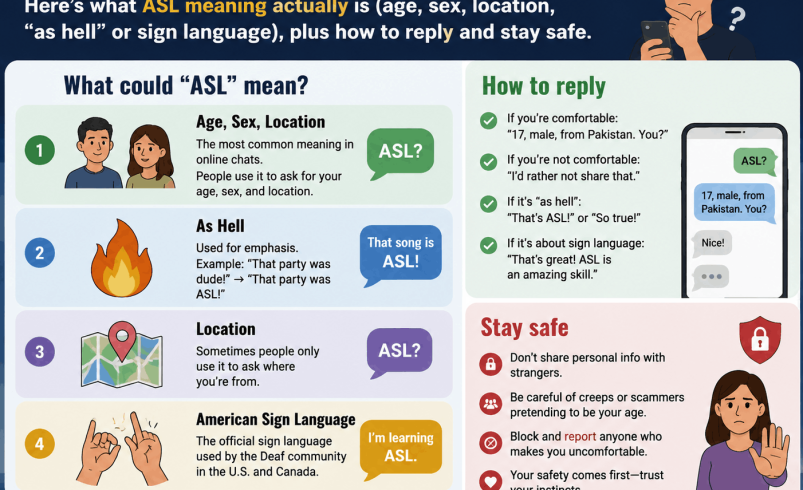
You’ve just been sent “asl?” and you have no idea what to say back. The depends entirely on where you saw it: in a chatroom or DM it usually means “age, sex, location”, but on TikTok or Instagram it more often means “as hell”. There’s a third meaning too, American Sign Language, though context makes that one easy to spot. Below, we’ll go through every version, where each one comes from, and how to reply.
ASL has three common meanings, and which one applies comes down to context:
This is the meaning most people are searching for when they type “asl meaning” or “what does asl mean in text”. Written as ASLMeaning or a/s/l, it’s shorthand for three questions asked in one go: how old are you, what’s your sex, and where are you based.
Someone might send it as a single word, “asl?”, and expect a reply in the same format, something like “17 m London”. It’s blunt by design. Rather than three separate messages, it condenses the get-to-know-you small talk into one line.
A/S/L is a relic of 1990s and early 2000s internet chatrooms, particularly AOL Instant Messenger and MSN Messenger, where you’d land in a room full of strangers with zero information about who you were talking to. Asking a/s/l upfront was the norm before you carried on chatting.
It’s stuck around on platforms like Omegle-style random chat apps and some Discord servers, even though most messaging today happens between people who already sort of know each other. That’s part of why it can feel jarring: it’s a leftover habit from a very different, more anonymous era of the internet.
Back then, screen names gave away almost nothing. You couldn’t tell if you were chatting to a teenager three streets away or an adult on another continent, so a/s/l became the fastest way to fill in the gaps before a conversation went any further. It wasn’t polished or subtle, but it did the job in three words.
Social media changed most of that. Profiles now come with photos, bios, follower counts and mutual friends, so there’s rarely a need to ask outright. That’s why a/s/l can feel oddly old-fashioned when it shows up today: it belongs to a style of chatting that most platforms have quietly moved on from, even if pockets of it remain.
If you’ve seen “funny asl” or “hot asl” under a video or post, that’s not anyone asking for your details. Here, ASL means “as hell”, used the same way people might say “so” or “extremely”.
Examples you’ll spot in the wild:
This usage grew out of African American Vernacular English and spread widely through TikTok comments and captions. Say “as hell” quickly and it starts to sound close to “asl”, which is likely part of how the shortened spelling caught on. Younger users, particularly Gen Z, use it almost like a verbal exclamation mark, tacked onto adjectives for emphasis rather than as any kind of question.
Unlike the age/sex/location version, this one carries no expectation of a reply. Nobody’s waiting for an answer when they type “cold asl” under a video of someone in the snow, they’re just adding punch to a sentence. Some Gen Z slang dictionaries also list a third, more recent shift where “asl” gets used almost as a standalone reaction, similar to saying “what the heck”, though the “as hell” intensifier is still by far the more common usage across TikTok and Instagram.
Spelling has drifted a little too. You’ll occasionally spot “aslp” or “asl af” doubling up the emphasis, though these are much rarer than the standard three-letter version.
Working out which ASL you’re dealing with comes down to sentence position and punctuation.
It’s the “age, sex, location” version when:
It’s the “as hell” version when:
A quick trick: if you could swap “asl” for “as hell” and the sentence still makes sense, that’s your answer. “I’m tired as hell” works. “As hell?” as a standalone message doesn’t, so that’s the age/sex/location version instead.
You’ll see this written a few different ways: ASL, asl, a/s/l, and occasionally A/S/L in capitals for emphasis. They all mean the same thing. The slashes in a/s/l are just a visual reminder that it’s three separate pieces of information bundled together, though most people drop the slashes entirely when typing quickly.
Some replies you might see or send back follow the same shorthand pattern, for example “19 f Manchester” or “22/m/Leeds”. There’s no fixed order that everyone sticks to, though age usually comes first.
Yes, and this is the one meaning that has nothing to do with texting slang. American Sign Language is a full visual language with its own grammar, used mainly by Deaf communities in the United States and Canada. It’s different from British Sign Language (BSL), which is what’s used in the UK and recognised as an official language here under the BSL Act 2022.
If you’ve seen “ASL” alongside words like interpreter, Deaf, signing or hands, that’s almost certainly this meaning rather than the texting slang. Context does most of the work here, since the two uses rarely overlap.
Here’s the part most guides skip over, and it matters more than the definition itself. When “asl?” turns up in a message to a child or teenager from someone they don’t know, it’s a request for identifying information: how old they are, their sex, and roughly where they live. Handed to the wrong person, that’s enough to work out who a child is and where to find them.
This doesn’t mean every use of ASL is sinister. Plenty of it is harmless slang between friends, or the “as hell” version with no personal question attached at all. But if a stranger opens a conversation with it, that’s worth treating carefully.
A few practical points for parents and carers in the UK:
If a friend sends it, a straight answer or a joke back is fine, it’s low stakes. If it’s a stranger, you don’t owe anyone that information. A few ways to handle it:
None of these require an explanation. Plenty of accounts sending unsolicited “asl?” messages are doing it in bulk to strangers, so a non-reply is a perfectly normal response.
| Meaning | Used where | Example |
| Age, Sex, Location | Chatrooms, DMs, messaging apps | “asl?” |
| As Hell | TikTok, Snapchat, Instagram captions | “funny asl” |
| American Sign Language | Education, accessibility, Deaf community content | “She’s fluent in ASL” |
What does ASL mean in a text message?
In most texts between strangers, ASL means “age, sex, location”, a shorthand way of asking someone their age, their sex and roughly where they’re based. It’s most common as an opening message in chatrooms or DMs rather than something friends ask each other regularly.
What does A/S/L mean in texting specifically?
A/S/L, written with slashes, means exactly the same as ASL without them: age, sex, location. The slashes just separate the three pieces of information visually and don’t change the meaning at all.
What does asl mean texting from someone you don’t know?
If a stranger opens with “asl?”, they’re asking for your age, sex and location before the conversation goes any further. Since this can reveal identifying details to someone you have no reason to trust, it’s worth being cautious rather than replying automatically.
Is asl always about age, sex and location?\
No. On social media, particularly TikTok and Instagram, “asl” more often means “as hell” and works as an intensifier, like “cold asl” meaning very cold. Whether it’s a question or an adjective add-on tells you which meaning applies.
What does asl mean on TikTok?
On TikTok, asl almost always means “as hell”, added to the end of a word for emphasis. You’ll see it in comments and captions far more than as a direct question to another user.
Should I answer if someone asks my asl?
Only if you know and trust the person asking. Giving your age, sex and location to a stranger online hands them information they can use to find or identify you, so it’s generally safer to ignore, deflect or block instead.
What’s the difference between asl slang and ASL sign language?
Texting slang ASL (age, sex, location, or as hell) has nothing to do with American Sign Language, the visual language used by Deaf communities. Context makes it obvious which one’s meant, since sign language rarely comes up in casual chat abbreviations.
Why do people say “funny asl” or “hot asl”?
It’s the “as hell” usage, adding emphasis the way you might say “extremely” or “so”. “Funny asl” means very funny, and “hot asl” means very attractive, both used casually on social media rather than as a question.
Is it safe to give your age, sex and location to someone online?
Not to someone you don’t know. Those three details together can be enough to identify or locate a person, particularly a child or teenager, so it’s best kept for people you’ve actually met or trust.
What should I do if my child’s been asked their asl by a stranger online?
Talk to them calmly about what happened and who sent it. If you’re concerned about grooming or exploitation, report it to CEOP at ceop.police.uk/safety-centre, or call the NSPCC Helpline on 0808 800 5000 to talk it through first.