£20 an Hour Is How Much a Year? Full UK Salary Breakdown
- August 20, 2026
- 0
If you’ve been offered a job paying £20 an hour and you’re trying to work out what that actually means for your annual income, here’s the quick answer:



9621 Agnes Crossing, Lake Suzanneview, New Mexico Island 84604-9295.
If you’ve been offered a job paying £20 an hour and you’re trying to work out what that actually means for your annual income, here’s the quick answer:
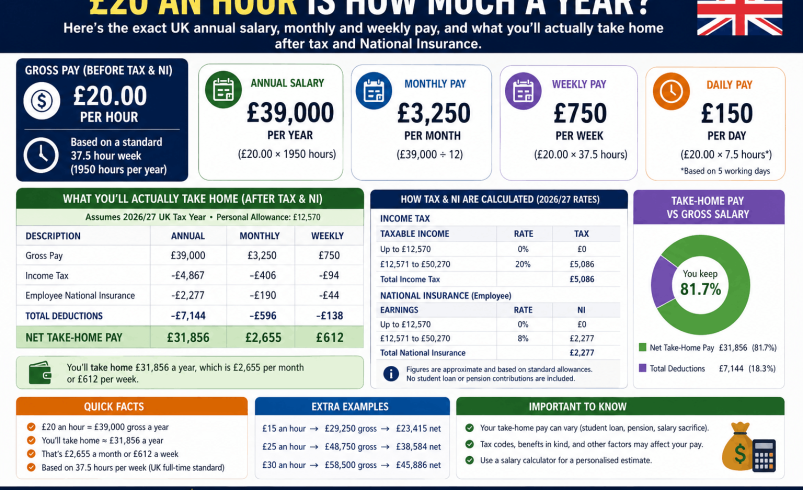
If you’ve been offered a job paying £20 an hour and you’re trying to work out what that actually means for your annual income, here’s the quick answer: on a standard 37.5 hour week, £20 an hour works out to £39,000 a year before tax. Change the hours, and the number moves too, which is exactly where most online calculators leave people confused.
This guide breaks it down properly for a UK reader: your gross salary at different weekly hours, what you’ll actually take home after Income Tax and National Insurance, how it compares to the National Living Wage, and what it looks like part-time. If you found this page searching for the dollar version of this question, the maths works the same way, just swap £ for $ and use your own country’s tax bands instead, since the UK figures below won’t apply directly to US pay.
The answer depends entirely on how many hours you work each week, since there’s no single fixed UK working week. Here’s the gross (before tax) annual figure at the most common full-time and part-time patterns.
| Hours per week | Weekly pay | Annual salary (gross) |
| 20 (part-time) | £400 | £20,800 |
| 30 (part-time) | £600 | £31,200 |
| 35 | £700 | £36,400 |
| 37.5 (standard full-time) | £750 | £39,000 |
| 40 | £800 | £41,600 |
37.5 hours is the most common full-time week in the UK, particularly in office, admin and public sector roles, which is why £39,000 is the figure most people mean when they ask how much is 20 an hour annually. Retail, hospitality and manual roles more often run a 40 hour week, which pushes the annual figure to £41,600.
This is the number that actually matters for budgeting, and it’s the part most quick calculators skip entirely. Two things come off your gross pay in the UK: Income Tax and National Insurance.
For the 2025/26 and 2026/27 tax years, everyone gets a personal allowance of £12,570, meaning you pay no Income Tax on the first £12,570 you earn. Above that, the basic rate is 20% on earnings up to £50,270, and National Insurance is charged at 8% on earnings between £12,570 and £50,270. These thresholds are frozen until April 2031, so they won’t shift with inflation over the next few years.
These figures assume a standard tax code with no student loan repayments, pension contributions, or other deductions, so your actual payslip may differ. If you’ve got a workplace pension, expect a few percent more to come off before tax, though that money isn’t lost, it’s going toward your retirement.
If you’re actually comparing US dollar figures rather than UK pounds, the calculation method is identical, multiply your hourly rate by your weekly hours, then by 52 weeks. At a standard 40 hour US working week, $20 an hour comes to $41,600 a year before tax, but US federal and state tax brackets are structured completely differently from UK Income Tax and National Insurance, so the take-home figures above won’t transfer across. Check the IRS tax brackets for your filing status if you need the after-tax US figure specifically.
Context helps here, since £20 an hour is well above the legal minimum in every UK age band. From 1 April 2026, the National Living Wage for workers aged 21 and over is £12.71 an hour, meaning £20 an hour is roughly 57% higher than the statutory minimum. Younger workers see an even bigger gap: the National Minimum Wage sits at £10.85 for 18 to 20 year olds and £8.00 for under 18s and most apprentices.
For comparison, the voluntary Real Living Wage, calculated independently by the Living Wage Foundation based on actual living costs, currently sits at £13.45 an hour across the UK and £14.80 in London. £20 an hour clears both comfortably, which puts it solidly above what’s generally considered a comfortable hourly rate outside London, and closer to average for many skilled roles within it.
Plenty of people searching this aren’t working full-time, so here’s what part-time £20 an hour actually looks like across a few common patterns.
Part-time earners still get the full £12,570 personal allowance, so a smaller proportion of part-time income ends up taxed compared with full-time pay, which is worth factoring in if you’re weighing up reduced hours against a pay rise.
Since most UK employees are paid monthly rather than weekly, here’s the same £20 an hour figure split into the pay periods you’ll actually see on a payslip.
If your employer pays four-weekly rather than monthly, which some hospitality and retail employers do, multiply the weekly figures by four instead of dividing the annual figure by twelve, since the two aren’t quite the same.
This trips a lot of people up. Statutory paid holiday in the UK is 5.6 weeks a year (28 days for someone working five days a week, including bank holidays, which employers can choose to include or add on top). For salaried, full-time roles, your £20 hourly rate already factors in paid time off, since your annual salary is spread evenly across 52 weeks regardless of whether you’re working or on leave.
For casual, freelance or zero-hours work paid strictly per hour worked, you may be entitled to holiday pay calculated separately, often shown as a percentage uplift (commonly 12.07%) added to your hourly rate rather than baked in. It’s worth checking your contract specifically, since this detail changes your real annual income by a meaningful amount.
On a standard 37.5 hour week, £20 an hour comes to £39,000 a year before tax, or roughly £31,600 after Income Tax and National Insurance. On a 40 hour week, it rises to £41,600 gross, or about £33,470 take-home.
At a standard 37.5 hour week, £20 an hour works out to £3,250 a month gross, or roughly £2,633 after tax and National Insurance. At 40 hours a week, it’s £3,467 gross monthly, closer to £2,789 take-home.
It’s a solidly above-average hourly rate, sitting well above both the National Living Wage (£12.71 from April 2026) and the voluntary Real Living Wage (£13.45 UK-wide, £14.80 in London). Whether it feels “good” also depends heavily on your location, since £39,000 a year stretches much further outside London than within it.
There’s no single legal definition, but 37.5 hours a week is the most common full-time pattern, particularly in office and public sector roles, while 40 hours is standard in retail, hospitality and many manual trades. Your contract will state your specific contracted hours.
No, £20 an hour is almost always quoted as a gross figure, meaning Income Tax and National Insurance are deducted afterwards through PAYE. Your actual take-home pay will be lower than the gross hourly rate suggests, roughly 19% to 20% lower once both deductions are applied.
Gross pay is your full £20 hourly rate before any deductions, while net (take-home) pay is what actually lands in your bank account after Income Tax and National Insurance come off. At a typical full-time salary, expect net pay to be roughly 80% to 81% of gross.
Yes, considerably. £20 an hour is around 57% higher than the National Living Wage of £12.71 (from April 2026) for workers aged 21 and over, and even further above the lower rates that apply to younger workers and apprentices.
It scales directly with your hours: 20 hours a week comes to £20,800 a year gross (roughly £18,500 take-home), while 30 hours comes to £31,200 gross (roughly £27,300 take-home). Because everyone keeps the full £12,570 personal allowance regardless of hours, part-time pay is taxed slightly more lightly as a proportion than full-time pay.