If you’re after profitable intraday trading advice, the honest starting point is this: most retail traders lose money doing it, and anyone promising guaranteed profits is either misinformed or misleading you. FCA-regulated brokers themselves publish data showing that roughly 60% to 85% of retail CFD accounts lose money over a 12-month period. That doesn’t mean intraday trading can’t work, it means it only works with a genuine edge, tight risk control and realistic expectations, not a shortcut to quick income.
This guide sets out what actually helps: proven strategies, sensible risk management, the mistakes that catch out most beginners, UK-relevant tools and platforms, and the tax rules HMRC applies to your profits. It’s written for people trading UK shares, CFDs, spread bets or forex from the UK.
What Is Intraday Trading?
Intraday trading, also called day trading, means buying and selling an asset within the same trading day so you never hold a position overnight. You avoid the risk of news breaking while the market’s closed, but you take on the risk of fast, short-term price swings instead.
It’s different from swing trading (holding for days or weeks) and very different from long-term investing through something like a Stocks and Shares ISA. Common instruments for UK intraday traders include:
- Shares, bought directly through brokers such as Hargreaves Lansdown, AJ Bell or Trading 212.
- CFDs (Contracts for Difference), where you speculate on price movement without owning the asset.
- Spread betting, a UK-specific product that’s typically tax-free for private individuals.
- Forex, usually traded through CFD-style accounts on major currency pairs.
Each has a different tax treatment in the UK, which matters more to your actual take-home profit than most strategy advice does.
Is Intraday Trading Actually Profitable?
This is the question most guides dodge. Every FCA-regulated broker offering CFDs must publish the percentage of retail client accounts that lost money trading with them over the past year, and those figures currently sit between about 60% and 85%, with the FCA having previously put the overall figure at around 80%. eToro sits near the better end (roughly 46% losing), while brokers whose clients trade more frequently and with more leverage tend to sit higher, some around 76%.
So yes, some traders are profitable, but they’re a minority, and the ones who manage it treat trading like a disciplined, repeatable process rather than a series of lucky bets. Any claim of consistent, guaranteed profit should be treated as a red flag, whether it comes from a course, a signal service or a social media account.
Proven Intraday Trading Strategies
No strategy guarantees a win on every trade. These are the approaches most consistently used by experienced traders, with realistic expectations attached.
Breakout Trading
Wait for a share or index to break above resistance (or below support) on strong volume, then enter in the direction of the break with a stop just beyond that level. This tends to work best in the first 90 minutes after the London Stock Exchange opens at 8:00am, when the day’s range is often established.
Range Trading
Some FTSE-listed stocks trade sideways for extended periods. Range traders buy near support, sell near resistance, and exit quickly if price breaks through either boundary.
News and Momentum Trading
UK companies release earnings and trading updates throughout the day, often causing sharp moves within minutes. The initial spike carries real risk because spreads widen and slippage increases, so many traders wait a few minutes for the immediate volatility to settle before entering.
Trend Following With Moving Averages
Using a short-term moving average (often 9 or 20-period) against a longer one (50-period) to confirm the intraday trend, then only trading in that direction, filters out a lot of weak counter-trend setups.
Risk Management Techniques
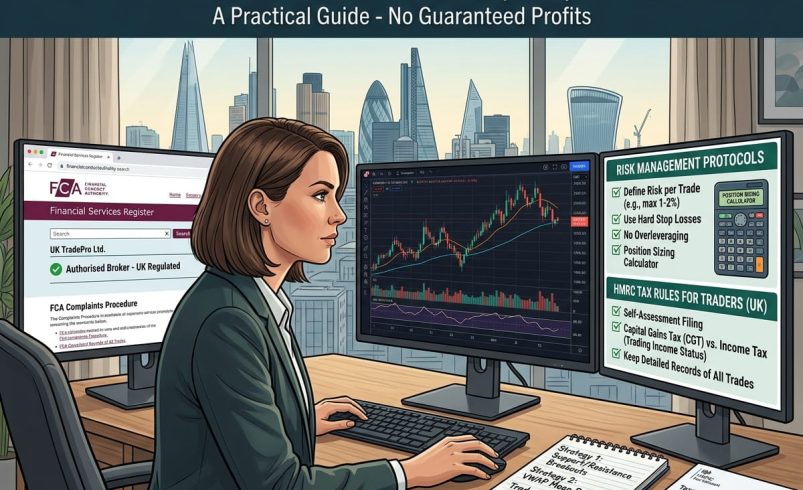
Risk management is what actually separates traders who survive from those who blow up an account in a month. The core rules experienced traders stick to:
- Risk no more than 1% to 2% of your account on any single trade.
- Set a stop-loss before entering the trade, not after it starts moving against you.
- Avoid illiquid small-cap shares intraday, since wide spreads eat into any edge.
- Keep a trading journal logging every entry, exit and reasoning, so you can review what’s genuinely working after a month.
- Accept that on some days, the right decision is not to trade at all.
Common Mistakes to Avoid
- Trading money you can’t afford to lose. If a loss would affect your rent or bills, it shouldn’t be at risk intraday.
- Ignoring spreads and overnight financing costs, which quietly erode profits on frequent small trades.
- Overtrading out of boredom rather than waiting for a setup that fits your plan.
- Leaving tax until January, then facing an unexpected bill you hadn’t budgeted for.
- Following paid signal services or social media “finfluencers” without checking whether the broker behind them is even FCA-regulated. The FCA has flagged cases where over 90,000 people lost around £75 million over four years to one such scheme.
Tools and Platforms (UK-Relevant)
Before opening an account with any platform, check three things:
- FCA authorisation, verified directly on the FCA Register, not just a logo on the broker’s homepage.
- FSCS protection, covering eligible client money and investments up to £85,000 per person, per firm if the broker becomes insolvent. This is separate from the £120,000 bank deposit protection limit introduced in December 2025, which doesn’t apply to brokerage accounts.
- Negative balance protection on leveraged products, meaning you can’t lose more than you’ve deposited, a requirement the FCA has enforced on CFD providers for retail clients since 2019.
Popular FCA-regulated platforms among UK intraday traders include IG, CMC Markets, Hargreaves Lansdown, Interactive Brokers, Trading 212 and Spreadex. Fees, spreads and charting tools vary considerably, so compare current pricing directly on each provider’s site, since these change often.
Tax Considerations in the UK
This is where a lot of generic “intraday trading advice” falls short, because UK tax rules are quite different from those in the US or elsewhere.
Spread betting is classed as gambling under UK law, so profits are typically exempt from both Capital Gains Tax and Income Tax for most private individuals, with nothing to report to HMRC.
CFDs and direct share trading are generally taxed under Capital Gains Tax. For the 2025/26 tax year, the CGT annual exempt amount is £3,000, down from £12,300 as recently as 2022/23. Gains above that are taxed at 18% for basic-rate taxpayers and 24% for higher-rate taxpayers on financial assets. Buying UK-listed shares directly also incurs Stamp Duty Reserve Tax of 0.5% per purchase, though most US shares and UK-domiciled ETFs are exempt.
If HMRC decides your trading counts as a business rather than personal investing, using its “badges of trade” test, profits are taxed as Income Tax instead, at 20%, 40% or 45% depending on your total income, plus possible National Insurance. Factors HMRC considers include trading frequency, how organised the activity looks, and whether trading is your main source of income.
ISAs: you can hold and trade shares within a Stocks and Shares ISA, with gains free of CGT and Income Tax up to the £20,000 annual ISA allowance for 2025/26, but you can’t hold CFDs or spread bets inside one, and frequent trading inside an ISA can rack up dealing charges quickly.
FAQ
Is intraday trading legal in the UK?
Yes, it’s completely legal for private individuals, and no licence is needed to trade your own money. You should use an FCA-authorised broker and are responsible for reporting and paying any tax owed on profits.
How much money do you need to start day trading?
There’s no legal minimum, and some brokers accept £50 to £100 to open an account. In practice, very small accounts struggle against spreads and fees, so most experienced traders suggest starting with an amount you’re fully prepared to lose while learning.
What percentage of day traders actually make money?
Based on FCA and broker-published data, somewhere between roughly 15% and 40% of retail CFD accounts are profitable over a 12-month period, depending on the broker, meaning the majority lose money.
Do I pay tax on intraday trading profits in the UK?
It depends on the product. Spread betting profits are usually tax-free, CFD and share trading profits are generally subject to Capital Gains Tax above the £3,000 annual allowance, and if HMRC treats your activity as a trade, profits are taxed as income instead.
What’s the best time of day to day trade UK shares?
Most UK traders focus on the first 90 minutes after the London Stock Exchange opens at 8:00am, when volatility is highest, and around 2:30pm when US markets open and add liquidity to UK large-cap stocks.
Can I lose more than I deposit while trading?
Not as a retail client with an FCA-regulated broker, since negative balance protection has been mandatory on CFD and spread betting accounts for retail clients since 2019. This protection doesn’t apply if you’re classified as a professional client.
Is spread betting better than CFDs for UK traders?
Spread betting is usually more tax-efficient since profits are typically exempt from CGT and Income Tax, while CFD profits are usually taxed under CGT. Both carry similar market and leverage risk, so the choice often comes down to tax treatment and platform preference.