Is Unbanned G+ Safe? What “Unblocked Games G+” Really Is
- August 20, 2026
- 0
If you’ve searched “unbanned g+” or “is unblocked games g+ safe”, you’re likely trying to work out whether these gaming sites are actually okay to use, not just



9621 Agnes Crossing, Lake Suzanneview, New Mexico Island 84604-9295.
If you’ve searched “unbanned g+” or “is unblocked games g+ safe”, you’re likely trying to work out whether these gaming sites are actually okay to use, not just
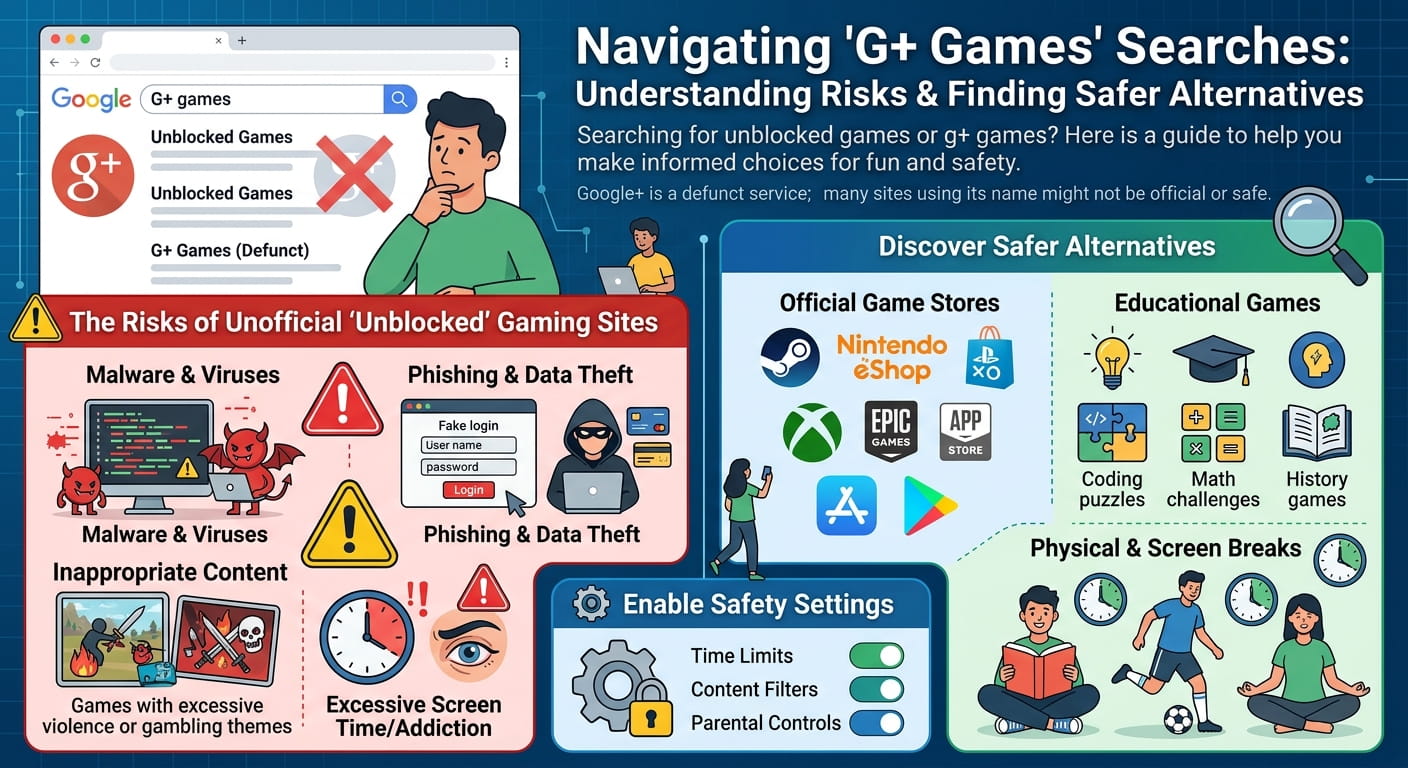
If you’ve searched “unbanned g+” or “is unblocked games g+ safe”, you’re likely trying to work out whether these gaming sites are actually okay to use, not just whether they’ll load on a school Chromebook. The honest answer is no, not consistently. “Unbanned G+” and “unblocked games G+” both refer to the same loose cluster of sites, and research into this specific category found real safety problems: inconsistent moderation, unvetted advertising, and at least one title built entirely around graphic violence sitting in the same unlabelled library as puzzle games.
This isn’t a guide to help you get past a school or workplace filter. It’s a straight answer to the safety question itself, because that’s what most people asking about “unbanned g+” or “arc unbanned g+” genuinely want to know before they or their child click through.
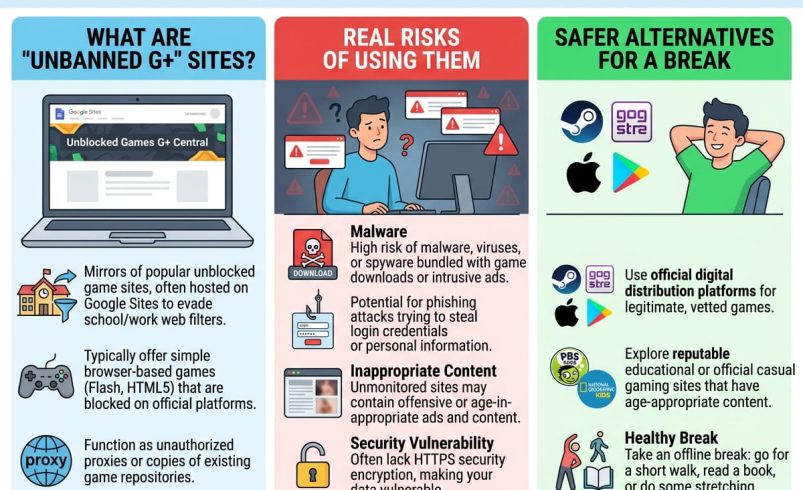
“Unbanned G+” is just an alternative spelling of “unblocked games G+“, sometimes also written as “unbanded g+” or “un banned g+” depending on how someone typed it. All of these point to the same thing: a scattered network of websites offering free browser games specifically marketed as able to get past school and workplace internet filters.
There’s no single official “G+” company behind any of it. It’s a naming pattern copied across dozens of sites, several hosted directly on Google Sites because school filters tend to trust Google’s own domains for legitimate classroom tools, which is exactly the loophole these sites are built to exploit.
Not reliably, and this is worth being specific about rather than vague. Three separate safety issues turned up during research into this category of site.
Content moderation is inconsistent. One G+ style site reviewed for this topic listed a graphic simulation game, built around inflicting harm on a character using weapons including firearms and a chainsaw, in the exact same category list as cooking games and racing titles. There was no age gate, no content warning, and no separation from anything else in the library.
Advertising is often poorly screened. Sites in this category commonly run on ad networks with minimal vetting, which raises the risk of misleading pop-ups, fake download prompts, or redirects to unrelated pages, even on the pages where the games themselves are harmless.
Ownership is usually unclear. Most of these sites don’t list a company name, contact address, or proper terms of service. That makes it hard to know who’s actually running the site, what happens to any data it collects, or who’s accountable if something goes wrong.
If you’ve also seen “arc unbanned g+” while searching, that’s simply another naming variant within the same cluster rather than a distinct, separately vetted platform. “Arc” here generally refers to hosting the game library through a specific mirror or proxy setup, one of several methods this category of site uses to dodge detection once a filter catches up with the last domain.
New variants and spellings appear constantly precisely because these sites get blocked and rebuilt under a slightly different name on a rolling basis. That churn is itself a safety signal worth paying attention to. A site that needs to keep renaming itself to stay accessible isn’t building a stable, accountable reputation the way an established gaming site would.
UK schools filter internet access as part of their safeguarding responsibilities under the Department for Education’s Keeping Children Safe in Education guidance, which requires “appropriate filtering and monitoring systems” on school networks and devices. Gaming sites get blocked partly to reduce distraction, but mainly because unmoderated content libraries are exactly the kind of thing that filtering exists to catch.
That’s the core problem with treating “is it unbanned yet” as the only question worth asking. A filter that a gaming site can dodge is a filter that other content might slip through by the same route, and the safety concerns found in this specific niche back that up directly rather than just in theory.
A calm, practical response tends to work better here than an outright ban that just pushes the behaviour to the next rebranded site.
If the actual goal is a quick, appropriate browser game break rather than getting around a block specifically, a few properly moderated options do the same job without the risk.
Coolmath Games runs a long-established, advertiser-vetted library of puzzle and logic games aimed at a school-age audience, and it’s commonly allowed on school networks precisely because it maintains consistent content standards. Scratch, built by MIT, lets students play and build their own simple games and is already widely used within UK computing lessons, so it’s often pre-approved rather than something to sneak past. BBC Bitesize Games offers short, genuinely curriculum-linked games that double as a legitimate break. Many schools also maintain their own approved list of downtime sites, which is worth checking first since it removes the appeal of an unofficial workaround altogether.
Yes, they’re the same thing, just different spellings people use when searching, including “unbanded g+” and “un banned g+”. All of them refer to the same loose network of sites built to bypass school and workplace content filters.
Not reliably. Research into this category found genuinely graphic content sitting alongside harmless games with no age gate, plus commonly poorly screened advertising and unclear site ownership.
It’s another naming variant within the same G+ site cluster, often referring to a specific mirror or proxy method used to keep the library accessible after a previous domain gets blocked. It isn’t a separately vetted or more trustworthy version.
Because school and workplace filters catch up with each domain over time, so new versions get built under slightly different names to stay accessible, which is itself a sign of an unstable, unaccountable site rather than a reliable one.
The core risk is more commonly poorly vetted advertising than malware embedded in the games themselves, but misleading pop-ups, fake download buttons, and redirects are common enough across this category to treat with real caution.
Yes, using these sites breaches most schools’ acceptable use policies, since they exist specifically to bypass safeguarding filters, and repeated use can lead to disciplinary consequences depending on the school’s own behaviour policy.
Talk to them about why the filtering exists rather than reacting with an immediate ban, check what device or account was used, and consider flagging the specific site to the school’s IT team since new domains appear regularly.
Coolmath Games, Scratch, and BBC Bitesize Games all offer properly moderated, curriculum-friendly browser games that don’t rely on bypassing a school’s safeguarding filters.