If you’ve searched Faston Crypto Etherions wondering whether it’s a real project worth your money, here’s the direct answer: as of today, there’s no publicly verifiable smart contract, whitepaper, named team, or listing on a major exchange for this project, which places it firmly in high-risk, unverified territory rather than something to invest in. It’s often referred to by the shorthand EFC, and described as a mix of a native token, tradable NFT creatures called Etherions, and DeFi features like staking, but none of that has been independently confirmed anywhere a UK investor could check.
This guide sets out exactly what’s being claimed about Faston Crypto Etherions, what genuinely can and can’t be verified, and how to protect yourself if you’ve come across it through an advert, a message, or a search result promising early access or guaranteed returns.
What Is Faston Crypto Etherions Meant to Be?
According to the marketing material circulating about it, Faston Crypto Etherions combines three things: a native cryptocurrency token (EFC), a collection of tradable NFT creatures called Etherions that users can supposedly buy, breed and battle, and a layer of DeFi features such as staking and governance. The name borrows “Ether” from Ethereum, which is a deliberate branding choice designed to suggest a connection to an established, credible network.
The project is said to run on a “modified Ethereum architecture” with a hybrid consensus mechanism, and various promotional sources claim transaction speeds and throughput figures that would put it ahead of most established blockchains. None of these technical claims come with a way to check them independently, and different sources describing the project give inconsistent details about its supply, launch date and consensus mechanism, which is itself a warning sign rather than a footnote.
The Core Problem: Nothing About EFC Can Be Verified
This is the part that matters most, and it’s worth being blunt about it rather than repeating marketing language as fact.
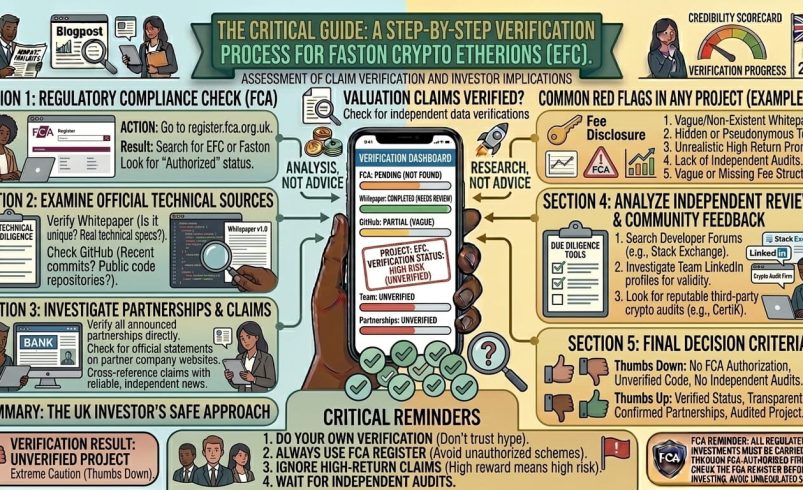
No confirmed smart contract address. A genuine token has code and a transaction history visible on a blockchain explorer such as Etherscan. No such address has been publicly and consistently identified for EFC.
No published whitepaper. Established crypto projects release technical documentation that independent developers can read and challenge. No such document has been published for Faston Crypto Etherions.
No named team. Promotional material references an “Etherions Team Faston” without naming a single founder, developer, or technical lead with a checkable professional background.
No confirmed listing on a major exchange. Faston Crypto Etherions does not appear on CoinGecko or CoinMarketCap, the two standard reference sites for tracking legitimate, tradeable cryptoassets, and it isn’t listed on any well-known centralised exchange such as Binance, Coinbase or Kraken.
No independent security audit. Audits are mentioned in some promotional descriptions, but no named auditing firm or published audit report exists anywhere that can be checked.
Why This Pattern Looks Like a Content Farm, Not a Real Launch
A noticeable amount of the content describing Faston Crypto Etherions appears across low-authority websites using very similar phrasing and structure, repeating the same unverifiable claims without adding new evidence. That’s a recognised pattern in crypto SEO, where large volumes of near-identical articles are published to build search visibility around a name well ahead of, or entirely instead of, any actual product.
This doesn’t automatically prove fraud on its own. Some genuinely early-stage projects do build up search presence before publishing full documentation. But combined with the complete absence of an on-chain footprint, a named team, or an exchange listing, it fits a pattern that’s commonly seen ahead of pump-and-dump schemes or projects that generate hype and then quietly disappear.
Faston Crypto Etherions Trading: What “Trading” Even Means Here
Because EFC isn’t listed on any recognised exchange, there’s no legitimate, verifiable way to buy or trade it through the platforms most UK investors already use. If you’ve seen a site or app claiming to let you trade Faston Crypto Etherions directly, treat that with serious caution, since it means you’d be sending funds to a platform outside the checks that apply to a properly listed asset.
Genuine decentralised exchange trading is technically possible for any token with a real contract address, but since no consistently verified address exists for EFC, there’s currently no way to confirm that any trading interface claiming to offer it is connecting to a genuine, functioning contract rather than a fake one designed to take your funds.
What UK Rules Say About Crypto Promotions Like This
Since 8 October 2023, the Financial Conduct Authority’s Cryptoasset Financial Promotion Regime has required that any financial promotion of cryptoassets to UK consumers, regardless of where the promoter is based, must come from an FCA-authorised firm, be approved by one, or come from a business registered with the FCA under money laundering regulations. Promotions must also include clear risk warnings and give consumers a proper cooling-off period before they can invest.
If you’ve seen Faston Crypto Etherions promoted to you directly, through an advert, a social media post, or a message inviting you to buy in early, and it doesn’t carry those standard risk warnings or come from a checkable, registered source, that promotion is very likely non-compliant with UK rules regardless of whether the underlying project turns out to be real. That’s worth reporting, not just ignoring.
How to Check Any Crypto Project Yourself
The same five checks apply whether you’re looking at Faston Crypto Etherions or any other unfamiliar token.
- Search the token name and its contract address on Etherscan (for Ethereum-based tokens) or the relevant blockchain explorer, and confirm the address matches what the project itself claims, not just what a third-party article states.
- Check CoinGecko and CoinMarketCap for a listing; both are free, independent, and cover essentially every legitimately traded cryptoasset.
- Look for a named team with a checkable professional history on LinkedIn or elsewhere, not just first names or a generic “team” reference.
- Search for a published, technical whitepaper, and be sceptical of documents that are heavy on marketing language and light on actual mechanics.
- Check the FCA’s Warning List at fca.org.uk/consumers/warning-list-unauthorised-firms and the Firm Checker at register.fca.org.uk for any platform asking you to deposit money to access the token.
If You’ve Already Sent Money or Connected a Wallet
If you’ve sent funds to a platform or address linked to Faston Crypto Etherions, or connected your wallet to a site claiming to offer it, stop any further transactions immediately and don’t send more money to try to “unlock” or “release” funds, a common follow-up tactic in crypto scams.
Report it to Action Fraud at actionfraud.police.uk or by calling 0300 123 2040, and contact your bank if you sent money from a UK account, since some banks can flag or occasionally recover payments sent for fraudulent purposes if reported quickly. If you connected a wallet rather than sending funds directly, revoke that connection’s permissions using a tool like Etherscan’s Token Approval checker and consider moving remaining assets to a new wallet as a precaution.
What Legitimate Crypto Projects Look Like, for Comparison
It’s worth knowing what the other side of this looks like. Established tokens such as Ethereum itself, or reputable projects built on it, have years of verifiable transaction history on public blockchain explorers, published and regularly updated technical documentation, named and checkable development teams, and listings on multiple major exchanges that themselves undergo regulatory scrutiny.
None of that is a guarantee against loss, since even legitimate cryptoassets are volatile and unregulated in most respects, but it’s a fundamentally different starting point from a project with no verifiable footprint at all. The gap between “high risk but real” and “currently unverifiable” is exactly the gap Faston Crypto Etherions sits on the wrong side of.
FAQ
Is Faston Crypto Etherions a scam?
It can’t be confirmed as fraudulent outright, but it also can’t be confirmed as legitimate, since there’s no verified smart contract, whitepaper, named team, or exchange listing. Treat any offer to buy, stake, or trade EFC with serious caution until that changes.
Is EFC listed on CoinGecko or CoinMarketCap?
No, Faston Crypto Etherions does not currently appear on either site, which are the standard independent references for tracking legitimately traded cryptoassets. The absence of a listing is one of the clearest verification gaps around this project.
What are Etherions?
Etherions are described in promotional material as unique digital creatures represented as NFTs, which users can supposedly buy, breed, train and battle within the Faston ecosystem. As with the rest of the project, this feature hasn’t been independently verified as functioning on any confirmed blockchain.
Can I buy Faston Crypto Etherions on a UK exchange?
No major UK-accessible exchange lists EFC, so any site or app claiming to sell it directly should be treated as unverified and high-risk. There’s no confirmed, checkable way to purchase it safely at this time.
Who is behind Faston Crypto Etherions?
Promotional material refers to an “Etherions Team Faston” without naming individual founders, developers, or technical leads with checkable backgrounds. The absence of a named, accountable team is one of the clearest red flags for any crypto project.
Is it illegal to promote crypto like this in the UK?
Promoting cryptoassets to UK consumers without following the FCA’s Cryptoasset Financial Promotion Regime, in place since October 2023, is a breach of UK financial promotion rules and can be a criminal offence in serious cases. If you’ve seen EFC promoted without proper risk warnings or from an unregistered source, it’s worth reporting to the FCA.
What should I do if I already invested in EFC?
Stop sending any further funds immediately, especially if you’re asked to pay more to “release” or “unlock” existing funds, since that’s a common follow-up scam tactic. Report the situation to Action Fraud and your bank, and revoke any wallet connections you made to related sites.
How can I tell if any crypto project is legitimate?
Check for a verified smart contract address on a blockchain explorer, a published whitepaper, a named and checkable team, and a listing on CoinGecko, CoinMarketCap or a major exchange. If two or more of these are missing, treat the project as high-risk regardless of how professional its marketing looks.