Dumbest Laws in States: Real US Laws (and the Myths to Skip)
- August 19, 2026
- 0
If you’ve searched for the dumbest laws in states across America, you’ve probably already hit the problem: half the lists online repeat each other word for word, and



9621 Agnes Crossing, Lake Suzanneview, New Mexico Island 84604-9295.
If you’ve searched for the dumbest laws in states across America, you’ve probably already hit the problem: half the lists online repeat each other word for word, and
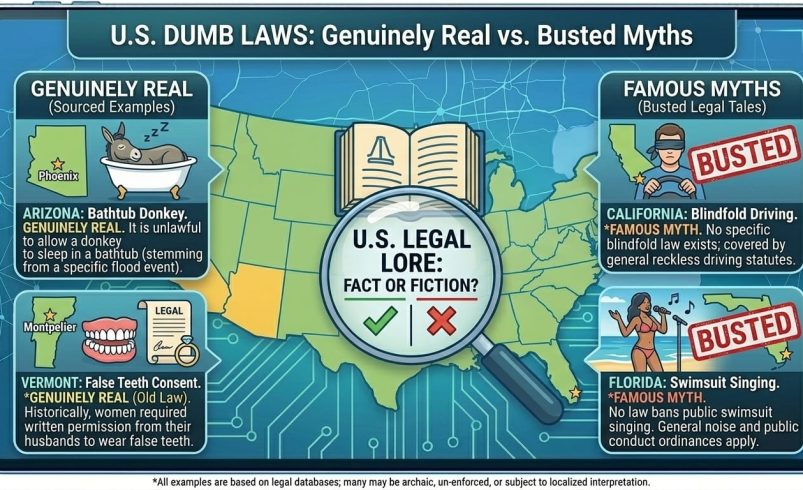
If you’ve searched for the dumbest laws in states across America, you’ve probably already hit the problem: half the lists online repeat each other word for word, and a good chunk of what they claim is real law turns out to be an urban legend nobody can trace back to an actual statute. The genuinely real ones are still out there, though, and some are stranger than the made-up versions.
This guide only includes odd American laws that trace back to an actual statute, city code, or court case, with the source noted where it matters. It also flags a few of the most famous “weird laws in the US” that keep circulating despite never being confirmed, so you’re not left repeating something false at your next pub quiz.
Wikipedia’s own entry on strange laws puts it plainly: a large number of these hoax or exaggerated laws get passed around online and in print, often through chain emails long before social media existed. Some genuinely existed once and were repealed, some were never real to begin with, and some are cases where a website mistook a court’s interpretation of a broad law (like a general nuisance or disorderly conduct statute) for the literal wording of a specific one.
A Virginia lawyer quoted in one legal blog put it well: people believe a lot of what they read online, and it’s worth checking the source before repeating it. That’s the approach this list takes. Where a law is confirmed by a city code, state statute, or a news report of an actual case, it’s included below. Where it’s one of the internet’s favourites but nobody can find where it actually says that, it’s flagged as a myth instead.
Idaho is, as far as legal researchers can confirm, the only US state with a law explicitly banning cannibalism, made illegal there in 1990. Every other state relies on general murder, assault, or abuse of a corpse statutes to cover the same ground, which is why Idaho stands out as having named the specific act.
Wisconsin’s state food regulations require that cheese and butter produced commercially in the state be graded and must be, in the regulation’s own wording, “highly pleasing.” It’s a genuine quality grading standard tied to the state’s dairy industry, not a joke someone invented for a listicle.
Wyoming law prohibits buying scrap metals, rubber, rags, or paper from someone who is visibly intoxicated. Breaking it can mean a minimum fine of $50 or up to 60 days in jail, aimed squarely at stopping opportunists from taking advantage of drunk sellers, or drunk people offloading stolen scrap.
It’s a misdemeanour in Iowa to serve or sell margarine while representing it as real butter. This dates back to a long-running dairy versus margarine dispute that several US states legislated on during the 20th century, and Iowa’s version is still on the books.
A newer West Virginia law allows hunters to use drones and tracking dogs to locate wounded game, but it specifically excludes birds. Using a drone to help hunt birds can still land you a fine or a hunting licence suspension, even though the same tech is fine for other game.
Massachusetts law makes it illegal to sell or play golf using exploding golf balls, and repeated offences can carry jail time. It sounds invented purely for comic effect, but the statute is real and still enforceable.
Running or taking part in a greased pig contest or turkey scramble is a misdemeanour under Minnesota law. These contests were once common at rural fairs, and the law appears to have been aimed at concerns over animal welfare during these events.
The small town of Quitman, Georgia, has a municipal code (Section 8-1) making it unlawful for chickens, ducks, geese, or other domestic fowl to run loose on public streets. It’s a local ordinance rather than a state law, rooted in genuine practical concerns about loose livestock causing traffic hazards and property damage, not an attempt at humour.
Alaska law states that an intoxicated person may not “knowingly” enter or remain somewhere alcohol is sold. In practice this is rarely enforced against ordinary drinkers, but the wording is genuine and has been confirmed by multiple legal sources.
Virginia has had a law against profane swearing in public since 1860. Originally it carried a $1 fine, and today it’s classed as a Class 4 misdemeanour with a fine of up to $250, applying equally regardless of gender.
A handful of “funny laws in the US” show up on almost every list, yet nobody has ever traced them to a real statute. These are worth knowing specifically so you can call them out.
Women can’t swear in Logan, Utah. This one has circulated for years, but a local newspaper searched the Logan City Code directly and found nothing matching it. If it ever existed, there’s no surviving record, and most legal researchers now treat it as an unverified myth.
Women can’t take more than three steps backward while dancing in Bellingham, Washington. Like the Utah swearing law, this is repeated constantly with no cited source, no statute number, and no local reporting confirming it exists. Treat it as fiction until someone actually finds the ordinance.
It’s illegal to own more than a set number of certain items (a claim that gets applied to all sorts of objects depending on which site you read). These kinds of specific numeric bans crop up again and again in “usa crazy laws” lists with the number changing between sources, which is itself a strong sign nobody has actually read the law in question.
The common thread with all three is the same: confident wording, no citation, and a version that shifts slightly depending on which site is repeating it. That’s the pattern of an internet myth, not a genuine statute.
If you come across a claim about a silly law in a US state and want to know if it’s genuine, there are a few reliable ways to check rather than trusting a listicle.
Search the state’s official legislature website or municipal code portal directly, since most states now publish their statutes online in full. Local news archives are also worth checking, since a genuinely enforced odd law will often have a news story attached to an actual case, the way the Georgia chicken ordinance and the California chicken traffic case both do. If a claim only ever appears on humour sites with no statute number and no case attached, that’s a strong signal it’s exaggerated or invented.
Most of these odd laws weren’t written to be funny at the time. They usually solved a real, specific local problem: loose livestock damaging property, unscrupulous scrap buyers taking advantage of drunk sellers, or dairy producers protecting their market from cheaper margarine. Repealing old, narrow laws simply isn’t a priority for most legislatures once the original problem fades, so the wording just stays on the books, technically enforceable even decades later.
That’s really the difference between the genuinely real laws above and the popular myths. The real ones usually have a clear, if outdated, practical reason behind them. The myths tend to sound like a punchline first and a law second, which is often the giveaway that they were never law at all.
There’s no single official answer, but genuine contenders include Idaho’s specific ban on cannibalism and Massachusetts’s ban on exploding golf balls, both of which are real, current statutes rather than internet myths.
Rarely, but they’re often still technically on the books and enforceable. Most exist because repealing narrow, outdated local laws simply isn’t a legislative priority, not because anyone actively wants to enforce them today.
It depends how you measure it, but Georgia, Wisconsin, and Wyoming all have distinctive, genuinely verified odd laws tied to local history, from loose chickens to dairy grading standards to buying scrap from drunk sellers.
A significant number circulating online are exaggerated, misquoted, or entirely invented, according to legal researchers and Wikipedia’s own entry on strange laws. Always check for a specific statute number or a real news story before assuming a claim is genuine.
Many of these laws date back to when livestock and public streets overlapped far more than they do today, so rules about loose chickens, pigs, or public animal behaviour solved genuine practical problems at the time they were written.
In theory, yes, if the law is still active and someone chooses to enforce it, though this is uncommon in practice. Most of these laws carry only small fines rather than serious penalties, and enforcement today is rare.
Search the specific state’s official statute database or a city’s municipal code directly, both of which are usually available online. If a claim only appears on humour sites with no statute reference, treat it with real scepticism.
Because many sites copy from each other rather than checking original sources, so an exaggerated or invented “law” can spread across dozens of pages that all look independent but trace back to the same unverified original claim.